Accuracy of Cone Beam Scan with Metallic Restorations?
Anon. asks:
How accurate is a Cone Beam CT (CBVT) scan when the patient has metallic restorations like amalgams, crowns and bridges? Do these metallic restorations deflect or interfere with the scan? Do these detract from the accuracy of the readings? Is the CBVT scan like an MRI scan? Or is it more like a radiograph? I would like to get all of this straight before I send my patients in for CBVT scans. Thanks.
7 Comments on Accuracy of Cone Beam Scan with Metallic Restorations?
New comments are currently closed for this post.
Avik - UK
6/2/2008
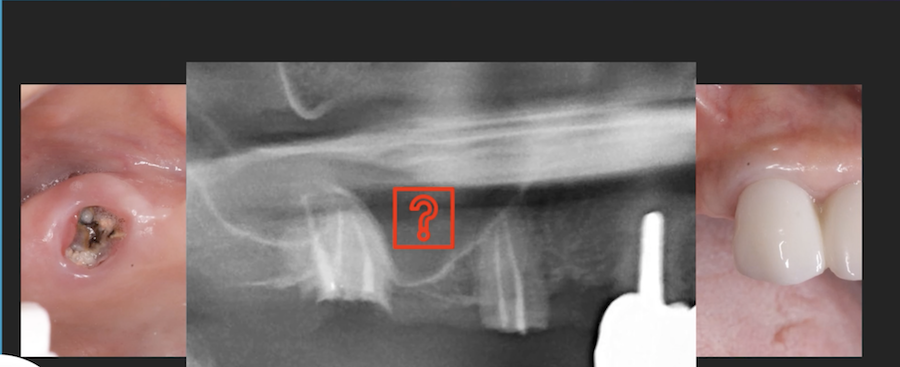
yes with cbct scans you will get mettallic artifact arounds amals,crowns etc .. it will deflect and distort the xray beams - beware especially posts crowns arounds the edentulous area as this will affect the data u need to gain for the scan area - generally we look at bone below cervical margins which is ok if supra cervical metal is present but as posts aresub-cervially placed this is a problem - therefore plan ct ct scans carefully and look at your dental chart for possible artifact around the areas u will b scanning as u will have redundant data that is very difficult to read - hope this helps u
mike stanley, asst.
6/3/2008
Anything with high radiopacity, including gutta percha, will create artifacts.
steve c
6/3/2008
Even with scatter and artifact I find measures are accurate so the information I gain is still valid. I will often refer for a Newtom scan in an area where an old bridge is in place so that I know exactly what the bone is like before removing the bridge and committing to an implant plan. I'll do the same with hopeless old teeth with large metalic restorations before they are removed so that I and the patient have a good idea whether implants are feasible or not. When using a program like Nobelguide the effect of scatter is more limiting and causes much more concern.
Dan McEowen
6/4/2008
Scatter from metal or metal oxides is almost always in an horizontal plane from the xray source so distortion is most always lateral to the metal object. Anatomic structures both above and below these objects are not affected with scatter and are accurate in size and measurement. With some of the more user friendly software, scatter can be removed leaving an accurate image in the 3D mode. Compared to medical CT, the scatter is less and images more accurate to visualize. Gutta percha, metal posts and other materials in the root structures are less distorted than metal copings or full metal crowns. When visualizing implants, Titainium appears to have less scatter than other metals in the Cone Beam scan.
sean meitner
6/8/2008
There is scatter with metal in the adjacent teeth or crowns and also if you are using metal sleeves for sugical guides. if there is a concern with surgical guides i recommend using guide sleeves made from ;ceramic , alumina tubes from Guide right.
mike stanley, asst.
6/10/2008
All great information.
On re-reading the question, we forgot to address the MRI vs Radiograph portion of the question.
Definitely less like MRI because the lower radiation dose of the CBVT shows less soft tissue detail than Medical CT, and nothing compared to MRI. MRI shows little hard tissue (or so I'm told.) All of the software I have seen is oriented toward hard tissue, but some allow fuller manipulation of data and segmentation to visualize soft better.
CBCT doesn't yet have the resolution of PA films so it doesn't replace intraoral radiographs yet. CBCT is GREAT for TMJ, sinus, airway issues, implant planning, etc.
Oh, I forgot to mention, that in many cases, by manipulating the reconstruction parameters (usually seen as Contrast & Brightness onscreen) you can minimize the scatter and place measurement points or see what you need to see. As Dan mentioned, it is usually lateral, so if you plan ahead, you may be able to reposition the head enough to reduce your negative impact.
Most of the time I can even use this to see the various parts of implant assemblies (implant, abutment, screw, crown coping, porcelain.) There are many free DICOM software packages you can add to your bag-o-tricks to help if, to rephrase Dan, your software isn't friendly. There are also Dental Radiology services to help you read the information in a CBVT scan.
David S. Peterson DDS, FA
6/2/2009
I agree with the other posts that artifact from radiodense material including metal will cause problems reading the film. I have found that if I download the dcm files into Simplant, I can use the segmentaion wizard to eliminate most of the scatter. Another helpful suggestion is to insure that the patient is scanned while discluding the teeth using a radiolucent orthotic or cotton rolls.