Barrier Membranes: Are there Alternatives?
Dr. G. asks:
I am a general dentist and have been placing my own implants in many cases for over five years. Whenever I do a bone graft, I cover it with a resorbable collagen membrane. Sometimes I only need a tiny piece of membrane and have to throw out almost an entire piece of unused membrane. This is expensive and in this economy I am trying to find ways to reduce my overhead. Is there anything else I can use to cover these bone grafts that is cheaper and just as effective? Are there any materials that can be mixed and applied over the graft to harden and contain the graft material? Is there a reasonable alternative to barrier membranes?
62 Comments on Barrier Membranes: Are there Alternatives?
New comments are currently closed for this post.
eric-sb oms
12/8/2009
yes, membranes are expensive and you should not be throwing them away. here's what i do:
I cut, in a sterile fashion, the big membranes up into pieces - and then package individually (in a sterile fashion) the following sizes:
1. Anterior tooth - buccal plate intact
2. Anterior tooth - buccal plate defect
3. Biscuspid size socket preservation
4. Molar size socket preservation
after doing hundreds of GBR / socket preservations, I know what sizes i need. there are also times when I need whole membranes, so i always have a bunch of them around.
i can't stress enough how important sterility is for this. these are dispensed as single patient products, and the companies will tell you this is wrong.
if the above technique is done properly, there is no reason why you cannot get 2-4 procedures out of a single membrane. membranes are great for any GBR - socket preservation, and it sounds like you have all-ready figured this out. again, just be sure you use good sterile technique when you pre-divide the membranes.
Wleed Haq
12/8/2009
Calcium sulphate can be mixed with the graft which hardens over time (several minutes) and is bacteriostatic. You can buy it separate or combined with your bone graft eg Vital (available in UK) or use a bone graft that does not require a membrane such as Easygraft. I'm sure Peter Fairbairn can ellaborate on this as he is on the cutting edge of this in the UK.
Dr.Amit Narang
12/8/2009
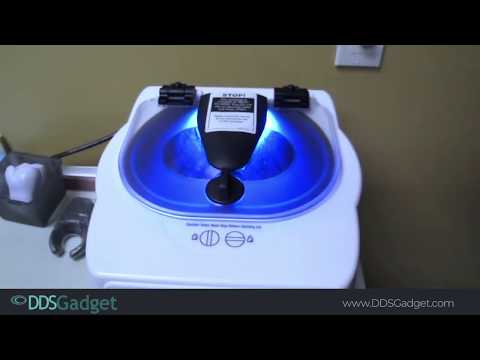
You can try using PRF as membrane over your select cases... not all but many can be taken care off with only PRF over the graft material, and also its free of cost as we all know !!
Joseph Kim, DDS
12/8/2009
Don't repackage the membranes. If there is an infection in the area, or sepsis, you will be in trouble. Just order less expensive membranes such as PTFE or bulk quantities of resorbable collagen. I use ACE Surgical collagen membranes and Cytoplast teflon membranes.
Richard Hughes, DDS, FAAI
12/8/2009
Dr. Amit, I agree 100%.
Manosteel
12/8/2009
We buy the 30x40 collagin RCM6 membranes from Ace Surgical and using sterile technique cut them into 1/4ths ie 15x20 and package them in autoclaved clear bags. This seems to be right for a single sight. Never really had a problem with it.
Robert A Horowitz
12/8/2009
Since when were proper treatment and sterile surgical technique driven by profit? The membranes/barriers made by Osteogenics are outstanding. They are sold by numerous companies and have distinct advantages over other materials on the market. There are many papers (Bartee, Horowitz and others) demonstrating socket preservation and vital bone formation under their PTFE barrier. The collagen membrane is useful in many situations, lasts longer than others, handles very well and is not expensive at all.
Calcium sulfate (Orthogen has the most experience with it) is sold by a different companies (Stem Vie by Sybron). Yes, as said, you can mix it with a graft and use it as a barrier as well. Handling is quite technique sensitive. HOWEVER, when you get there, it is worth it.
Peter Fairbairn
12/9/2009
Wleed it was good to meet you at my talk on Synthetics,as you know I have not used a traditional bio-resorbable membrane for 5 years and no autogenous for 4 years.
The issue here is using graft materials that are their own cell occlusive membranes and are stable thus allowing the body to doits work withoput hinderance of the periosteal blood supply.There are a number of ways of achieving this.
As Bob says Caso4 can be of use although technically difficult to use and in the UK we have Vital which is Beta TCP in a hydroxl sulphate matrix which allows it the "set" thus be cell occlusive for 3 to 5 weeks depedant on patient physiology. This product also has this benefit of a negative charge (Zeta potential ) which leads to a large increase of Osteoblasts at the site (Hunt and Cooper the significance of zeta potential in osteogenesis 2006). I have done hundreds of sucessful ,some extreme cases and routinely use it in the sinus where the lateral wall is sealed by the graft.
Stability is another big issue as the satbility is throughout the graft material which improves the mesenchymal cell differentiation.
For reading on this the best is a recent paper by L. Podaropoulus et al , bone regneration using B-TCP in a calcium Sulphat matrix , JOI , Vol XXXV/No 0ne /2009 and also the pares by Ralf Smeets , Stein et al A clinicalevaluation of a Biphasic grafting materialin the treatment of human perio bony defects;a 12 month RCT in the journal of Perio Vol 80 number 11 and Smeets et al other paper A new Biphasic osteoinductive ca composite materialwith negative zeta potential, Head Face Med 2009 ;5;13.
Then is also Easygraft which is a Beta TCP coated with a pollactide and then when mixed with a medical biolinker becomes solid and cell occlusive. Here again we have treated a large number of cases sucessfully over thelast 2 years.
The main benefit with these materials is that we help the body to return itself to its previuos healthy state as the materials a fully bio-resorbed at 6 to 9 months ( patient pyhsiology dependant)
Whilst new these materials are showing remarkable results.
Regards
Peter
Dr. Mehdi Jafari
12/10/2009
A few words from an old man who has been using barrier membranes and biomaterials for years;
Patient's own periosteum is the best choice to cover the grafted bony defects especially when biomaterials have been used. If one intends to impede any epithelial in-growth or down-growth, then an inexpensive collagen sheet works very well.
satish joshi
12/11/2009
Dr.Jafari,
I think we have discussed this issue before.As flaps are being rendered tension free to cover sockets or large defects,periosteum is incised to advance flaps and grafts may not be fully covered with periosteum.Please correct me if I am wrong.Collagen sheets like colatape resorb very quickly, otherwise it is very very inexpensive.
I know Bob(Dr.Horowitz)is involved with research on this subject and I know he already had written article on socket grafting on this web site few years ago.So he has some ideas how these membranes work or don't work.
Dr. Mehdi Jafari
12/12/2009
Sir, It sounds to me that he is in favor of collagen sheet. However, every one is eligible to have and follow his own experience.
Fabe
12/13/2009
Question to Eric SB OMS:
Do you use reusable sterilization bag that allows you to sterilize it before you place the cut membrane in ?
Please describe your protocol.
Thanks
SBoral surgeon
12/13/2009
Fabe,
I use a sterile piece of gauze, wrap the piece of membrane in it, and then put the gauze into a small sterilization bag ( pre-sterilized )
I take this very seriously as these products are not meant for multiple patient use. You cannot sterilize the membrane, I would imagine this would alter its structure. Others have mentioned other products. Use what you like. This is how I maximize the value of an extremely overpriced product in a safe way (biomend, bioguide.)
Richard Hughes, DDS, FAAI
12/14/2009
You may want to consider gas steralization.
Peter Fairbairn
12/15/2009
Another key here is blood supply or rather the lack of, bio-resorbable membranes can impeded this vital periosteal supply to the graft site. There has been a drft back to Ti mesh and other membranes with larger pore size which are more efficient (recent research ) at prevention of soft tissue ingrowth.
But still the graft materials that are their own membrane are nano-pourus to vascularisation thus improved blood supply.
Dr S.
12/15/2009
As Dr. Horowitz said, calcium sulfate is a very effecttive and inexpensive choice. Some people find it technique sensitive, but if you get it right, nothing like it. There are quiet a few calcium sulfate materials out there (DentoGen by Orthogen). Since it is not expensive, it is really worth it to at least give it a try.
dr rabbani
12/17/2009
dear dr.s
can u please brief the technique how caso4 is used as a barrier membrane.i have been using collagen membranes like mem-lok but they are expensive.wanted to use caso4 and give it a try.
Richard Hughes, DDS, FAAI
12/17/2009
Using CaSO4 as a membrane is an old technique it is known as "barrier by bulk".
Joseph CHOUKROUN
12/29/2009
In Bone engineering, the behaviour of osteoblasts depend of the biomaterial type. If you use allogenic bone: it's 90% of fibrous collagen.The collagen (organic) is the most attractive product for the osteoblasts. You can use only PRF Membranes. cheapest and get cell stimulation during more than seven days.Because with collagen, you have cells quickly in the site and can stimulate them. If your biomaterial is mineral (TCP, DBB, HA)you have not collagen in the site during the first days. This is because you need a collagen membrane, if you want to succeed. The way of fibrous collagen biomaterial(FDBA) and Growth fcators like PRF is really the more reasonnable and the more active.
Robert J. Miller
1/3/2010
Dr. Choukroun is correct in his assessment of collagen containing bone grafts and membranes. Osteoblasts produce Type I human collagen which acts as a scaffold for the first stage of bone mineralization. In addition to collagen, growth factors that cause genetic modification/potentiation of bone producing cells will accelerate bone growth. The factors PDGF, VEGF, and TGF beta will jump start this process. While you can incur considerable expense when using rhBMP and membranes, the cost effectiveness of an autologous fibrin membrane will give you similar results. PRF membranes contain all of the previously mentioned growth factors in addition to platelets and leukocytes.
This mix of blood components gives you a durable membrane, with bacteriocidal and accelerated growth properties.
RJM
Dr S.
1/6/2010
Dr. Rabbani,
Sorry for replying late, but I did not come back to the forum for a while. You can just add saline or setting solution to the calcium sulfate. As it starts to form a putty, you can mold it in the defect as a barrier. Hope this helps. Thanks.
Dr. Gerald Rudick
2/9/2010
One of the main considerations in placing a biological separation barrier is whether to use a resorbable or removable type is required.
Years ago I felt it was a big waste of money to have to cut a piece of the membrane to the required size, and then disgard the rest. The manufacturers of these membranes absolutely forbid the reuse of an open package, and rightly so. Dental offices do not have the sterility found in hospital operating rooms, and as such trying to repackage a piece of left over membrane is really against the law; should a problem arise.
I felt that the removable PTFE type offered more protection,was stronger and would stay in place longer than the resorbable types.
While in the plumbing section of a renovation center, I came across "plumber's tape" which is PTFE. The ordinary teflon is too thin for dental use, but the Gas Line Teflon is thicker, and similar to Tefgen. The thicker variety is used in food processing plants to convey liquids, used in hospital piping for anaesthesia gases,etc. and can be steam sterilized.
I cut out some pieces, placed them in gauze, and then into paper sterilzation bags. I took the samples to the bacterialogy lab and had them tested for sterility which proved to be 100% sterile. The Teflon manufacture's label reads 100% pure PTFE, which is the same as those from the dental industry.
I did a series of bone grafts using them, and obtained very similar results as those from materials purchased from the surgical supply dealers. I published the results in the 2003 September/October issue of Implants News and Reviews.
The sterilization bag costs more than the enclosed PTFE membrane.Since the width is only 1/2", we place them in shingle overlap fashion is a wider area has to be covered.
Gerald Rudick dds Montreal
Richard Hughes, SS. FAAID
2/10/2010
Gerald: Yes the Gas PTFE works well.
Greg Steiner
2/19/2010
Hello Dr. G
Google "Socket Graft". Socket Graft includes a covering called Socket Seal. If you choose a different graft material the seals are also sold seperatly.
Jin Lee
2/28/2010
Gas PTFE does not change it's structure after sterilization cycle? I'm assuming that you are not using directly from the role of tape.
Dr.K
3/28/2010
If you're mixing calcium sulfate with bone, what's the ratio? And how long does the mixture take to harden to avoid a barrier membrane?
Mario Marcone
4/21/2010
To Dr Choukroun & Dr Miller:
I agree entirely with this approach. The question is what will you do in this protocol if primary closure cannot be attained, would you cover the collagen allograft/PRF mix with PRF membranes and in turn cover all this with an exposed final cytoplast non-resorbable membrane? Also, Have you tried using implants as tenting devices to augment some kind of ridge height/width with the Choukroun PRF protocol, in order to save a surgical step?
Mario Marcone
4/21/2010
Dr Choukroun:
Does the Jason collagen membrane require complete coverage by soft tissue or can it tolerate some exposure?
Robert J. Miller
4/24/2010
PRF membranes can be used in a number of ways. There are several important considerations:
1. Number of walls in the defect. In a 4-5 walled defect, a PRF membrane alone can be used. It will be supported by the architecture of the defect. However, if we use PRF alone, you must at least double the membrane thickness so it does not resorb prematurely. In 3 or less walls, PRF alone is not sufficient. You must use a reinforced membrane or tenting screws.
2. Combination of graft and membrane. When we place a graft, regardless of type, we mix the PRF serum (contains PDGF, VEGF, TGFb) with the material. Then we place a resorbable collagen membrane over the graft and secure it with a horizontal matress suture. We then layer the PRF membrane over the collagen. It helps to buffer the pH and prevents premature dehisence of the collagen. It allows gingival fibroblasts to quickly migrate over the grafted area if primary closure cannot be attained.
3. PRF over the graft or implant area if primary closure can be attained. This used to accelerate soft tissue healing and to increase biotype of the flap. This will help to prevent crestal bone remodeling around the implant.
We do not use non-expanded PFTE membranes. There are no live cells or growth factors available and we have found a delayed healing response when employed.
RJM
Mario Marcone
4/24/2010
Dr Miller, Dr Choukroun:
Thank you Robert. Now as opposed to a tenting screw, please consider this: An implant is placed such that the platform is desired at a certain vertical position, but several threads are exposed all around. Can we treat this implant as a tenting screw and employ the L-PRF bone grafting technique? I would think that if the particulate biomaterial, such as a freeze-dried mineralized bone, mixed with the L-PRF serum exudate, placed around the implant threads and to the implant platform with sufficient bulk, covered with a collagen membrane, such as a Jason, and then covered with a L-PRF membrane,sutured appropriately, I should be able to attain vital bone formation to the platform and around the implant threads, hence a simultaneous vertical augmentation. Would you agree? And I realize that if it does not work, I can lose the implant, but the environment cannot distinguish a tenting screw from an implant, so I figure this would work. The surgical steps are reduced. Comments?
Mario Marcone
4/24/2010
Dr Miller , Dr Choukroun:
And one more thing, I would precede this protocol with a bone stimulation procedure with the "Bone Activator" about 10 days prior.
Thank you
Mario Marcone
Mario Marcone
4/24/2010
Dr Miller,
When you say "reinforced membrane", do you mean a collagen membrane that is long lasting.
Robert J. Miller
4/24/2010
You certainly can use the implant as a tenting screw. This procedure has been used for decades. However, as this is a one-walled defect, bone regeneration will take 30-50% longer than a multi-walled defect. As such, it requires primary closure. Flap management will determine the success of this procedure. Premature dehisence will cause failure of the graft. Advance the flap carefully and without tension, then layer the PRF membrane over the top of the implant and graft material. Use horizontal matress sutures to evert the flap. The use of a titanium reinforced membrane will help to preserve space in critical size defects.
RJM
Mario Marcone
4/24/2010
Thanks Robert,
MM
Dr. Mehdi Jafari
4/24/2010
As a specialist surgeon, I thought that the horizontal mattress sutures compromise the blood supply of a soft tissue flap by puting pressure over the vascular pedicle of the incision edges and increasing the probability of wound dehiesence.We were taught that wherever any reduction in blood flow to the wound edges seem to be detrimental or the flap is covering a somewhat bulky foreign body,the horizontal mattress sutures have to be avoided. N'est-ce pas, monsieur?
Robert J. Miller
4/25/2010
If you like to have your sutures pull out of your flaps over grafts, then rely on interrupted sutures alone. A combination of interrupted to tack your flap margins and then a horizontal mattress suture to evert the flap margins has always worked best in my cases. The only time a horizontal matress suture will cause vascular embaressment is if you blanch the tissue at closure. The number one cause of graft failure is premature dehisence. I have never had a flap necrose as a result of using a horizontal matress suture. If you have a preference for vertical matress, that is fine. But I find that you need additional sutures if you use vertical. This is more likely to compromise blood flow.
RJM
satish joshi
4/25/2010
I totally agree with Dr. Miller. In my case only two to three interrupted sutures to hold the flaps and then horizontal mattress work perfectly all right. As a matter of fact there are less chances of exposure.
Richard Hughes, DDS, FAAI
4/26/2010
Dr. Miller, My same experience. I agree with you 100%.
Peter Fairbairn
4/27/2010
When using Easygraft fortunately premature dehiscience is not an issue the graft will remain abd the the tissue will granulate over it.. even up to 3 weeks in socket grafting cases.
Peter
Peter Fairbairn
5/12/2010
Great new Caso4 product from MIS implants out of Israel called Bond Bone which has great handling properties and can be used with your own favourite graft material to stabalize it and act as a resorbable membrane. Or just use as a membrane over the graft.
This is the Caso4 product we have been waiting for.
William Reeves DDS PC
9/14/2010
I have used an extensive amount of the bond bone Peter mentioned.
I have used it by itself, mixed with graft material, and even as a tamponade. I was amazed at how fast tissue coverage happens over this material. I have had a couple cases where the patient returned with that dull, aching pain where I treated as a dry socket with excellent resolution.
Regards,
William Reeves DDS PC
Mario Marcone
9/25/2010
Dr Miller,
I'm thinking about using PRF membrane over Alloderm Dermal Matrix (to replace the collagen membrane) sutured over a mineralized collagen bone graft + PRF around tenting Implants for a vertical augmentation of about 2-3 mm. My thinking is that this should take care of possible suture line opening even after diligent flap management. The flaps would be sutured using horizontal mattress to evert the flap & individual interpositioned interrupted sutures. Any thoughts?
Robert J. Miller
9/25/2010
This is a great strategy and one that we use for critical graft areas. Vertical augmentation, however, requires one more important feature; absolute passive closure of your flap margins. The number one cause of graft failure is premature dehisence of flap margins. Layering of PRF will enhance initial healing and result in earlier angiogenesis into the graft area, especially into the vertical component. But it will not make up for inadequate surgical preparation. Make sure you create a wider flap base with deeper apical release. This will eliminate any frenum pulls. Last is a good periosteal release for passive closure. PRF will then stimulate periosteal stem cells to convert to osteogenic cells, speed up flap closure, reduce an excessive inflammatory response, and result in bone with higher density. But in this case do not be in a rush to restore the implants with vertical augmentation. A little more healing time will significantly reduce crestal bone remodeling as the bone will have greater mineralization.
RJM
Mario Marcone
10/2/2010
Absolutely right, Robert.
How do you interpret one popular approach involving vertical & horizontal GBR with a dense PTFE membrane and no primary closure.
Mario Marcone
Mario Marcone
10/11/2010
Pericardium membrane with GBR - What are its physical properties and does it have any advantages over other resorbable membranes particularly acellular dermal matrix (Alloderm)?
Robert J. Miller
10/11/2010
Dense PTFE membranes are merely cell occlusive. If you can prevent epthelial migration into the graft site long enough, you will achieve the same results as with any other type of membrane. However, the chances of a PTFE membrane dislodging prematurely are dramatically higher. If your graft component is at the crest (vertical), you will surely have a graft failure as there are no vital cells at this level. You want a three-dimensional turnover of your graft; only available with primary closure and enhanced by cytokines contained in L-PRF. There are new PRF courses listed in Osseonews.
Our results with pericardium membranes have been fair. They tend to resorb far too quickly for my use and we have found a significant amount of crestal remodeling as a result. Alloderm offers one advantage. Unlike thin resorbable collagen membranes, it tends to increase the thickness (biotype) of the tissue and decreases the amount of bone remodeling. It is our prefered soft tissue graft if we cannot use a subepthelial connective tissue graft (first choice).
RJM
Mario Marcone
10/12/2010
Thanks Robert, this makes total sense.
What's your experience with Block Allografts and/or Xenografts ... the little literature available is looking good, especially with the block allografts.
If you use these, can you comment about corticocancellous versus cancellous. And, are they really good space maintainers in vertical augmentation.
Robert J. Miller
11/19/2010
Autogenous block grafts are the preferred modality for vertical augmentation. Block or particulate for lateral augmentation works equally well provided your space is maintained (Ti mesh, Ti reinforced membrane, or tenting screws). The choice of which one you use depends on the amount of medullary bone adjacent to the graft. We use a block graft for lateral augmentation if there is adequate medullary bone by using piezo surgery to create an inlay preparation in the bone. This creates a four-walled defect. If the bone is cortical in nature (D1), we use particulate with a membrane, use L-PRF to add growth factors, and then decorticate entirely through the ridge to the periosteum on the lingual side. This will stimulate the periosteal stem cells to convert to osteogenic cells and help graft turnover. We avoid xenografts in any graft procedures where implants will be employed. In every re-entry case I have seen, xenographs remain fibrous encapsulated and dramatically increase the potential for peri-implantitis and implant loss.
RJM
Richard Hughes, DDS, FAAI
11/20/2010
Bob, That was an excellent explination. You may want to consider flexibone foe the lateral onlay grafts and closure assisted with alloderm. Yes, the xenofrafts are to hard and the particle size is to large. They do not turnover well.
Chad Ordelheide
11/29/2010
I recently used a PRF membrane for ridge preservation. Unfortunately, the top membrane was lost after about a week. The lower membrane is still intact and I will monitor healing weekly.
In this case I used multiple interrupted sutures. What suturing technique should be used to secure a membrane of a completely intact socket over FDBA grafting material?
Robert J. Miller
11/30/2010
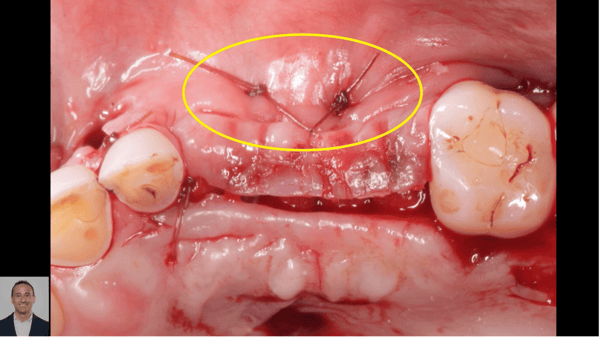
Always use a horizontal mattress suture. If the defect is large, it should look like railroad tracks. If the defect is smaller, cross over the center so it appears as an X. This will keep the PRF membrane from migrating out of position and keep the wound margins compressed over the fibrin mesh.
RJM
Chad Ordelheide
11/30/2010
What is the expected resorption/integration time for a PRF membrane?
Robert J. Miller
11/30/2010
PRF membranes will resorb in two weeks. If the defect is large and we feel there will be premature dehisence of a graft, we will layer a collagen membrane first, then cover with PRF. This will speed up epithelialization. Most average size defects will have complete closure in 7-10 days, about a quarter of the time for collagen alone.
RJM
Richard Hughes, DDS, FAAI
12/1/2010
Bob Miller: Thank you for your contributions. This has been my experience also.
Mario Marcone
1/24/2011
Dr Miller,
Any comments on the following;
Gore is discontinuing its nonresorbable Gore-tex membrane as of the end of 2011. This may be of some concern to some clinicians like Ueli Grunder from Zurich. It is now promoting the resorbable Resolut Adapt LT membrane, a synthetic membrane.
Any experience with this ?
Robert J. Miller
1/25/2011
Not surprising that Gore is discontinuing their expanded PTFE membranes. They need primary closure for the full term of bone healing and, if exposed, they lead to bacterial infiltration of the graft area. The Resolut Adapt LT membrane is their answer to the ePTFE problems. While it is not a problem if it is exposed, it leads to another dilemna. It is composed of PGA:TMC (polyglycolic acid: trimethylene carbonate). As this membrane degrades, the the byproducts reduce the pH (more acidic). This will delay osteoblast metabolism and, in turn, maturation of the grafted area. We do not use synthetic membranes as a result of this process. We prefer thick collagen membranes that ultimately get incorporated into the bone milieu.
RJM
Mario Marcone
1/25/2011
I agree, Robert. The studies with PGA membranes are not very encouraging.
However, despite its possible drawback of exposure and ensuing infection, there was definitely the advantage of being able to control the final augmentation morphology by burying particulate grafting material under a membrane that could be molded and shaped according to the desired form, as with the titanium re-inforced Gore-tex membrane combined at times with tenting screws. Obviously, the concern is maintenance of the graft space and desired shape during healing.
(Let's exclude, for the sake of discussion, allograft bone blocks and autogenous bone blocks, as well as non-expanded PTFE membranes)
What can possibly parallel this approach with collagen membranes when the non-resorbables are gone?
Should we be looking for a stiffer type of collagen membrane?
What about using products like Lambone or Grafton DBM pressed fiber sheets as membranes?
Any experience with this?
Robert J. Miller
1/28/2011
We have used laminar sheets of cortical bone with some success. The thinner sheets resorb too quickly and have no memory once they are wet. The thicker bone sheets are preferred, but once again you need primary closure. When we need architecture with critical line angles and volume for aesthetics, we now use titanium mesh. This will not collapse and will give you bone volume in essentially the shape you have formed. The openings in the mesh allow periosteal stem cells to be recruited to the upper part of the graft area, giving three-dimensional turnover of the material. However, primary closure for at least two months is absolutely critical.
RJM
Dr Mario Marcone
2/7/2011
Robert,
Do titanium meshes need to be stabilized with tacks or is overlying flap/membrane management over the mesh sufficient to stabilize the mesh.
Dr Mario Marcone
2/7/2011
Anybody share their experiences with titanium mesh?
Gore is dumping production of expanded titanium reinforced nonresorbable membrane. What will replace it? The non-expanded non-resorbables?!
Robert J. Miller
2/7/2011
We always use bone screws when utilizing titanium mesh. I have never seen Ti mesh that has had immobility after placement. It can be stabilized laterally or with an occlusal screw alone, depending on the defect shape and critical structures.
RJM
Chad Ordelheide
5/9/2011
Coding for PRF Membranes...
Bone grafting for a ridge preservation is Coded as ADA D7653 but it says any charge for a Membrane should be charged separately. What code is being used for PRF membranes as they are not CT grafts, etc?