Dental Implant Barrier Membranes
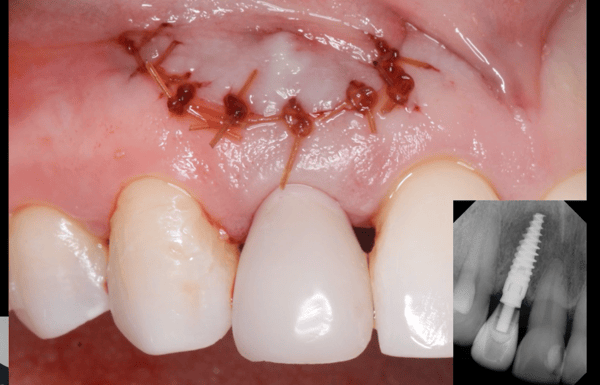
Barrier Membranes certainly have their place in dental implant placement. I much prefer a resorbable membrane because of no second surgery, but if not primary closure the membrane picks up the stuff in the patients mouth and smells. I am having very nice success using Gel Foam over grafting material with primary closure. Has anyone else done this method. What membranes have been successful without primary closure?
21 Comments on Dental Implant Barrier Membranes
New comments are currently closed for this post.
SATISH JOSHI
8/24/2004
I used to use gelfoam in the begining just to bring overhead down. In many cases I did not get satisfactry results as we know gelfoam dose not survive long enough.Instead i ended up in central defficiency in case of socket grafting. I do use surgical grade plaster of paris as a membrane with better success.
Basile Muntean, DDS
8/24/2004
I don't know of any resorbable membranes to work without primary closure. Plaster of paris works good; mix it with some DFDB and coat the top with cyanoacrylate?
Jeffrey Hoos DMD
8/25/2004
What companies are selling Surgical grade plaster of paris now? I have had great success with cynoacrylate but my source died for that. I did not want to use just any "super" glue.
Michael Katzap, DDS
8/25/2004
Have been using Bio-gide ( osteohealth), or biomend ( zimmer), to supposrt grafts. If primary closure is impossible or there is wound breakdown, have the patient on Peridex rinses till the incision heals. What is the point of mixing the plaster with DFDB?
Arthur Ashman
8/25/2004
I HAVE USED ALL OF THE MATERIALS COMMENTED ON BY THE RESPONDING DENTISTS.
MY FAVORATE..BY FAR..FOR CLOSING AND SEALING AN OPEN SURGICAL SITE (EX: SOCKET, INPLANT, OR PERIODONTAL GRAFT) IS BIOFOIL ORAL PROTECTIVE STRIP..FROM KERR/SYBRON.
IF LONG TERM RETENTION NEEDED..I ADD SOME CYNOACRYLATE TO THE 4 CORNERS..OR PLACE IT OVER AN ADJACENT TOOTH.
Pankaj Narkhede, DDS, MDS
8/25/2004
Surgical Grade plaster, CASO4
Ace dental sells it. They have great stuff & inexpensive.
CaSo4 does not need a closure. technique sensitive. Once you know the trick you are all set.
As you know there are techniques of easy soft tissue closure too. That works great!
Pankaj Narkhede, DDS, MDS
CA
A. Lakha, DMD
8/25/2004
For single teeth extraction sites in the aesthetic region, I'll cover the graft material with autologous connective tissue and epithelium from the tuberosity or palate. It works really well. For multiple extraction sites, I use Alloderm GBR. Excellent results.
Basile Muntean, DDS
8/25/2004
The point of bringing DFDB into the mix is osteoinduction - imitates bone matrix and stimulates bone formation in ectopic sites whereas CaSo4 is only osteoinductive (does not initiate bone growth. By mixing DFDB you end up with better quality of bone for your future implant placement.
Jeffrey Hoos DMD
9/7/2004
I am very interested if anyone has used paracardium as a barrier. It appears to be a wonderful barrier because it will strech in all direction. You should have primary closure.
Of course it is human tissue and some patients do not like it.
Daren Rosen, DDS
11/29/2004
I have used CAPSET once and found it very soft & watery after placing it above the bone graft. Does this matter? Is CAPSET any better than a "traditional" membrane like BioGide?
Anon
6/16/2005
All grafting materials are working via osteoconduction. DFDBA and FDBA do not have any advantage and are in fact poor conductors. Bio-Oss with some auto mix with a Bio-Gide have proven histology and produce great results.
Bryan Siegelman
6/16/2005
I would beg to differ with the previous comment regarding all grafting materials being only osteoconductive. If fact, DFDBA, and FDBA have both shown to be osteoinductive. Look at the trilogy of articles published by Gerry Bowers in the Journal of Periodontology in 1989. He has histological evidence to show that these materials are in fact osteoinductive. To be sure these materials are osteoinductive, however, many of the both grafting masters use dfdba and fdba as their workhorses in regenerative treatment.
Anon
6/16/2005
I'm sure many opinions have changed since 1989. Reference Schwartz/Mellonig 1996 J perio. "Ability of Commercial DFDBA to Induce New Bone Formation". Commercial bone banks have provided DFDBA to the dental practitioner for many years; however , these organizations have not yet verified the osteoinductive capacity of their DFDBA preparations.
The DFDBA particles used in this study varied greatly in their ability to induce bone at ectopic sites. The results strongly suggest that some of the DFBDA used clinically today may have little-to-no osteoinductive capacity.
Another great article was published in 'The International Journal of Oral & Maxillofacial Implants' Report of the Sinus Consensus Conference of 1996. Data from 38 surgeons, placing 2997 implants over 10 years. 299 failures resulting in 90% success rate. DFDBA was the least effective material. The report concluded that BMP activity in Allografts is doubtful, regardless of the preparation. Even as an expander, the use of Allografts is questionable. The findings may be related to the tendency for Allografts to delay both bone formation and osteointergration.
Barry Levin
10/18/2005
I would have to agree with Bryan Siegelman. As a periodontist with formal training in bone and periodontal regeneration, I am certain that non-autogenous bone grafts can have osteoinductive potential. Another commenter cited the Schwartz-Mellonig article discussing inconsistencies with different bone banks. The study cited that although variability exists, there was absolute non-orthotopic osteogenesis with allograft bone. I was made personally aware by Jim Mellonig which bone bank showed the most consistent results. What is certain is that if one chooses to interpret the literature with bias, they will have no difficulty in doing so. What clinicians need to do is carefully evaluate the nature of the studies they read. Just because an article is published does not validate it's findings wihtout challenge. It is our responsibility as surgeons and restorative dentists to read a vast number of qualified journals and apply what can be learned to our clinical practice after challenging ourselves to interpret the studies and their findings.
As always, it is often the specialist's responsibility to produce the studies and test their validity. Sometimes it is best if the specialists provide the type of care they are best trained to perform. This may rub some clinicians the wrong way. If specialty programs produce the literature then their graduates should provide the care. A weekend course does not replace 3 years of advanced training. When unqualified individuals interpret the literature incorrectly, often false conclusions are drawn and patient care suffers. Sorry to offend anyone.
ANTONIO DÓLERA, DDS
10/19/2005
I ABSOLUTELY AGREE WITH BARRY LEVIN COMMENTS.
MOST OF PUBLISHED RESEARCH MUST BE READ CAREFULLY.
MANY OF THEM MAY INDUCT TO WRONG CONCLUSIONS.
IT USUALLY HAPPENS WHEN INFORMATION IS INTERPRETED BY CLINICIANS WITH NO FORMAL EDUCATION AND OR TRAINNING.
Anon
10/30/2005
Any comments on the recent FDA news release regarding the investigation into human tissue for transplantation?
Anon
11/29/2005
"Any comments on the recent FDA news release regarding the investigation into human tissue for transplantation?"
We have already having some difficult recommending and having patients accept donor bone sources. Autologous bone grafting has become our main bone graft source again.
Anon
12/6/2005
Not using FDBA or DFDBA at all. Using Bovine source and considering new growth factor with bTCP matrix. We harvest some autologous chips for sinus augs.
sorin herhkovitch dmd-clu
2/23/2006
the only membranes wich work witout primary closure are osix(collagen resorbable-very slow)and diferent types of titanium mesh(perforated or not)Calcium sulfat resorbs very fast especially if there is noy primary closure ,but is bacteriostatic,very compatible with oral tissue and does not infect.
Anon
2/24/2006
Ossix is a decent membrane however, I find it to be rather rigid. Bio-Gide is much eaiser to handle in my hands.
Anon
6/11/2006
Because specialists produce the studies only specialists should interpret and use them. What reasoning is this from a supposedly educated mind? And you don't base your treatment on research done by other specialties?
You are inferring that a general practioner cannot interpret scientific research.
Studies are misinterpreted by Dentists and Specialists alike. It could be suggested that the specialist population is selected from those who couldn't make it in private general practice. Those of us who did could never afford to go back for three years.