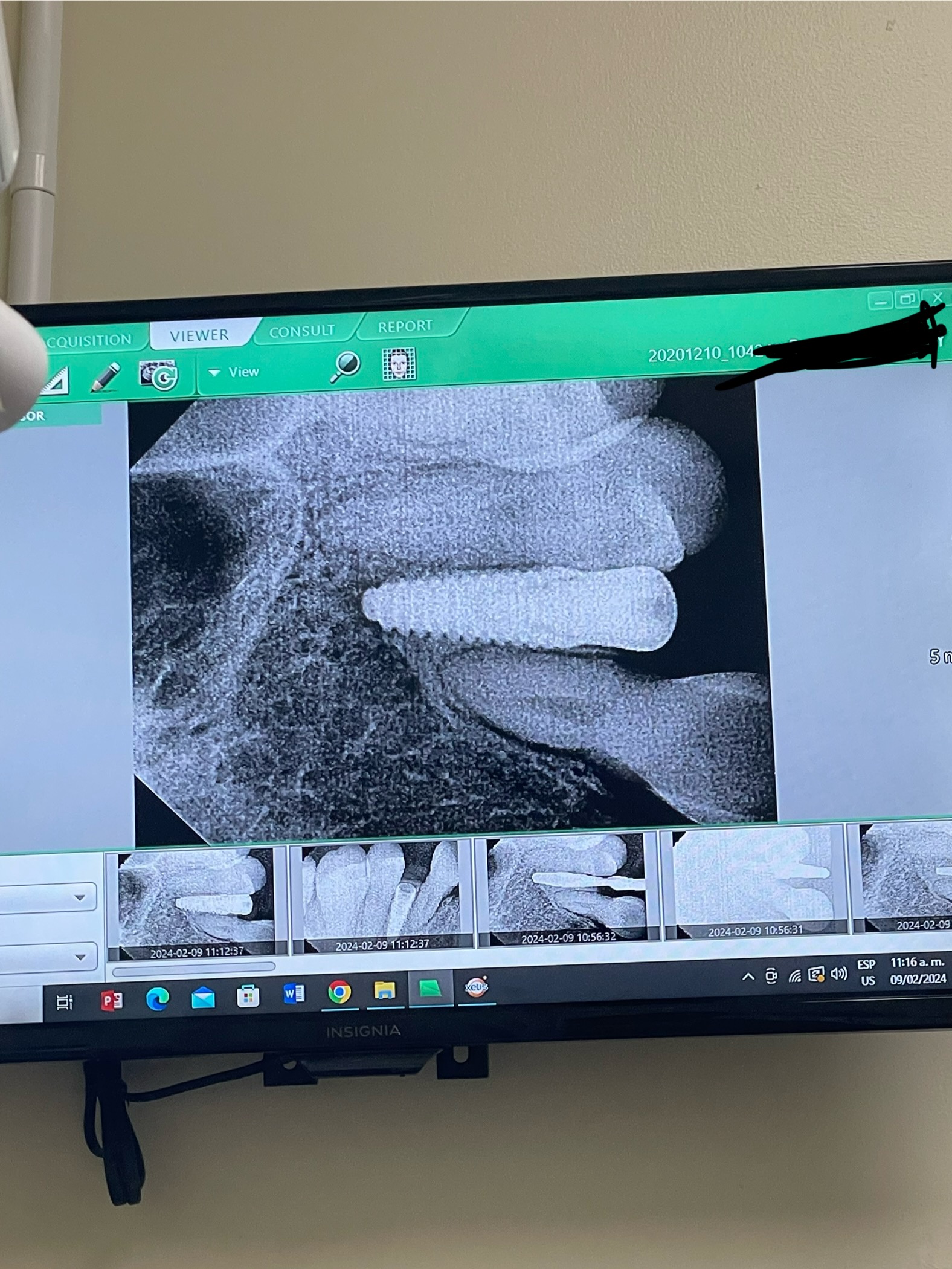
Implant Crowns: Should They Be Touching Opposing Lower Teeth?
Emily, a dental implant patient, asks:
My TMJ dentist said that my general dentist made a mistake by making my two upper jaw dental implant crowns not touch the opposing lower teeth when I bite. He says it is important that all my teeth touch when biting down. My general dentist that did the crowns said he purposely made the implant crowns touch only very lightly so that the implants would not get loose. I am in a quandary as to whether I should have these crowns re done or not. I am wondering why I am getting two totally opposite opinions. Isn’t there one way to put in these crowns? Who is correct in my situation?
11 Comments on Implant Crowns: Should They Be Touching Opposing Lower Teeth?
New comments are currently closed for this post.
Dr. T
9/29/2008
Teeth sit in the bone supported by a ligament. They can jiggle a bit and when you bite they can move very slighty.
Implants are fused with the bone. They have no give and do not move.
When you close together the teeth will meet and when you bite they will squeeze together a small distance further. Because of this implant supported crowns should only be in light contact on biting otherwise too much force would be placed on them. This could lead to possible problems in the future such as failure of the implants or wear of the opposing teeth. You are more likely to get TMJ problems if the implants interfer with your bite than if they are slighly out of it.
A general guide is that when all teeth are touching you should be able to pull Shimstock foil ( a very thin ocllusal checking foil ) through between Implant crowns.
My only question is if one dentist says they do not meet and the other says they are in light contact, which one is it?
Neda-Moslemi
9/30/2008
Dear Emily,
What is your problem with TMJ? Does the problem begin just after installing the prosthesis of the implants? And how many implant units do you have in your mouth?
I agree that implant restoration should have contact with opposite teeth in centric occlusion, but a lighter one in comparison with a tooth. Implant restoration should not have any contact in excursive movements of the jaw.
Hope to hear from you soon,
Neda
David Peterson
9/30/2008
The implants, in light or no occlusion, will have no effect on your TMJ condition - your bite is still the same just like it was before. The only way the implants can have an effect of your TMJ is if you're biting down and the first place where you close is on the implant crowns. This way forces would be transmitted to your TMJ and would effect your TMJ.
Maybe you should switch to a different TMJ specialist who actually understands implants the way crowns are fabricated for them.
Alejandro Berg
9/30/2008
I would have to agree with Dr. Peterson, a ver light touch will keep the opposing tooth in ossition but will have no effect on your tmj.
duke
9/30/2008
don't change your crowns E. The natural teeth apposing the implants will erupt slightly if the bite is too light to make a more + contact. Might take a couple months but it'll happen. If you wear an occlusal guard (plastic bite plate) over the natural teeth that might impede their erruption though, so you might want your GENERAL dentist to take a look. A heavy bite is way more damaging. By the way, there is no recognized specialty specifically for the treatment of TMD in Canada.
R. Hughes
9/30/2008
Duke is correct. Implant crowns must have a feather contact in centric. Actually no to a feather contact is better. Plus you should wear a night guard occlusal guard at night (Iprefer an anterior deprogrammer). There is no TMJ speciality and your TMJ dentist is most incorrect! The concepts of implant occlusion are different than with natural teeth.
chowdhary
10/8/2008
peterson and hughes are very correct.if your implant will move just 3-4 microm in bone while ur teeth will go 70-80 micro m due to ligament surrounding the bone.so when your occlusion is designed by your dentist for the implant corwn , when there is initial contact of all other teeth , ther will be not contact of implant crown, but when further load is applied (maximum) then implant crown will have contact. this concept is always good for the better life of the implant supported crown.your TMJ problem could be due to some other reason .
Dr. Bill Woods
11/14/2008
What is the nature of your TMJ problem and what therapy have you had and for how long? I would want to know that first. The advice about contacts in the previous comments are right on the mark. I cant get one of my patients to come back in and I have been needing to check her bite for two years! I have no idea what I will get to see when she finally shows up. Bill
Peter
3/24/2011
Dear Sirs:
I'm in the process of having my implant completed following bone grafting. At this point, the implant is in and a tiny metal cap is on it. In a couple of weeks I'll have a crown put on. Today, I accidentally (and very stupidly, I know) bit with a dried banana on the implant and had a piercing pain / shivers. I do not feel any pain now, but could I have caused any lasting damage to the implant or the bone or the tissue around it (or any other related problems) by having stupidly bitten on the dried banana?
Thank you very much for your feedback,
Peter
Richard Hughes, DDS. FAAI
3/25/2011
Only at most, with an ultra feather contact in centric occlusion. It's best to have no contact.
Carmen
6/5/2018
I have an opposite problem. I have 5 implants in and just now got my second crown on a mollar. The first tooth was fine with very small Gap in my bite between top natural teeth and bottom crown. The second however, there is a substantial Gap between the two. Dentist says the top will natural lower...umm... No, my mollar will have to come out completely to even touch.... What do I do??? Is it too late once it's cemented in?