posted in Treatment Planning & Complications
« Bone Augmentation and Ridge Preservation | Maxillary Dentures Supported by Mushroom-Shaped Mucosal Implants? »
Print This PostDr. Mena asks:
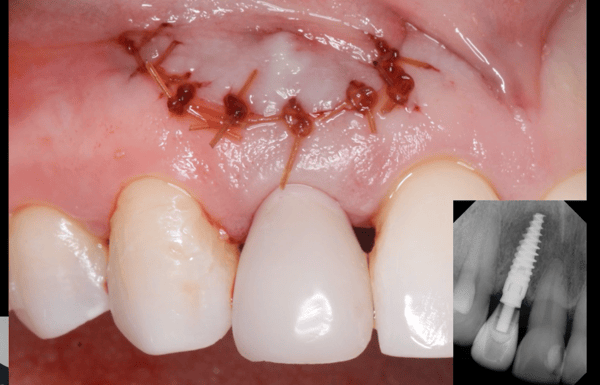
I recently did a few immediate loading cases with root-formed
dental implants and composite resin temporization on titanium or zirconia
abutments.
All of the cases had some kind of chronic infection prior to
the extraction, which was the reason for the extractions. All cases
were treated with antibiotics after the extractions and dental implant
placement. The dental implant fixtures had primary stability and I torqued them to
about 40 Ncm. No bone grafting was performed between the alveolar wall
and the dental implant.
Until now, the dental implants have been working well, but some of the
implants are showing thru thin gingival tissue. Is this going to
become a problem? Any thoughts?
7 Responses to “ Implants Showing Thru Gingival Tissue ”
If impalnt is symptomless without deep pockets over that area and if it is not an esthetic issue I would leave like that.
If it is an esthetic issue I would attempt CT graft or GBR depending upon situation.
Dr. Mena:
I was here in Buenos Aires listening to Professor Jan Lindhe, and he said that implants after extraction might be not installed nearer than 2 mm from buccal bone, if this happens, no marrow bone and no irrigation will be possible, maybe this happened in your cases…
Hottest Regards from Argentina!
When placing immediate implants into extraction sites in the maxillary anterior I always favor the palatal aspect of the extraction socket when preparing the osteotomy. This is especially important in thin periodontal biotypes.
The facial cortical bone is very thin with little medullary component and will resorb to the facial screw threads of the implant in most cases. This will appear as a gray-blue area when viewed through thin translucent gingiva. I always graft the remaining facial peri implant space with a slow (non) resorbing material graft material and veneer graft the facial cortical bone with the same graft material,connective tissue or both depending upon the circumstance.
Dr.P above is right on target.
Right on target, but for the wrong reasons. When placing an implant at time of extraction in a chronically infected site, the level of matrix metalloproteinases is signicantly elevated. MMP’s (collagenase, elastase, gelatinase) directly affect the bone causing osteocytes to differentiate into osteoclasts - hence creatal bone remodeling. Thinner biotypes are more prone to breakdown simply because of decreased volume and greater parabolic architecture. Either do soft tissue grafting at time of implant placement to thicken the biotype, or use a diode laser to pre-condition the tissue PRIOR to surgery (or both). This will result in a lower concentration of MMP’s, and significantly reduced crestal bone remodeling.
To Robert J. Miller: instead of lasers, what about just using a Lucas’ curette to clean up the postextractive socket? It’ s been working for years…
))
Another one bites the dust.
Leave a Comment
Comment Guidelines: This is a forum for dentists for intelligent discussion. No insults. No outside links. No promotional comments. Though we require an email to route questionable comments to our editors, we will NEVER publish your email. Patients: Please do NOT post dental questions here. Instead Ask Us or Find a Local Dentist.
Note: At times your comment may not appear on the website immediately, because it has been sent to our editors for approval. Once approved, we will publish the comment. There is NO need to resubmit your comment, if it does not appear on the website immediately.