Mucous Retention Cyst: How to Address?
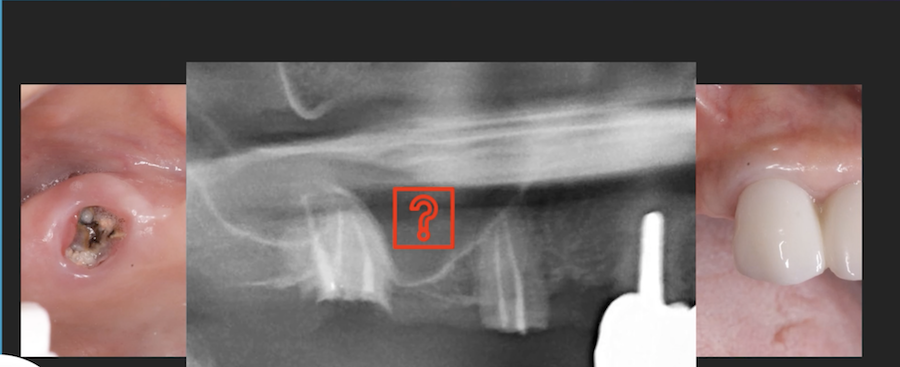
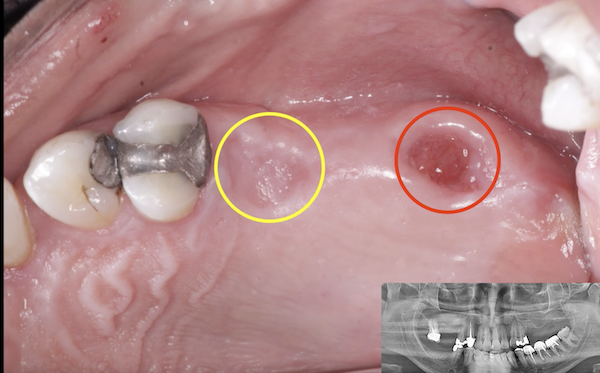
Dr. A. asks:I have a patient with missing molars on the right side of the maxilla. Upon evaluation of his CT scan I discovered a lesion consistent in appearance with mucous retention cyst.
The lesion occupies over 50% of the right maxillary sinus. I referred the patient for surgical removal of the lesion with ENT specialist. The ENT refused to do the surgery. She stated that according to ENT guidelines this kind of lesion does not require any treatment if asymptomatic, and that success of sinus graft will not be at any risk as a result of present problem since the nature of the lesion is not infectious.
I didn’t found any literature addressing this issue and would like to have an expert opinion or referral to some publication.
37 Comments on Mucous Retention Cyst: How to Address?
New comments are currently closed for this post.
Bruce Bay area OMFS
10/23/2007
your ent is correct.
Daren Rosen
10/23/2007
Ignore it. It will be elevated with the membrane and have no consequence as to the success of the surgery.
Dr. Michael Weinberg
10/23/2007
Dr. Michael Pikos recommends removal of the MRC if a sinus graft is being done. Call him at his office in Palm Harbor, Florida to get his opinion.I would take his word over the ENT. At his grafting course he recommends removal if it is in the area. Compressing the cyst will do more harm than good.
Perioplasticsurgeon
10/24/2007
Dear Dr. A,
I to would be cautious when approaching a case like this. I can only speak from personal experience, I think Daren Rosen advice isnt off base, you can lift in cases like these and it may not be a problem. However these days I air more toward Dr. Michael Weinberg point of view. I had one bad experience doing an open sinus lift in a patient with a nice sized MRC. I ended up perfing into it and ultimately removing it, which left behind a sizeable perforation. Needless to say I am a little more cautious when I approach these cases.
Dr. Wienberg, I agree with you, Dr Pikos probably has alot more insight and experience then a ENT when it comes to sinus grafting and implants and cases such as these.
Hope thats helpful
Brian Young, DDS, MS
10/30/2007
I agree with your ENT about the assessment; however, I would tend to remove the cyst if it had the potential to block the ostium. If the size of the graft (membrane elevation) is such that the ostium is occluded, the infundibulum would no longer be patent and could lead to acute problems.
While it may not be routine to remove all of them, in my opinion it totally depends on graft size and lesion size.
Dr Hadar Better
10/31/2007
The MRC is not an issue by it self as DR Daren Rosen pointed out its asymptomatic usually and you may ignore it.
There is one thing you must evaluate and that is whether the mucous retention cyst may block the sinus drainage after the membrane is elevated.
This might happen in only extreme cases - that is when the MRC is big and the amount of membrane elevation is also large.
drs. T
11/1/2007
I think your ENT is a wonder doctor. i wonder how you can see what it is on just a rx. There should be a differential diagnosis even if it seems the most obvious possibility. I have had an experience with a third molar that looked like an normal cyst but after removal by the surgeon it turned to be a rare form of cancer with an jaw resection in the end. So Iam very carefull to let those things left when I start surgery. I just want to know if it is that innocent as it looks like on a radiograft. At the end you are responsable after your surgery and not the ENT!
Dr. Mehdi Jafari
11/2/2007
Three common inflammatory disease entities that involve the maxillary sinus are mucocele, retention cyst (RC), and antrochoanal polyp (ACP). Nontraumatic maxillary sinus mucocele (MSM) is commonly thought to form after obstruction of the sinus ostium, with accumulation of fluid. Secondary infection can lead to its rapid expansion. So far, the exact pathogenesis of RC and ACP is not very well understood. Formerly, the traditional treatment of MSM, RC, and ACP has been exenterative surgery, typically through a Caldwell Luc approach, with complete excision of the disease and underlying sinus lining. Retention cysts are common in the maxillary sinus and may be found on imaging studies in approximately 9% of the population. Retention cysts are thought to form because of obstruction of the ducts of seromucous glands in the sinus lining, which results in an epithelium-lined cyst containing mucous or serous fluid. Most maxillary sinus retention cysts are asymptomatic and do not require treatment. However, some patients may complain of ipsilateral cheek pressure and pain. Establishing a relationship between cheek symptoms and maxillary RC is difficult. Surgery may be needed for such patients with ipsilateral symptoms for both diagnostic and therapeutic purposes. Maxillary sinus exploration with complete excision of the RC has been advocated by many ENT specialists. Mucoceles are caused by obstruction of the sinus ostium and behave like an abscess. Drainage through a middle meatal antrostomy is adequate. Removal of the sinus lining should be avoided. On the other hand, RC and ACP are caused by disease in the sinus lining. Complete excision of the lesion and the underlying lining is necessary. Diseases that originate from the floor or anterior wall of the maxillary sinus are difficult to access through the middle meatal antrostomy and therefore are likely to recur. Endoscopic sinus surgery is adequate for some cases and may be offered as initial treatment. A recurrent retention cyst can be managed by repeated marsupialization in the office, whereas ACP recurrence requires Caldwell Luc operation that affords a more complete removal of the disease and the surrounding sinus lining. The possibility that ACP represents a subset of RC with accelerated growth that continues to enlarge and later protrudes through the natural or accessory maxillary sinus ostia are plausible but difficult to prove. Any attempt on open sinus surgery in order to lift its floor by grafting must at least be undertaken 4-6 months after the endoscopic surgical eradication of the RCs provided that that the patient proves to be symptom-free and there is no sign of recurrence on his/her CT imaging.
Cortni Johnasen, RDH
11/5/2020
I also have MRC and it kills me. My oral surgeon says they don’t cause pain and will not take out, so they sent me to an ENT and that doctor disagreed with their diagnosis. She said it was not a retention cyst and sent me back to the oral surgeon that refuses to take it out.
Can anybody help me?
Jeff West
11/6/2007
I do not understand why the ENT doc did not remove the cyst for you. In my practice I do it myself. In 20 years I have not had a problem. I also do a great deal of craniofacial reconstruction so this is nothing for me to do or I find a ENT that has come balls.
Dr. Kimsey
11/6/2007
To: Jeff West
Very funny! did you mean some instead of come?
Annette McGee (pt)
8/11/2008
I just found out that I have a bilateral maxillary and left spenoid sinus mucous retention cysts that measures 16 mm and I have present left frontial migraines. My Dr. at first thought that I have a pituatory tumor due to other complications. Therefore an MRI was done. I was wanting a second opinon. What would be the best approach?
Bruce McKelvy
8/12/2008
Mucous retention cysts are benign and do not require treatment in most cases. Surgery would probably not be in your best interest. Whether surgery would "cure" your headaches is a very big question, I personally don't think so.
Aida Glez
8/13/2008
Hi, I had an MRI done after my neurology believed I had optic neuritis since I have swollen eye nerves and failed a field test. I also have headaches, loss of balance and pain when I move my eyes in a certain way like up. The MRI showed a mucus retention cyst. Is this something you think I should be worried about? Also, in the results of the MRI is states that "There is no significant T2 or FLAIR signal abnormality within the white matter." The word "significant" to me states that I may have something but not big enough to be an issue. Am I correct in this assumption or does "no significant" mean there is absolutely nothing to worry about?
Clare Masters
8/17/2008
I just had a MRI and it showed a mucous retention cyst 23 mm in diameter in my maxillary sinus. Could this be the cause of my many sinus infections last year? Do you think it will be necessary to have it removed? How will they remove it?
the mom
9/8/2008
My daughter's orthodontist found a mass about lima bean sized and shaped in her maxillary sinus when he did her panoramic films. I took her to her pedi doc who did sinus films the next day and was told they were normal, that there was only inflamation per the radiologist. The films they did were grainy, not good quality. I then got a copy of her orthodontists film and took it to the pedi for eval. She called me back and said there was definently something there and she would have the radiologist review the film. Two weeks later I get a call, and I was told that there appeared to be no other lesions in the bone so it does not look as though it is malignant, and they think it is a retention cyst. They want to refilm her in 3 months. I can also add that she is done growing, and has not been sick, and there was nothing on her orthodontists films 3 months ago. I asked them to do a CT for a more conclusive dx and I am getting resistance....we'll call you back etc. Am I wrong? The radiologist reviewed a copy of a film from the dentist office. I know that things need to be watched if there are no problems at the time. But they think it is a retention cyst. What would you recommend?
Natalie Jenkins
9/27/2008
I hade an MRI done for headaches and showed everything was fine but it showed that I have a moderate size maxillary sinus mucus retention cyst on my right side. In January I went to the doctor because my left eye looked like it was drooping and he sent me to get an MRI of the brain and MRA's of my orbits, and due to my thyroid condition a CT scan of my thymus. He also thought that I had Myastenia so my first neuro-optomologist did a tensolin test and it was negative. So I got a second opinion from another neuro-optomologist and he did a lot of testing and said that it was not my left eye drooping but my right eye was 2mm protruded and it could be the start of graves disease but he didn't know for sure and to follow up with my endocronologist. I did follow-up with her and she has adjusted my meds to try to stabilize my levels since that has been a chore to do for the last 2 years, but she also doesn't know if my eye problems have anything to do with my thyroid either, so my question is that for the last 10 months I have been going to multiple doctors for my right eye which I also have swelling around my whole eye and no one knows for sure why my eye is swollen...can it be from the cyst???? If anyone maybe has any answers for me please contact me...I don't know what else to do.
Please Help me!!!
another mom
10/5/2008
This is in response to the mom with the daughter who had the panoramic xray. I had the exact situation at the ortho. They found my son has a large mucous retention cyst. I immediately went to my pediatrician who said it was normal fluid and if he had no signs of infections then to leave it alone. So I went anyway to an ENT and got more reassurance. He said they are most common during puberty and if they are asymptomatic then leave it alone. And I did show him the films too.
a4boysmom
10/31/2008
I have been experiencing extreme headaches ~ everything from sinus headaches, tension headaches to full blown migraines for the past 15 years. In the past 3 years they have gotten EXTREMELY worse. Have been seeing a neurologist duringthe whole time. We have been treating the headaches and migraines and to no avail have yet to come up with a treatment that works all the time. For awhile I was Ok as long as the medications worked most of the time. Alot of times I would end of in the ER for such painful migraines/headaches - at that point I wasn't sure which was which - I just knew it was very painful! I was sent for an MRI and have the results but have not talked to my neurologist "yet" however want to be prepared when I do. The results show that there is a focus of bright T2 signal in the right maxillary antrum, most likely a mucous retention cyst. No high grade sinusitus or mastoiditis seen. Also a rounded 1cm defect in the right occipital subcutaneous fat, most likely a sebaceous cyst. What are the opinions on the best course of treatments for both of these?? Where do I go from here?? Could these be the cause of such horrible headaches??? HELP!!!! PLEASE!!
Tina
1/30/2009
In October, I went into the hospital w/severe vertigo. I was only having it when I flipped my head over to dry my hair and then it came on one morning and wouldn't stop. Since October, I have had only 3 or 4 days where I was vertigo free. I have been to my family doc and my ENT mulitple times. My ENT swears it's migraine related, but I am not really getting headaches. I just went back to my family doc and she ordered an MRI, which revealed an 18mm Right Maxillary Sinus cyst. My headaches currently occur in my right cheek, which I always thought was sinus pressure and have been told by my ENT that it is a migraine. I go back to my ENT next week to see what to do about the cyst and maybe if it is causing my non-stop vertigo. I don't know how much longer I can deal with the vertigo. I have a normal audiogram w/"perfect" hearing. And I have Eustacian Tube Dysfunction in my right ear from mulitple ear infections as a child and adult. I am only 24 years old and it is really hindering my everyday life, I am at my wits end, I am looking for any other opinions on the topic. Does surgery work to end vertigo?
Jody
2/17/2009
I have the same exact situtation as "a4boysmom" any advise on this, I have been everywhere and tried every medication for these headaches, nothing works..... my MRI showed that I have amucous retention cyst in the right maxillary sinus, which is strange that my headaches are always on the right side!
To a4boys mom you can email me at jgarde06@yahoo.com if you have any answers or just want to chat about your issues : ) Thanks everyone!!!
Lynn
2/19/2009
I just found out have a large mucus maxillary cyst in the right and a small maxillary cyst in the left. I went to the ENT because I have a buzzing in my left ear, sometimes I have hear a "pop" sound this has gone on for more than a year. My left nostal gets plugged up all the time, when I clean it I see some green in it, sorry.Right nostal is always clear. No facal pain. Lately I wake with frontal headaches when I get out of bed the headaches go away within minutes. What all is going on and could the buzzing be caused by my cysts.
Dr. Nguyen
3/13/2009
Dr,
A patient of mine recently had a CT scan of the paranasal sinuses. The neuroradiologist found a 0.8 cm retention cyst at the inferior wall of the right maxillary sinus, a 2.6cm retention cyst of the left maxillary sinus, and a second probable retention cyst measuring 0.8 cm of the lateral wall of the left maxillar sinus.
what do you think so be done?
deborah reinhold
3/16/2009
My daughter has had Mucus retention cysts for two and a half years. Although it is not common, they have caused her extreme headaches, light sensitivity, etc. that mimic migraines. As soon as her ENT removes the cysts, (14 times now) the headaches disappear and do not return unless she has another cyst.
NCMom
3/28/2009
My daughter has a small mucuous retention cyst on the inside of her lower lip and has had it for several months. Her ENT gave us the option to remove it based on the fact that it would not entirely go away on its own but it also isn't hurting her by being there. We opted to have him remove it and scheduled it on a Friday when she's out of school.
My question is, how will she feel that following Saturday? We have some activities planned that Saturday and I want to know if she will be feeling ok.
ronin
3/31/2009
Hi,
Just wanted to know what are the symptoms of a sinus retention cyst? Would headaches be a symptom? Would being unable to fly over 10,000feet be a symptom? Are steroids taken to address the situation, and if so, would it be prednizone? Can a sinus cyst cause blurry vision, or cause an individual to faint if his heart rate is increasing, perhaps through physical activity? Thank all in advance.
Elle
4/2/2009
Hi
Just wanted to know the symptoms of maxillary retention cyst on the right side of the brain. I have just been diagnosed with one. I have blacked out, had rapid heart rate at times, headaches, nausea low blood pressure can the cyst be the cause?
Thanks,
Elle
Nonnie
4/22/2009
I too has an MRC that was quite large. I had a VTI CT scan, and scheduled surgery. My surgeon did not use the VTI cap, stating he knew the "anatomy" well enough and didn't need it. I felt great after the surgery for the first time in over 20 years, I had no dizziness, it was miraculous. Then over the course of the next six months I started feeling a bit dizzy, and it has gotten progressively worse. The cyst is back. The surgeon was able to remove three walls and thought that would be enough, but obvously isn't good enough. What do I have to do to get rid of this cyst for good?
Fred
4/25/2009
I am 28 yers old. MR imaging showed a retention cyste 2 cm big, in the bottom of left sinus maxillaris. It has been there for three months, after I had a flu. During this time, I have experienced headache and general feeling of sickness.
What is the best treatment? Saltwater or antibiotics?
Sarah
7/15/2009
What are people's opinions as to whether maxillary mucus retention cysts should be disclosed if found in the course of research participation? I am in psychiatry and we scan people with sequences targeted at different goals other than identifying the nature of cysts, so scan sequences are incomplete to rule in or out what they probably are, although statistically they must usually be mucus retention cysts, and of course people are always asymptomatic with respect to these cysts in the studies. Right now I am telling people when I find them, and informing them that odds are it's benign but to get them checked into by their physicians, but the downside here is I might be causing people to worry unnecessarily.
Robert Byrne
7/20/2009
I have a long history of LS headaches with Dystonia and other neuro symptoms. In addition, a history of (2) rather severe head injuries resulting in being knocked-out. The first resulted in a broken jaw with loss of nine teeth (@ 16yo), the second was to the back left of the head and resulted in temporary loss of vision(17yo). I am now 45 yo and spend most of my days at home. Approximately 6 weeks ago while in pain I found relief by sticking my fingers far into my nostrils and pulling the nose sideways. This resulted in a flow of clear fluid to drain. Upon a CT scan I was found to have a large retention cyst in max sinus cavity. Since this event my left ear keeps filling with air or fluid and the top of my head is under extreme pressure(the top of head pressure is an old symptom). I get relief by tapping the top of my head. This seems to encourage the pressure pain to move down into the ear where it slowly discharges and a salty/chemical taste down my throat. This however, results in the sensation of me being pulled to the ground (like in an earthquake. Per dr instructions I am on flonase,, mucinex, clariten D, sinus rinse all in addition to my dystonia meds. While I can breathe better than I have been able to in years, it seems that I have traded one demon for another. The dr informs me that these types of cyst never get removed. I'm not getting much real help but being kaiser they'll give me anything i want from the pharmacy. Any drs out there with any constructive advice?
Pavan
9/7/2009
To Tina with the vertigo problem. Please try to find an expert on 'Vestibular balance'. Your ENT may or may not be such an expert. If not, try and find one.
Vertigo is common on my mother's side of the family. A head and neck specialist who is an expert in Vestibular balance sent her for an MRI (to exclude relevant causes), then did 5 minutes of manipulation on her. She has been vertigo free for almost a year now, after decades of using Stemitil.
There are exercises you can find on the net that you can do at home. Be careful if trying them. Good luck.
Susana
1/25/2010
I have a MRC in my lower lip and despite telling my doctor about it 3 times in the past year and a half, I keep being told that I should just wait until it goes away. It's painful, it gets in the way with my teeth and I unintentionally bite it often when eating. How can I convince my doctor that I want it removed? Any answer will be greatly appreciated.
Paul Gayer
2/11/2010
I have recently been undergoing a seriour bout of vertigo. My dr ordered a head ct which discovered a retention cyst in the roof of the left maxillary sinus. I wake up every morning with extreme dizziness however after performing the epley maneuveur I am usually fine for the rest of the day. Lying horizontal even for a short period of time as when I had my ct performed results in extreme dizziness that usually last for several hours. Do you think that having the cyst treated would remedy the vertigo problem?
Richard Hughes, DDS, FAAI
2/12/2010
Paul, You should consult with an ENT!
BobS
4/7/2010
I recently expelled a mucous retention cyst when blowing my nose. There was a slight splash of blood (about the size of a dime), with no significant subsequent bleeding. The cyst itself was approximately 1.5 cm long, and was shaped like a thick watermelon seed. Histology showed it was a simple cyst, and my doctor indicated there was nothing to be concerned about.
I had a slight cold at the time, and had no symptoms attributable to a cyst in my sinuses.
Is this unusual?
Tasha
6/30/2010
I have had at least 8 sinus infections for approximately 18 months and now have noticed a deformity where my ethmoid sinus cavity would be. This is not a visible deformity but noticed on palpation. I have had a CT where they found a mucous retaining cyst and a slight deviated septum. I know it is optional for me to have surgery on both of these but given my history of sinus infections and the fact that I am now getting pink eye 2 times in the last 3 months would it be recommended that I get surgery to correct both? And if the recommended to do the deviated septum would it be bad to insist on the cyst be taken out since I would like to go under anesthesia only once.