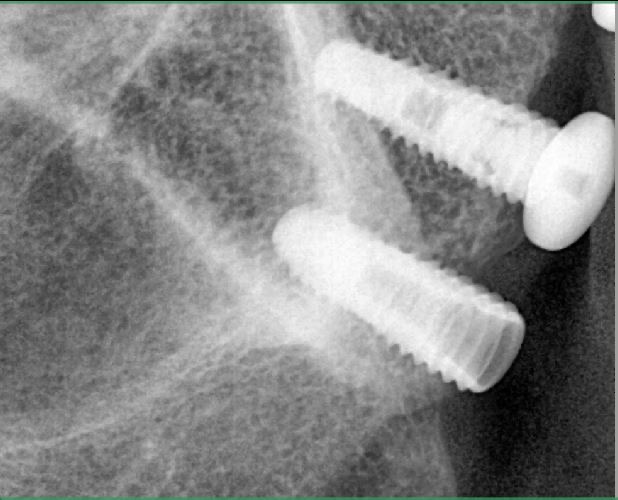
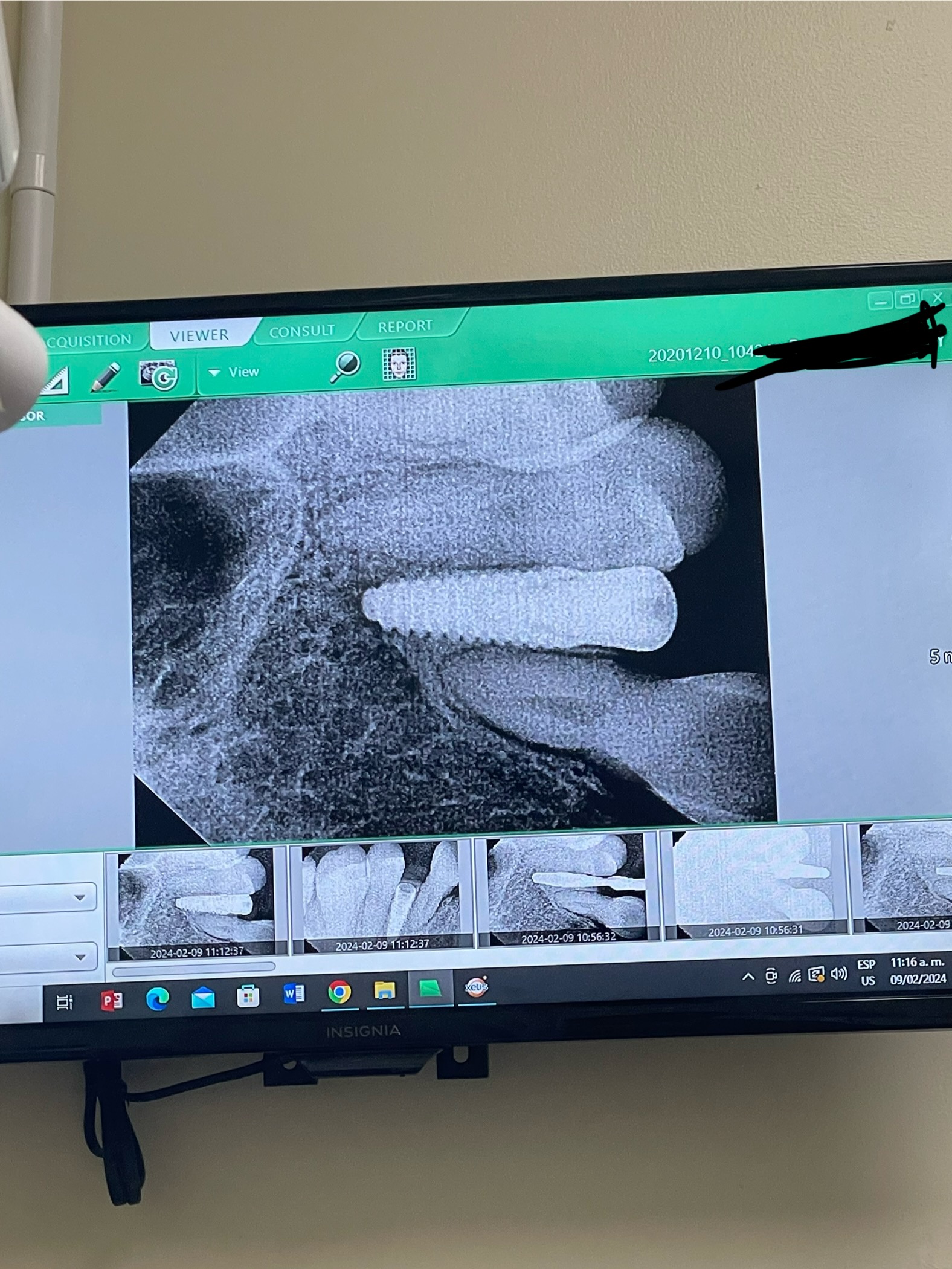
All-on-4
Dr. S. asks:
There have been numerous advertisements promoting treatment plans based on the all-on-4 implant systems. When I first started restoring implants, the strategy was for the implants to be placed perpendicular to the plane of occlusion. This was supposed to result in more favorable transmission of forces to the implant and surrounding bone. This was also supposed to transmit the occlusal and lateral forces to the implant restorative system so that there would be less unfavorable force on the abutment and abutment screw and was supposed to result in decreased incidence of abutment or screw fracture or abutment screw loosening. With the all-on-4 design, the terminal abutments are tilted at a 30 degree angle from mesial to distal, thus extending the length of the metal framework that can be supported. So have the laws of physics change or do we just know more about implant restorations now. I have seen a ton of articles in the peer reviewed literature supporting the use of all-on-4 design. But what do you experienced practitioners who have used the system say about its longevity and durability?


Featured Courses
>>More Online Implant Courses

FREE Webinar: Dental Implants and Bone Grafting in the Esthetic Zone
When: 12/02/09
In this one-hour FREE Webinar, Dr. Michael Tischler will outline the published parameters of successful placement of dental implants in the anterior maxilla, the most challenging area of the mouth to restore missing teeth and bone.
>>Learn More and Register Now!

39 Responses to “ All-On-4 Implants System: Longevity and Durability? ”

  • JPDemajo October 6th, 2009

    Over the past 2yrs I have done around 10cases using the All-on-4 system. In my opinion the system works very well. It has both advantages and disadvantages. Main advantage is missing the sinus or mental nerve but a disadvantage is the angled abutments which although help with the easiness of fit are very expensive. I feel more confident doing an all-on-6 as opposed to four. Bone loss levels are minimal irrespective of the angulations. I think screw loosening occurs more often using the multi-unit angled abutments because the screw is a short one as opposed to the large screw down the centre of the implant itself. On the whole very happy with results, will keep on using all-on-6 design, 4not so much unless the patient has opposing complete dentures or is a small frail patient.

  • Gary omfs October 6th, 2009

    Using co-axis implants (Southern implants) you don’t need expensive multi- unit abutments, just the regular. I have referring dentists who even use locator abutments for an overdenture on 4 coaxis implants in the maxilla… seems to work well. This is the cheapest overdenture I can imagine.

  • Don Callan October 6th, 2009

    The laws of physics have not changed. The restorations on implants should be much like natural teeth. Look very closely who funded the articles and the author. Call the authors and speak with with them personally.

  • Dr. Robert Schroering October 6th, 2009

    I have performed 238 “all on 4″ procedures to date. this is all within the last 3.5 years (spring 2006). I was at first extremely skeptical of the procedure, before I listened and learned about the science. The procedure has well documented success over 10 years. Bo Rangert, a PHD in Mechanical Engineering, helped develop the technique. Dr. Bo Rangert also wrote the book on why implants fail. “Risk Factors in Implant Dentistry: Simplified Clinical Analysis for Predictable Treatment, Second Edition”

    Author(s)/Editor(s): Renouard, Franck, DDS / Rangert, Bo , PhD)

    I trust his understanding of physics much more than some of the so called experts who base what they know on opinion rather than science. I have great success and offer this as a lower cost technique for those who desire immediate teeth (90% of the time I can immediately load these cases) without grafting and I have a much more esthetic result.

    For those who are critical of the technique they just have never looked into the science. One of my favorite quotes is from Albert Einstein.
    “It is what we think we know that stops us from knowing more”

    I am glad I finally looked into the science of the technique. Granted, their is a Paradigm sift that must occur. I am glad I stopped listening to the opinions of some speakers and I can know offer a great low cost treatment option to many of my patients.

    Personally, I am glad some of my neighbor colleages have not accepted this because it keeps my partner and I very busy. When they finally do, we will have more competition.

    I am grateful I can perform this procedure and highly recommend this to any dentists looking for a better way to treat their patients.

    Robert Schroering DMD

  • Gerald Rudick October 6th, 2009

    With all due respect to the above clinicians, and no doubt vast experience; I would personally be very cautious in supporting a 14 unit bridge on 4 implants.

    None of the above authors have specified the type of fixed bridgework, but only mention a metal framework.

    If the framework used is to connect to the implants and reinforce a good lab processed plastic splint, I might be inclined to take a chance, with a very understanding patient….however, if the superstructure is built of precious metal castings and porcelain, I might shy away from this technique, because if any one of the 4 implants fail, the entire prosthesis is money down the drain for the patient, and potential legal problems for the dentist.

    What ever happened to hybrid solutions built on 4 implants… easier to sleep at night… for the dentist!!!

  • sb oral surgeon October 6th, 2009

    My point exactly Dr. Rudick.
    All on four works, we know that. What happens if you lose one fixture - we all know this can happen despite perfect surgery and prosthetics.
    Here you have a useless prosthesis and a pt without many options for temporization.
    My quetsion to experts in all on four like dr schroering- what happens if you lose a fixture? how do you fix this? what works in your experience?

  • Mike Heads October 7th, 2009

    Oh yee of little faith. Dr Schroering was right. You can always find reasons not to do an All on 4 but once you can find a reason to do one the avenues open to you to treat your patients better is incredible. I appreciate it is difficult to understand but belive me it works, it has (in my hands)a higher succes rate (even for immediate loading) than normal implant placement.

  • Dr. Callen: RIGHT ON!!

  • Doc Tomy October 7th, 2009

    I am newbie to all on 4 but been to alot of CE about it. I understand Nobel active implants are way to go for maxilla (Any Suggestions) or can I use up my stock of Replace tapered which are expiring as we chat. I am not getting alot of treatment acceptance with it (cost????recession???Obama? ME:)

  • R. Stanton October 7th, 2009

    I will only do fixed on 6 and usually place 7 just in case one fails (99% success so far) but if finances limit, I do an open overdenture on 4, looks great (use top shelf teeth), functions well, pt’s love them, I sleep better, still a good $ maker for me. If one fails someday, can still use the denture on 3 while 4th is redone and denture can be easily relined to pick up redone 4th (haven’t needed to do this yet but the convenience of knowing I could is another reason for this restorative choice)

  • Brian Kucey October 7th, 2009

    Folks: You seem to be missing the point. All-on-4 is an entry level treatment designed to reduce costs for the patient. The original idea was to eliminate the need for any metal (PIB) framework and to connect the fixed bridge (denture) using metal temporary cylinders. This works well if you have a sufficient occlusal-gingival height prosthetically with a minimal cantilever length opposing a complete denture. If not, you will have prosthesis fracture which can cause damage to the terminal angulated abutments. The surgery is not a simplified version of the Branemark Classic technique but a modification of many years of observation. It works fine in experienced hands who understand all aspects (including lab). I have had to build PIBs in 2 cases where there was repeated prosthetic fracture. Remember to tell your patient that when the prosthesis is worn out, it is a total replacement if there is no PIB framework.

  • Dr. Robert Schroering October 7th, 2009

    I will try and answer a few questions since my last post. The “all on 4″ is not porcelain fused to metal with 14 teeth on 4 implants. It is a PIB framework with 4 to 6 implants and denture teeth to the first molars only. (a total of 12 teeth)
    One previous post stated.

    “What ever happened to hybrid solutions built on 4 implants… easier to sleep at night… for the dentist!!!”

    This is what an “all on 4″ or 4 plus one or two more implants, is all about.

    Not to be critical, but most people just do not understand the concept and they believe it cannot work. I understand this, because I had the same opinion before I went to a two day course to understand the principles. I have over a 99% success for 238 cases after the final prosthesis has been placed. I have only lost 3 implants after the final prosthesis. The patients did fine on 3 implants until I could replace the lost implant. I then luted this implant back into the PIB denture prosthesis, saving the patient from incurring anymore cost. Something you cannot do with porcelain fused to metal crown and bridge.

    I ask a similar question. What do you do with any full arch prosthesis when you lose the distal most implant. You replace the implant and redo the porcelain fused to metal. If it is a traditional “all on 4″ PIB with denture teeth attached, you do not need to replace the prosthesis, but lute this back into the framework.

    There is a reason the Clear Choice invested millions of dollars to establish 17 full service dental centers around major cities in the US. Believe me, it is not because the “all on 4″ does not work. It is because it does work and works very well.

    I know it is hard to change. Branemark is a great example. He stated the machined implant was the only surface to use. Until Nobel bought Sterios and the roughened surface implant became the only surface to use. It is amazing how quickly opinions can change.

    Dr. Rob Schroering

  • Are there any valid 10 year survivor rate studies for the all on four, that have been published but not by the hired guns?

  • Dr. Robert Schroering October 11th, 2009

    Richard,

    Most any article in a reliable journal has been reviewed before being published for it’s authenticity and validity. Here are a few articles to answer your questions.

    Evolution of the concept of angulated abutments in implant dentistry: 14-year clinical data. Sethi, A, Kaus, T, Sochor, P, Axmann-Krcmar D, Chanavaz, M. Implant Dent. 2002;11(1):41-51.
    This study is with 3,101 implants with an average observation time of 10 years.

    Rosen and Gynther J Oral Maxillofac Surg. 2007
    This long-term follow-up study (mean time, 10 years) demonstrates that patients with a severely resorbed maxilla can be treated successfully …This simplified surgical technique can be an alternative to the more resource-demanding technique with bone grafting
    Each patient was examined clinically and radiographically. 97% implant success rate.

    I would suggest going to Nobel’s web site and click on research. There are over 90 articles about immediately loaded cases. They are not all Nobel articles, but other companies articles as well. 40 deal with full arch lower immediate load and 13 with full arch maxilla.

    There are too many articles to name. I think when you really look at the research you would understand the benefits of this system.

    Rob Schroering DMD

  • Bob, Thanks

  • Henning Visser October 14th, 2009

    I just need a bit of clarification. What is a PIB? Dr Schroering mentions that; “if it is a traditional “all on 4″PIB with denture teeth attached, you do not need to replace the prostesis ,but lute this back into the framework”. Noble Biocare has a Porcelain Implant Bridge called a PIB. It is a costly Zirconuim frame on which porcelain is fired in the lab.This zr frame is fabricated using the CAD-CAM technique.

  • Carl Misch,DDS, MDS October 15th, 2009

    “All on 4″ means “None on 3″. If 100 implants supported 25 fixed restorations (4 per arch) a 80% implant survival could affect 20 out of 25 prosthesis, (if each failure was in a different arch). If 8 implants were used in each arch, a 87% implant survival would be enough for all arches to have a fixed prosthesis.

    Therefore, since “all on 4″ has higher risk than “all on 8″, the Doctor should charge twice the price for “all on 4″, to compensate for the complications and treatment required. In addition “all on 4″ often requires cantilevers and/or long options. Both situations increase prosthetics complications of screw loosening, fracture, etc. In short - use more implants and you will save the patient and your aggrevation and therefore you can charge the patient less money.

  • Ryan October 15th, 2009

    Carl - I think that’s very well put. No bashing to those who successfully use the technique - I’m just not sold on it for every situation.

    I recently finished a case where the patient came for a second opinion from another practice with upper/lower all-on-4 same day treatment plan. We instead opted for a lower 6 implant design with immediate provisional and traditional ‘low water’ type fixed bridge. Upper was a hybrid design on 4 implants. Even with CBVT we still found an unexpected amount of fenestrations and defects on the upper which necessitated delayed placement and a conservative approach to loading. He has also had complications with one of the upper fixtures. The upper has finally been restored.

    The patient said it best when we were done: “Even though it took extra time, I’m glad we went this route. I can see now what you were saying - if just one of those implants came apart, i would have lost the whole top bridge and had to start over…” I think that was kinda your point too…

    thanks for all of the great articles and books.

    Ryan

  • Dr. Mehdi Jafari October 15th, 2009

    Carl Misch is a great teacher and he is right about All-on-4 technique.Whatever he says, we can see in the clinic by ourselves.

  • yk October 16th, 2009

    i love it when a leading clinician knocks the all on 4. that way there is less competition for me. since i’ve been very happy doing the procedure for the last two years .

  • Dr. Alex Zavyalov October 16th, 2009

    I support Brian Kucey’s point of view that this system works well only when anthologists are complete dentures, which cannot load unnaturally angulated implants too much.

  • Bill Schaeffer October 17th, 2009

    Wow, Carl Misch - are you suggesting that you only get an 80% implant survival rate i.e. a 20% failure rate of your implants. Otherwise why would you suggest this should be used as the failure rate?

    Carl - lies, damn lies and statistics eh.

    Just for your information, All-On-4 does NOT mean None-On-3, as I have posted on this site before. It is generally rather easy to dismiss an idea or technique before you’ve taken the effort to learn about it properly. It often becomes harder once you’ve realised it works.

    Bill Schaeffer

  • Bill Schaeffer October 17th, 2009

    Sorry Carl, I get it now.

    You want to justify charging for 8 implants per arch and that that is really good value for money for the patient - ahh, it all makes sense.

    What was it someone once said? “Just follow the money!”

  • Carl, Excellent points and well stated!

  • Bill Schaeffer October 18th, 2009

    Richard Hughes DDS, FAAID, FAAIP, Dipl.ABO/ID,

    Why is what Carl Misch said excellent and well-stated?

    His statistical proposition is utter nonsense. It is a ridiculous suggestion. Why would any knowledgeable clinician, (regardless of what they thought of All-On-4), say that nonsensical statistics is excellent and well-stated?

    Bill Schaeffer, BDS, MBBS, FDS RCS Eng, MRCS Eng, and cub-scout badge for keeping my bedroom tidy

  • Robert J. Miller October 18th, 2009

    Bill - Your comment is well stated. If there is, in fact, a 20% failure rate in this modality, then it would call the whole paradigm into question. But nowhere in the literature have I seen anything approaching this figure for all-on-four. We can make the same statement for posterior terminal abutments on implant bridges. If you lose those implants, you lose the fixed segment in that quadrant. If you were to lose an implant in all-on-four, an overdenture can be fabricated. An additional implant can be placed again if desired. This is not an all-or-nothing phenomenon.
    One last thing…only Eagle scout credentials can be posted on this site!
    RJM

  • califgp October 18th, 2009

    Wow, alot of anger towards anyone who disagrees with a new method. Makes one question if the method is all that good in the first place, especially since there are limitations to All on 4, as even some big users seem to admit to.

    Anyway, can someone address Dr. Misch’s other point, which all the ardent supporters, have all conveniently ignored:
    “In addition “all on 4″ often requires cantilevers and/or long options. Both situations increase prosthetics complications of screw loosening, fracture, etc.”

  • Bill Schaeffer October 18th, 2009

    Hey Robert, it’s been a while - Florence last year if I recall correctly.

    You’re quite right about All-On-4 not being none-on-3 but it’s even better than you suggest.

    If one of the two middle implants fails to integrate, you keep the temporary bridge exactly as it is, except supported by 3 integrated implants, and you merely replace the middle implant.

    If one of the two distal implants fails to integrate, you reduce the length of the temporary bridge on that side, (just cut through the acrylic), and replace distal implant.

    At no time does the patient have to wear a denture again.

    For anyone who’s itching to post that “no bridge should only be supported by 3 implants!” - just remember that these are now 3 fully-integrated implants. When the temporary bridge goes in at the beginning of treatment (i.e. when the 4 implants are initially placed) it’s not sitting on any fully-integrated implants. And yes, they are told to go easy on it!

    As for Carl’s nonsensical-statistics, he knows better than that! He’s a whole order of magnitude out!

    Kindest Regards,

    Bill

  • Bill Schaeffer October 18th, 2009

    Calif - no anger towards anyone who disagrees and I’m sorry if that’s how it’s come across. I merely get frustrated when people who should know better, make silly statements as if fact - frankly, I was rather bemused by Carl’s suggestion of a 20% failure rate for implants (those pesky decimal points really are a nuisance!)

    As for;

    “In addition “all on 4″ often requires cantilevers and/or long options. Both situations increase prosthetics complications of screw loosening, fracture, etc.”

    Absolutely, you utilise cantilevers. In my practice, we use a milled titanium beam for the bridge. VERY rigid and light and the fit is immaculate. Does anyone have a concern about cantilevering back a unit off something as strong and rigid as this?

    I’m not sure what a “long option” is. I guess he means a long-span bridge. The most common bridges my patients choose for All-On-4 cases are milled-titanium beam with an acrylic wrap (acrylic teeth and gum). Easy to repair if chipped.

    If a patient chooses to have porcelain then the “gum” is made of composite and the titanium beam is milled with individual “cores” for each teeth. It’s expensive (though way less than 8 implants!) to make but if a “tooth” gets chipped you just replace the one tooth.

    Screw-loosening is simply something I rarely ever see. I guess that’s because of the fit and rigidness of the underlying titanium beam, or maybe it’s because I have half as many screws to loosen ;-)

    Is All-On-4 that you immediately load always possible? No. In just the same way that any technique is not always possible (even getting 8 implants into a jaw).

    Is All-On-4 the only option for a full-arch? Of course not. I’ve restored full-arches with 8 implants (four 3-unit bridges), and with 6 implants (both as a single full-arch bridge and in smaller units) and the usual way I restore them now is with an all-On-4 that I load with a temporary bridge the following day.

    Once again, when people tell me that All-On-4 doesn’t work it is frustrating because I use this technique regularly and I KNOW it works.

  • califgp October 18th, 2009

    Thanks Bill. This is an excellent response and addresses alot of issues.

  • Bill, Goody for you. One is less likely to have long term problems with an over engineered case. I do not know how long you have been involved with implant dentistry, but do remenber to over engineer. You will rarely be sited for to many implants!

  • Bill, It’s your practice and your patients. You will figure it out with time!

  • Bill Schaeffer October 19th, 2009

    Dear Richard,

    I have previously stated that I used to do things exactly the way you do them - with 6 or 8 implants per arch. Now I usually place just 4.

    I’ve done it your way and it works. I’ve done it on 4 and it works.

    I am not suggesting that you shouldn’t place 6, 8, 10 or 12 implants per arch. I am merely stating (from the perspective both of my own experience and that of published research) that you can also do it on 4.

    I’ve done it both ways - they both work. To say it doesn’t or won’t is incorrect. I remember people saying the same things about one-stage implants, immediate loading of implants and short implants and look how that turned out.

    As you so eloquently put it - Richard, it’s your practice and your patients. You will figure it out with time!

    Have a great day.

    Bill Schaeffer

  • Dear Bill, I do agree with you. One can restore people with only four implants. This depends upon a number of issues. Sometimes you need more!

  • osseonews October 20th, 2009

    We’ve just posted a new All On 4 Case in the Case section. Click Here to see the case.

  • Dr Kimsey October 20th, 2009

    I can’t but anticipate that the pure Ti implants used in the all on 4 technique will suffer from metal fatigue and fail after cycling enough.

  • Antonio Coppel,DDS, Spain October 24th, 2009

    Dear colleagues, those of you who haven´t done yet an all-on four procedure should try it before questioning it.
    We have done more than 60 cases in the last 3 years, many of them with a computer guided minimally invasive procedure, with 3 implants failed before loading. They were replaced before the placement of the final restoration. No implant failures post loading!
    Remember the final restration is metal-resin. The resin acts as a shock absorber.
    This treatment we offer to those patients with a severe maxillary and/or mandibular atrophy. Therefore almost no alveolar bone.
    Choose the correct restoration for each case!

    A. Coppel, DDS, Madrid-Spain

  • RMEE November 9th, 2009

    It has to be understood that the All on Four procedure was developed, according to Nobel for “Financially challenged patients.” Which means patient who can’t afford a full mouth restoration or bone grafting procedures. It is not meant to be a replacement for traditional implant therapy which many times involves bone grafting, and many more implants, and expensive high end restoration. All on Four is a procedure that increases the function for many patients who can’t afford a full mouth reconstruction. I think it has to be noted as well that Dr Misch is in fact a paid consultant/speaker for a competing implant company to Nobel Biocare. Therefore his comments which were not based on any known clinical data or studies should be looked upon as somewhat biased.

  • Bill Schaeffer November 10th, 2009

    ” It is not meant to be a replacement for traditional implant therapy which many times involves bone grafting, and many more implants, and expensive high end restoration. ”

    RMEE - I absolutely use it as a replacement for “traditional” implant therapy.

    It is NOT an issue about money. I used to do the whole graft, place, wait protocol for my full-arches, using 6 or 8 implants per arch.
    Now I just use 4 - even if they’ve got “buckets of bone” and “money’s no problem” - and load them immediately.

    All-On-4 works.

    I have no financial interest in ANY implant system or product other than that I place a lot of them.

    Kind Regards,

    Bill Schaeffer

    p.s. as for Dr Misch’s comment on this thread, the best I can say about that is that he must have been having a bad day!


Leave a Comment

Comment Guidelines: This is a forum for dentists for intelligent discussion. No insults. No outside links. No promotional comments. Though we require an email to route questionable comments to our editors, we will NEVER publish your email. Patients: Please do NOT post dental questions here. Instead Ask Us or Find a Local Dentist.


Note: At times your comment may not appear on the website immediately, because it has been sent to our editors for approval. Once approved, we will publish the comment. There is NO need to resubmit your comment, if it does not appear on the website immediately.