CT Scanning: Data, Planning, Training
Dr. Scott Ganz is a maxillofacial prosthodontist who has pioneered the development of CT scan use in implant dentistry. He maintains a private practice in Fort Lee, NJ and is an Associate Clinical Professor of Prosthodontics and Implant Dentistry at the College of Medicine and Dentistry of New Jersey.
Osseonews: What are the most significant diagnostic data that a CT scan provides?
Dr. Ganz: A CT scan yields the most accurate information about four critical factors in treatment planning for implants. A CT scan enables the dentist to quantify the quality and quantity of bone available. How much Type I bone, Type II bone, etc. with highly accurate quantitative measurements before the scalpel ever touches the patient. The patient may present with an apparent acceptable quantity of bone on a panoramic or periapical radiograph but the actual quality of that bone may be less than desirable for placing implants. A CT scan also provides a very accurate reproduction of the bone morphology in all dimensions. After diagnosing the CT imaging data, implant receptor sites are chosen to maximize your chance of success. It also shows you exactly where you may have a problem with an anatomic structure, such as proximity to the inferior alveolar nerve or a septum in the maxillary sinus.
Osseonews: These data would then be essential for treatment planning to maximize the success of the placement and rehabilitation.
Dr. Ganz: Absolutely. I cannot imagine treatment planning without the aid of three-dimensional CT scan information to guide me to make proper decisions for my patients.
Osseonews: You have also emphasized that treatment planning should be based on an evaluation of each patient on an individual basis.
Dr. Ganz: One of the problems I see is that there are many formulas or cook-book approaches to treatment planning for implants. You know, like so many implants are required to replace so many teeth or how many implants are necessary to support a particular kind of prosthesis. Most of the decisions have been made based upon anecdotal data, and not on a pre-assessment of the patient’s own existing anatomy prior to the surgical placement of the implants. Therefore one must be able to interpret these guidelines in light of the quantity, quality and morphology of the bone. You cannot accomplish that with any degree of accuracy without a CT scan.
Osseonews: Getting back to your unique guideline, “It’s not the scan, but the plan” the CT scan is just the beginning.
Dr. Ganz: That’s right. Prior to the CT scan, a scan appliance should be fabricated that encorporates a radiopaque substance like barium sulfate to represent the desired position of the final restorative result. The CT scan then can provide you with the information you need to develop the treatment plan, giving you the ability to assess the tooth position against the residual bone. You must know how to read the CT scan and how to apply the information it yields to your analysis and the fabrication of a surgical template derived from the CT data.
Osseonews: So a panoramic radiograph would not be able to provide nearly as much information as a CT scan.
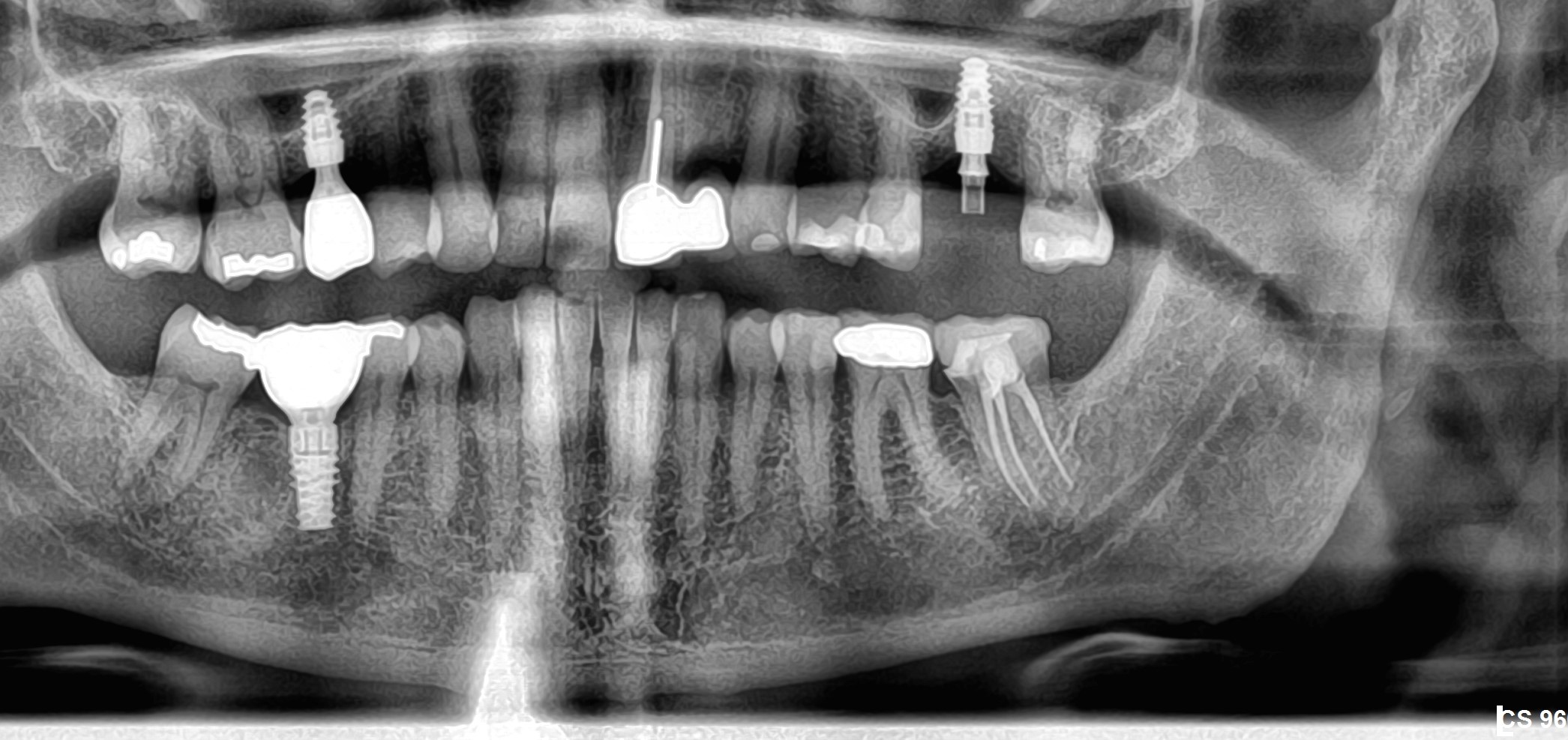
Dr. Ganz: A panoramic radiograph has been proven to have an inherent distortion factor which varies not just by the manufacturer, but within the scope of the radiograph itself. For example, is the distortion 25% in the anterior mandible? Not necessarily because this distortion factor varies and can result in a potential distortion factor of over 7mm! That distortion can be equivalent to the length of an implant! This two-dimension imaging technology cannot compare in any way with the information provided by the three-dimensional representation of the patient from a CT scan.
And when we are discussing immediate loading applications, wouldn’t be great to know all you can about the bone and all of the best locations for each implant prior to the surgical phase? Teeth-in-a- day, or teeth-in-an-hour – how can this be accomplished without thorough pre-surgical prosthetic planning? The confidence gained through advanced diagnostic imaging technologies and treatment planning will enable all of us to do an even better job of treating our patients.
Osseonews: How would you recommend dentists obtain the required training and knowledge in ordering and reading CT scans?
Dr. Ganz: The information that can be gleaned from a three-dimensional image of a patient’s mandible or maxilla is a wonderful teaching tool on its own – even without planning for implants. We can detect fenestrations, sockets that have never healed, pathological entities, poor bone quality. We can also identify cases which are unsuitable for implant restoration or should be referred to a specialist with more advanced training and experience.
Learning about CT is becoming easier. There are courses given around the country and internationally on how to use CT, how to use Sim/Plant, how to fabricate surgical templates based upon CT scan data, etc. Recently one of my concepts became a reality in the formation of the Simplant Academy – an educational component dedicated to raising the level of knowledge for clinicians interested in CT imaging. Their website is www.simplantacademy.org.
Implant companies have started to finally realize the importance of CT and are offering courses and educational events to inform clinicians about their solutions. Organizations such as the Academy of Osseointegration, the International Congress of Oral Implantologists and the American Academy of Implant Dentistry all can serve as resources to learn more about these exciting innovations. Also with the introduction of Cone Beam CT scans, the machine manufacturers have proprietary software solutions to aid in the diagnostic and treatment planning phases. Teaching centers in various parts of the United States have purchased these machines and are now incorporating this technology into their curriculum.