FDK Algorithm to Compensate for Distortions in Cone Beam Volumetric Tomography Images?
Dr. Y asks:
I am carrying out research on cone beam volumetric tomography image reconstruction.
I have read some articles about the using the FDK algorithm to compensate for artifacts or distortions in imaging. [Ed.: An error-reduction-based algorithm for cone-beam computed tomography Kai Zeng, Zhiqiang Chen, and Li Zhang. Med Phys. 2004 Dec;31(12):3206-12]. Is this the method employed by radiologists to produce a more accurate, distortion or artifact free reconstructed image? Can anyone assist me with this?
4 Comments on FDK Algorithm to Compensate for Distortions in Cone Beam Volumetric Tomography Images?
New comments are currently closed for this post.
Horst Bruning
10/28/2008
DearDr. Y:
the Feldkamp algorithm, which is widely used in cone beam tomography, generates a geometrically correct 3D image. Distortions or artifacts may occur in the gray scale or density information in certain regions, but the geometric correspondence between locations in the patient and voxels in the image is very accurate.
serge goldmann
10/29/2008
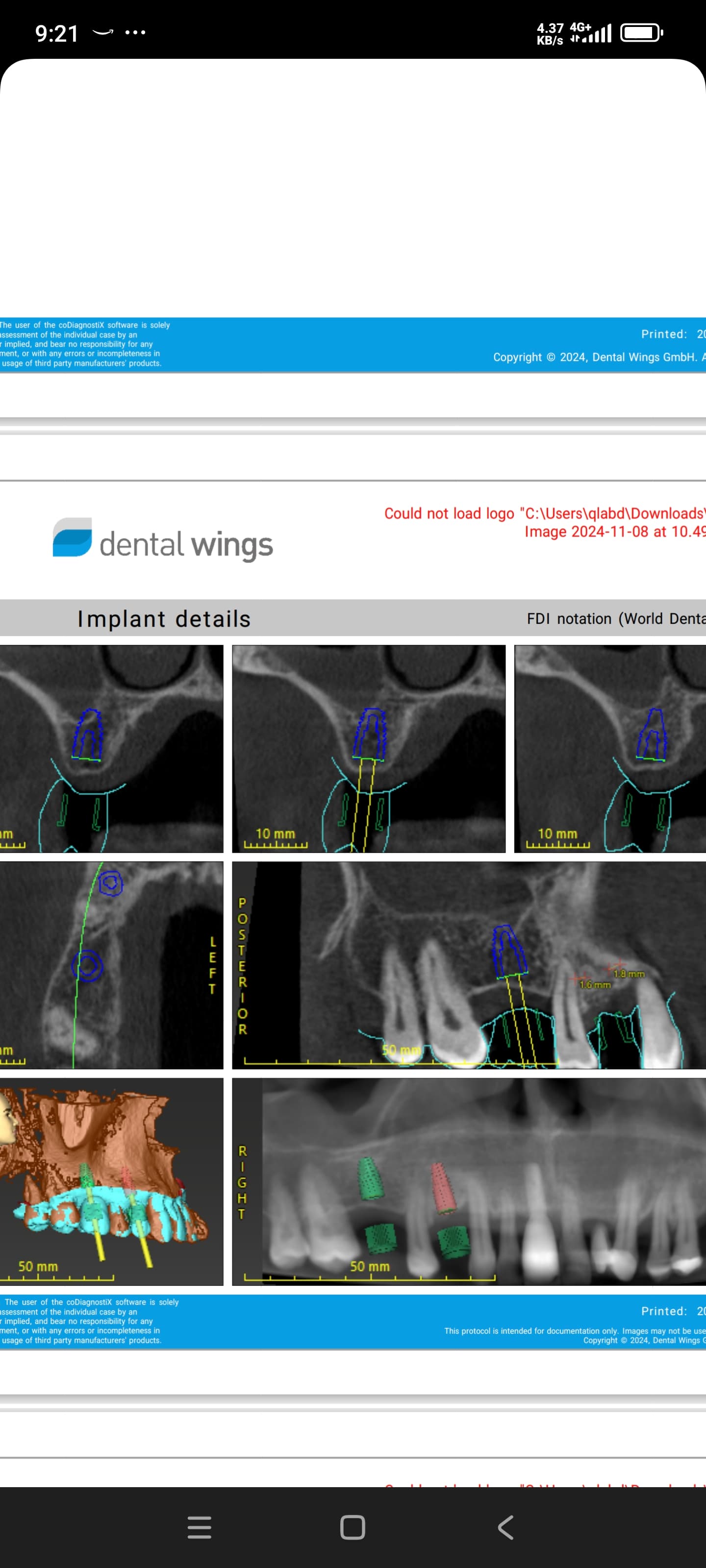
I my experience, i have consistently more place (length) to put my implants than expecting by cone beam. it seems that in the programm exists a security factor, (perhaps from the company not to be sued in case of problem?).does anyone have some insights about this?
Mike Stanley, asst.
10/30/2008
I did a quick & dirty check in our (First Generation) iCAT software.
I measured the distance between two points along a normal "Oblique" curve drawn on a mandible. Then, I moved a curve point of the Oblique line about 30mm and found that the original measurement did not change.
So.... the software is establishing the measurements from a larger dataset than just along the Oblique curve lines that I draw. It seems to be a "3D space" measurement. I had assumed that it would give the measurement along the curve.
As for accuracy and distortions, that is beyond my calculus level.
Kris Hermans
3/12/2009
FDK reconstruction can be together with p-matrices. These matrices provide spatial information on imaging source and dectector for each individual projection during the acquisition.
CBCT imaging system are actually quite sensitive to many forms of for mechanical instablilities (e.g. detector wobble). With p-matrices some of these can be compensated for somewhat.