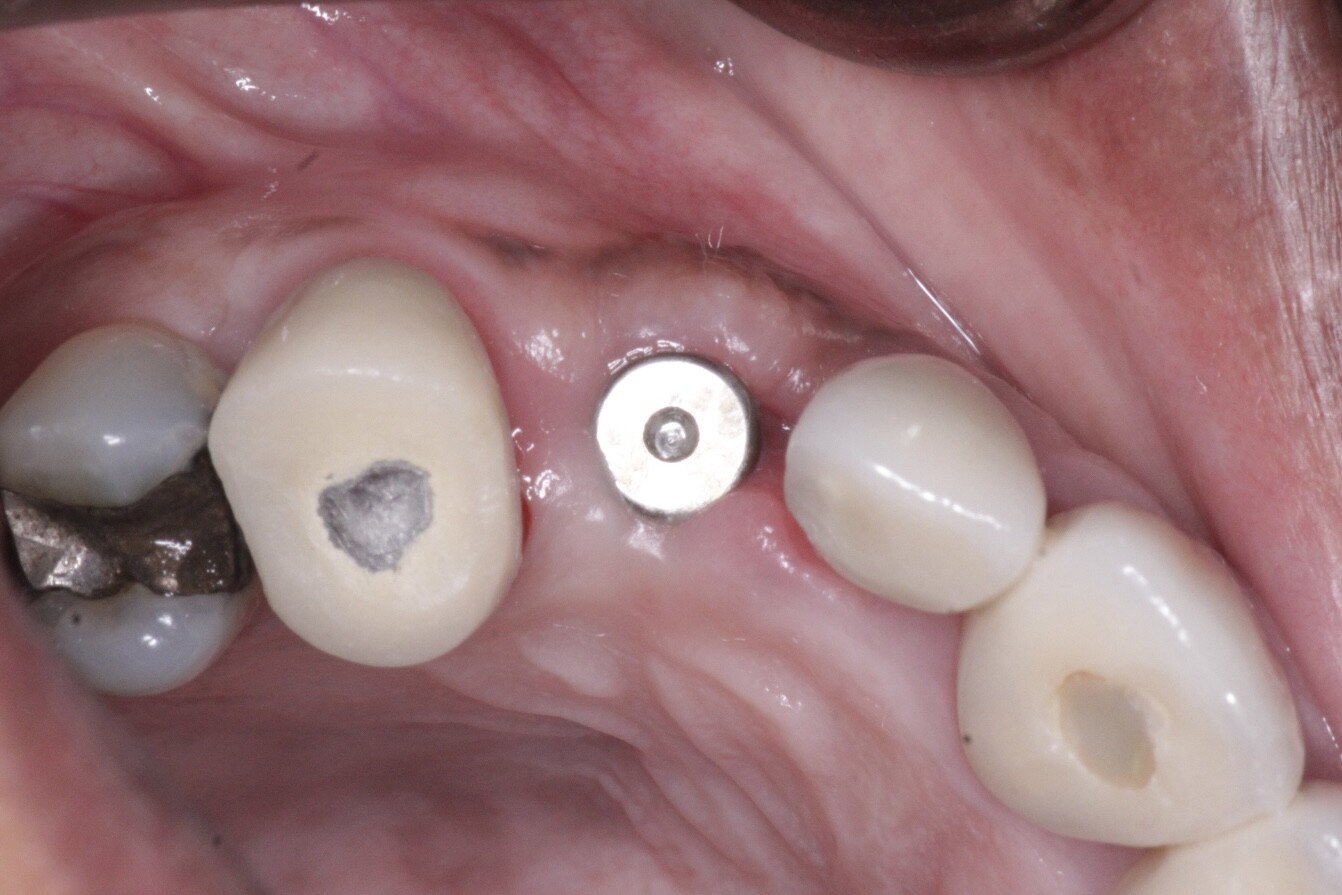
Large Defect in the Labial Cortical Plate
Anon. asks:
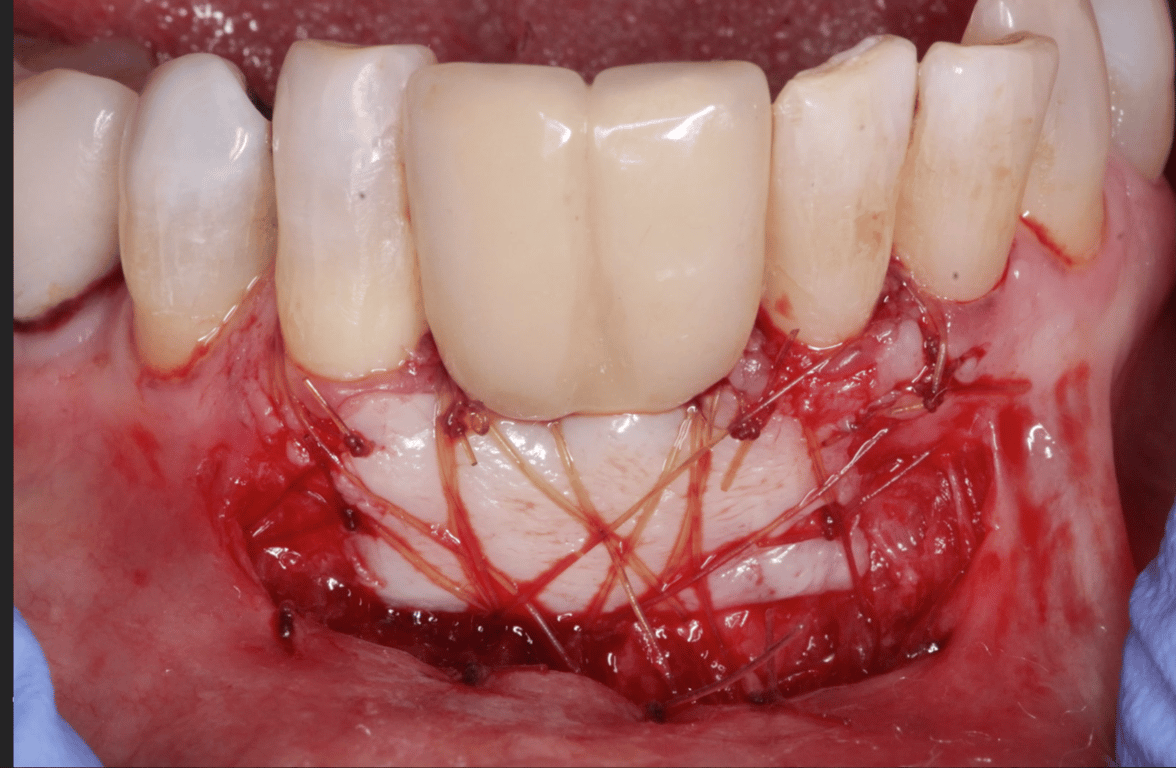
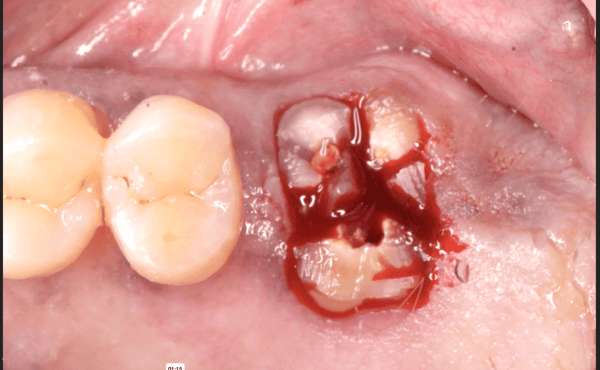
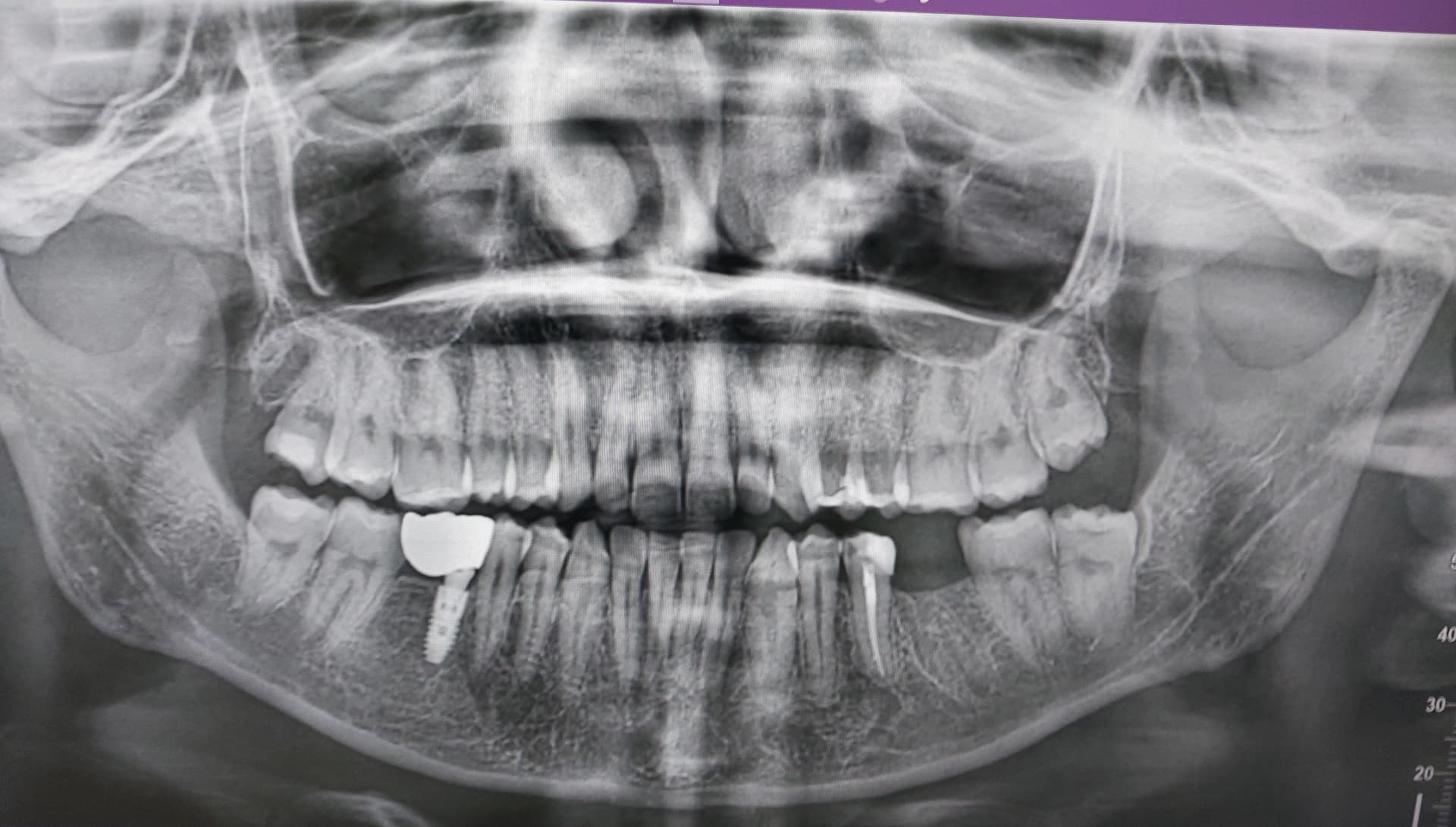
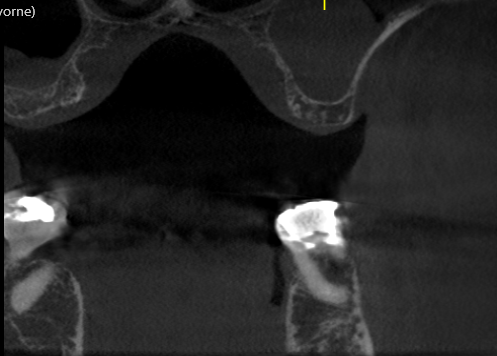
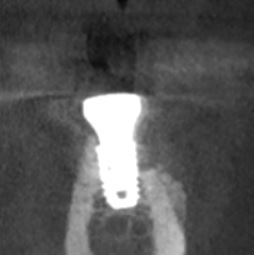
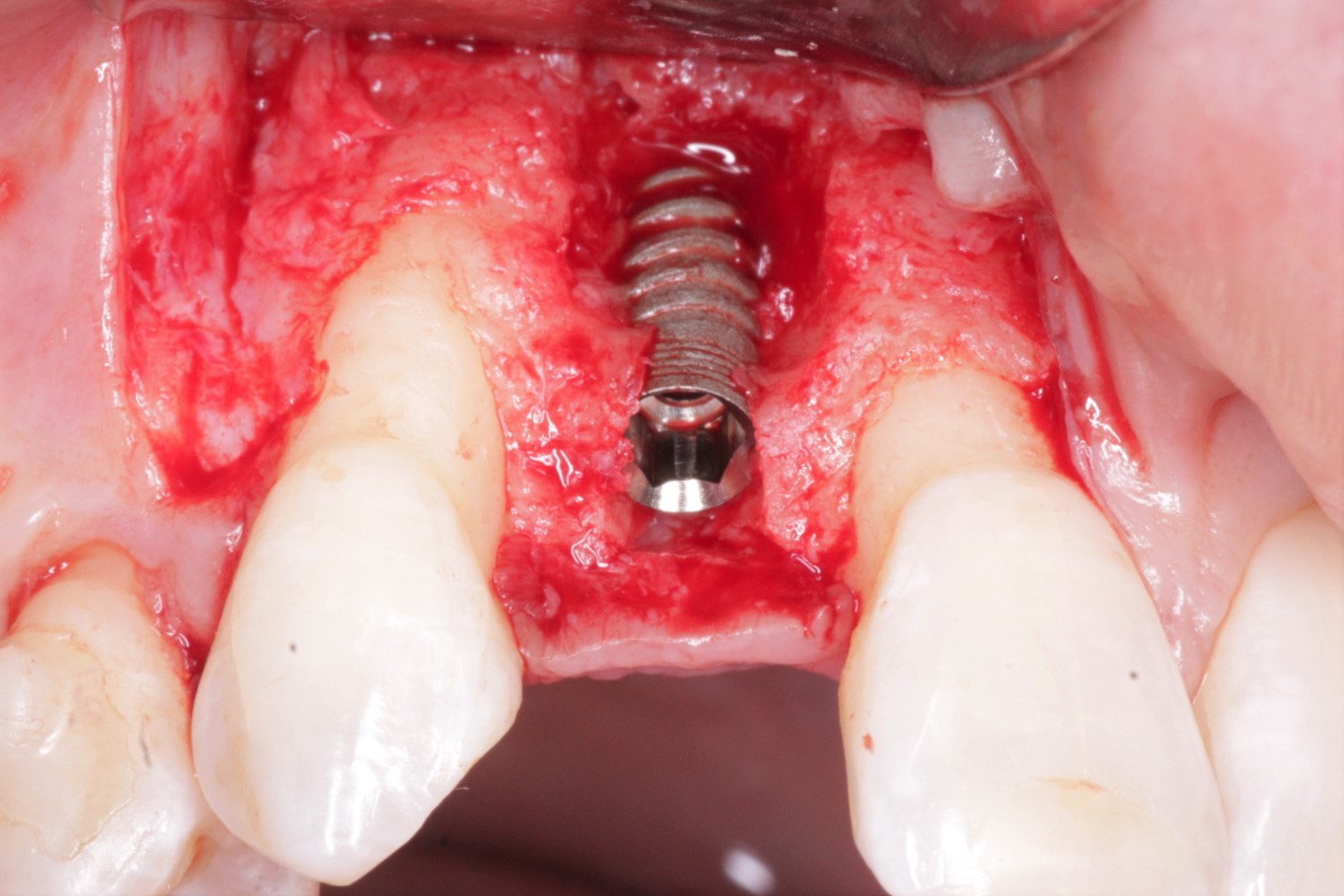
I placed 2 temporary dental implants immediately after extracting the lower 4 incisors. During the extraction procedure, the labial cortical plate of the left incisors separated with the teeth. This created a very large defect in the labial cortical plate. I therefore decided not to place the permanent implants. I felt that 2 temporary implants would provide for patient comfort and allow the area to heal.
After 2 months, I reopened the flap and removed the temporary implants and grafted the site with Bio-Oss. How long should I wait before going in to place the permanent implants? Any other thoughts?
39 Comments on Large Defect in the Labial Cortical Plate
New comments are currently closed for this post.
Dr SDJ
6/16/2008
I have heard Bio oss takes a long time to turn over into bone.
Eric Wallace SBOMS
6/16/2008
How did you graft the defect. I have seen a lot of inexperienced guys laying flaps, onlaying a 1-3 mm layer of Bio-oss and then closing. This is not a guided bone regeneration or a ridge augmentation. I you wait 6 months and go back, you will find very little incorporated bio-oss. In fact, most of it will raise up in the flap. Did you use a membrane, did you tack the membrane, did you score your periosteum to allow tension free closure. I'm not sure what the defect was, was it the two small holes from the temorary implants? In my experience, and I don't have grey hair yet, these onlay procedures are consistently underwhemlming. You may get away with it beacaue you can use very narrow implants.
I would have grafted the extraction area at the time you lost the buccal plate. The patient could have worn a flipper. Extraction sockets are very biologically active. I would have gone big here, used a combo of Bio-oss and mineralized allograft, placed a membrane, and skipped the temp. implants. Just a thought.
JW
6/16/2008
I agree with Eric, although it's too late for you now...next time. As tough as this is going to hear, my recommendation would be to refer this to a periodontist or OMFS for a ridge augmentation with block or membrane, unless you can do this yourself. I have gone back 18 months after placing Bio-Oss and found HUGE chunks of that stuff still there, it resorbs so slowly. I have moved away from it unless it's in the sinus or mixed with autologous. Eric and I have seen a lot of the same thing...when you lift that flap up, there is going to be a huge chunk of fibrous CT/Bio-Oss peeled back. Good luck
Dr. Ben Eby
6/17/2008
I have almost completely gotten away from any HA materials for grafting, expecially by themselves. My experience is that even when set up, it is brittle compared to bone, and you may have to remove unchanged particals that could leave you with a larger defect than when you started. Autogenous bone, mineralized allograft, grafton putty or Dynagraft II, and several other graft materials, with a good membrane, have worked well in my hands(I like to use AlloDerm, if I want thicker attached gingiva).
Dr SDJ
6/17/2008
Dear Dr Ben you seem to mention Mineralized Allograft not Demineralized as is the norm . Which brand is it and why do you prefer this.
steve c
6/17/2008
I agree entirely with Eric in that grafting is best accomplished at the time of extracton using a combination of Bio Oss and Cortical crushed allograft or autogenous bone under a double layer secure resorbable membrane. Bio Oss alone is not likely to provide the type ridge you need for successful implants. The only time that I may use Bio Oss alone is in a smaller sinus augmentation or a socket with intact or nearly intact walls. In other words you need good containment of the graft particles by bony walls with membrane and gingival closure. Then allow at least 6 months healing before reentry.
Dr. Ben Eby
6/17/2008
Dr SD
Allografts I have used include several different brands including MTF DBM & MBM (particulate and putty, from Musculoskeletal Transplant Foundation; Puros from Zimmer; Irradiated Whole Bone from Rocky Mountain Tissue Bank(especially good for sinus augmentations);AlloOss (cortico/cancellous particulate) from Ace Surgical; Grafton & Flex DBM; Dynagraft II, etc.... The major thing has always been tension free closure, overgrafting and a good membrane to cover the the graft material. There are several good type I RCM's that work well. I also use AlloDerm for a membrane when I want added tissue thickness. PRP helps bind materials together like a biolobical glue, reduces post operative pain and speeds up soft tissue healing.
This is not intended to be an exaustive list. It is only a few materials that I have had success with.
Ron Neff
6/18/2008
Anon-
Here are some general suggestions, not specifically for you, because it is hard to know what all happened from a few sentences.
Use osteotomes to do atraumatic extractions. Rotate and push anterior teeth like those light bulbs with the little pegs on the side, rocking buccally lingually is a formula for disaster, especially in the anterior and upper premolar areas.
Loss of the cortical bone is much more serious than needing to fill in a socket with a graph---serious meaning demanding, planning and technique intensive.
Bio-oss is a BOVINE xenograph. I don't get the idea that it resorbs. It is a foreign body not a resorbable human tissue. It can add scaffolding to a graph but alone it is not a substitute for human bone.
Allographic cadaver donor bone, or autogenous bone is required in the mixture for true remodeling around the Bio-Oss, and imperically I'd suggest two thirds allo/auto graph for future osteotomy that has enough human plastic cells to osteointegrate.
A membrane and non-tension complete closure are also necessary for success. I like plaster and bone wax in the mixture also.
See what happens, consider these offerings and hopefully you will find a way to succeed in this case as time goes by.
Dr A.R.Rokn
6/18/2008
In my experience Biooss alone is a very good osseoconductive product,if you use memrane you cann put your implants after 9 months with good prognosis.
Manoj nair
6/18/2008
Thanks for all the suggestons. I did not graft at the time of extraction because there was a periapical lesion associated with the four anteriors which were also endodontically treated. I have not used a membrane because I was taught that an intact periosteum is the best membrane and I considedred that the mucoperiosteal flap I raised would be sufficient. Thanks.
JAV
6/18/2008
Ron was referring to the use of a periotome, not osteotome, to do the extractions. Periosteum does not act like a membrane in this case. Why did you remove the temporary implants? How is the area temporized now? You should be able to get two implants in the anterior mandible and graft the deficient buccal with a bone graft and barrier at the same time. The biggest problem is how to temporize the area without traumatizing the surgical site. That's why I was concerned when you removed the temporary abutments.
Dr. J
6/18/2008
If you do not know what to do in that situation I do not think you need to be placing dental implants.
Dr. Mehdi Jafari
6/19/2008
I wonder why you didn't place your permanent implants immediately after the extraction of the incisors and cover the labial cortex defect by a piece of cortical bone which could be harvested from the nearby chin.Experience shows that grafting the alveolar sockets using Bio-Oss, may not be a good idea.The fact is that the Bio-Oss particles will never be considered as foreign bodies by the human body defense system, so they will never be resorbed totally or it may take a very long time.Then, it wouldn't be wise to place your implants within something that IS NOT real bone .
robk
6/20/2008
I agree with those stating that: if you do not know how to deal with complications , then do no implants. I teach at Columbia where grafts (fdba) and membranes a standard techniques and are always ready to be immediately utilized. Graft/membranes are part and parcel with implant placement: if you can't do this, then maybe learn how or limit your cases
eric wallace
6/20/2008
To whomever stated that periosteum is the best membrane:
I am an oral surgeon and I was trained in residency that periosteum is in fact the best membrane - they lied to me...
Im my private practice I have learned the hard way that there is no substitute for a well placed, well fixated, cell occlusive membrane. Periosteum is in fact a great barrier. However, with ridge augmentation, I have seen my expertise with barrier membrane placement have a direct correlation with the stability, quality, and quality of my grafts at re-entry.
Dr.Anooshah Hajiheshmati
6/22/2008
I really donot understand the indication of temporary implant in the forementioned area,the best policy in this case is as follows
1-extraction of 4 mandibular incisors by mesio distal and slighly rotational movement,to avoid complication.if during extraction the buccal plate fractured it should be replaced by GBR technique,remember bone remodeled 1 mm /month! so if you have a 3mm defect you should wait for 3 month.
2-in surgical protocol 3 fixture,preferablly 2 stage surgery for reconstruction of the hard & soft tissue and it is related to patient expectation.
2-temporarization/by meryland bridge or RPD .
3-prosthetic protocol begin after 8-12 week according to resonance frequeny test.
4-follow up:lifelong committment
Best Regards
Dr.Heshmati
Dan Holtzclaw, DDS, MS
6/22/2008
Interesting case you have here. A few good suggestions have already been made. Here is what I would have done (I am a board certified Periodontist). I personally do not like periotomes, just my personal preference. I perform all of my atraumatic extractions by running a 15c blade down the PDL. If you use "wiggling" motion you can wedge the blade of the 15c between the root and the bone. This will sever the PDL fibers and slowly expand the bone allowing for an easier extraction. If the thought of wedging a sharp 15c down the PDL does not make you comfortable, use a periotome. NEVER move the tooth in a buccal/lingual fashion with forceps, especially in the mandibular anterior (unless you want to fracture your buccal plate). If the tooth does not want to come out, I next use a high speed hand piece to section the tooth. Cut the tooth from buccal to lingual so you can "implode" the tooth in on itself mesidistally. If you section the tooth mesiodistally, you will still put pressure on the buccal plate when you try to separate the tooth.
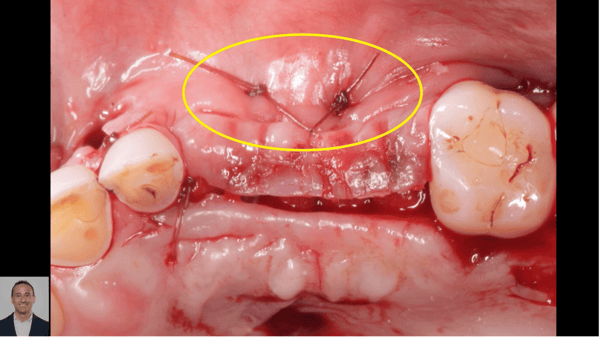
If I had lost a large section of labial plate as you say you did in this case, I would have immediately performed GBR. I only use Lifenet FDBA and/or DFDBA. Going on what your defect sounds like, I would have placed some tenting screws, FDBA, covered the bone with a resorbable collagen membrane, performed a periosteal releasing incision, and closed with a continuous interlocking horizontal mattress suture (PTFE). I have had great results with this technique.
Peter Fairbairn
6/23/2008
The periostuem can be the best membrane as long as graft material is cell occlusive , some of the newer TCP products "set" ,thus stabilizing the clot and prevent soft tissue ingrowth. Therefore blood suplly from the preiosteum ( 85 % of the blood to bone) can be utilized in the healing process. With 100s of sucessful cases over the last 5 years this is proving an interesting area.
satish joshi
6/23/2008
Even if you are a greatest supporter of periosteum as a membreane,you must understand that once you score the periosteum to get tension free flap,levee has been broken and your graft is destined to be flooded with fibroblasts.
Make a sound decision.Use membrane and fix it with tacs or periosteal suturing.
I do not understand your rational for placing two temp implants and removing in two moths.What did you gain out of it?
Good luck
PK
6/23/2008
Dr.Joshi
Can you explain more about periosteal/membrane suturing?
satish joshi
6/23/2008
Dr.PK
Just think about you tying a rope around your luggage on the roof of your SUV with roof rack.
In periosteal suturing of membrane,reflect your full thickness flap as much as possible.when your graft is ready to be covered with membrane(resorbable),take bite of periosteum with 3.0 vicryl (for strength) suture and take another bite like horizontal mattress on lingual or palatal flap.then slip your pretrimmed resorbable membrane under the suture,tuck the membrane under lingual flap and tie the knot.Take few more suture same way for more engagement.Then score periosteum and suture facial flap with lingual flap tension free.
The advantage of this technique is that you need not to remove tacs.But I prefer tacs because sutures loose strength as time passes,which can lead to membrane movement.I think this should help you.
DR.J
Anonymous
6/24/2008
I agree with the comments posted by several people earlier. Bio-Oss deos not degrade at all and hence not a very good bone graft. You want a bone graft that stimulates bone regeneration, you do not want something that stays there forever without doing anything. I either mix HA with calcium sulfate or use calcium sulfate by itself and apply it layer by layer as Orthogen (company making DentoGen) suggests. I really like that approach and use it mainly for most of my grafting cases.
Don Callan
6/25/2008
Very good coments by Dr's Wallace and Holtzclaw, as well as others, ALL of the HA materials (BioOss, Osteograft, M-Oss, Puros, J-blocks, etc.) are only osteoconductive materials. They create too many problems. They are good only for fillers.
Dr GM
6/27/2008
Hi. Interesting inputs by all.
Dr Nair, I think that the best course for you now would be to forget about placing implants in that region and go for a bridge/denture, if you want to do it all by yourself.
Or you can refer it to a competent surgeon to graft that area and place the implants, and the restoration to be done by you.
Or, you can take the surgeon's help to get the ideal bone and then you can place the implants.
All these materials mentioned in above posts are good to replace the cancellous part of bone, not the cortical part. forming a new cortical plate requires use of cortico-cancellous autograft fixed at that place with screws/boneplate, wait for atleast 6 months and then go for implant.
the graft materials mentioned are excellent, get replaced by natural bone and support the implant; but only when its a partial defect. it does not work when the entire plate is gone.
ACabero
7/3/2008
I have encountered the same problem when I was placing implants on the upper labial plate of the patient. It totally gave way during my pilot drilling. Usually when this happens, you have to stop the osteotomy and perform a bone graft on the implant site. Since this is a n upper labial area we need more bulk so that when you place your implants you will have sufficient bone. You can use the dislodged bone and crush it into the bone mill. This will serve as your autogenous bone then mix it with demineralized cortical bone so that your bone grafting will have a 90 % chance of survival rate. Place your membrane then suture it up. Then wait for six months up to 8 months to heal. You will see that this will have a better prognosis.
marik ina
7/7/2008
leave 8 weeks until you get the sufficient gum and then you can put implant together with the graft material, as long you got the good sufficient gum you can close the site - primary closure
Chan Joon Yee
7/20/2008
"I did not graft at the time of extraction because there was a periapical lesion associated with the four anteriors which were also endodontically treated."
First, I would not have used any temporary implants and secondly, I think I would have cleaned out the periapical lesions and grafted. I would also protect the graft with a collagen membrane sutured to the lingual mucosa and achieve primary closure with the labial flap. The membrane is mandatory whenever I have a large particulate graft. Collagen works best. I get unresorbed particles stuck to connective tissue when I don't use a membrane or fail to suture properly.
R. Hughes
7/20/2008
One can use blade implants, with and without grafting. This depends upon the situation at hand! Blades can save the day in lieu of expensive and extensive grafting. Also blades can save precious chairside time and time for the patient.
Dr. Mehdi Jafari
7/21/2008
I don't believe I am reading this, or may be I cannot trust my eyes anymore. May peace be upon late Dr. Linkow.
R. Hughes
7/22/2008
I still place blades! They work like hell. I was trained by Drs. Linkow, Roberts, Levi, Clark and Reymolds. The younger Docs. don't know what they don't know. As a matter of fact I wsed them on a mand bilateral distal extension case and performed an immediate load.
R. Hughes
7/22/2008
Dr. Linkow is still alive. I did lecture with him last year in Vegas.
Kent
7/24/2008
I'm just a patient wondering if I should be worried about a gum lump that appeared after front implant, it doesn't seem to be infection though (no redness, kind of hard to the touch), the sensibility of the area is similar to that of numbness. The procedure was done three months ago and my doctor -abroad- doesn't seem concerned b/c there is no pain or redness but I don't understand why that lump is there.
Dr S.SenGupta
8/24/2008
Re the anterior mandible
Very common situation to loose the anterior lowers
I have never come across a lower anterior mandible that i am not able to place implants into??
If buccal plate fractured thats ok ..place the implant deeper..level the bone if needed to get the width
Nothing to worry about in this region no vital structures etc ..beginner territory
Assuming that we dont have a gummy smile in the lower (rare)
If the defect is bad ..place implants on either side and do a bridge across the implants
2 Implants and you would get very firm placement here and probably 13mm+ length would support a 4 unit bridge with almost any configuration (except double cantelever)
Discussion on grafting is intresting but Im not seeing the need from what I understand of the case description
Whats the deal with temp implants!
Good fixation in this area of all places would allow immidiate load anyway ??
R. Hughes
8/25/2008
Situations like this, it's of to proceed with implant placement. First, make sure one has adequate ST for tension free closure. Second, degranulate and detoxify the sockets if needed. Third, make osteotomies. Fourth, place graft material (Osteogen) densely packed. Fifth, place the implant to proper relationship of the adjacient CEJ. Sixth, close tension free. Release flap if necessary. Seventh, protect the site. Eighth, remove sutures ~10 days and give it about 6 months.
Dr SDJ
11/28/2008
I have posted a case in the cases section please comment on it it is similar to the above mentioned case
Thornhill Dentist
9/8/2009
If during extraction, the buccal plate is fractured, it should be replaced by GBR technique.
emergency dental
1/15/2010
Bio-Oss deos not degrade at all and hence not a very good bone graft. You want a bone graft that stimulates bone regeneration.
Dr. A
8/29/2010
So far the Bio Oss Collagen works great for me. I've tried Dynagraft and Dynablast, 40% of them failed. How can those putties be osteoconductive and inductive at the same time. Amazing how the rep comes to my office and says there is "BMP" in there. Don't come to my office and say there is "bmp" when it's not even close to the osteoinductive properties like ininfuse. DFDBA/Puros, too many recalls, I don't feel comfortable using it. I don't like particulates, therefore the Bio Oss Collagen is my go to product for grafting. Bio Oss has been heavily researched, I don't understand why you guys are using products that have not been researched as heavily. Especially when it comes to placing implants.
DR APURVA DALAL
7/25/2011
HI. SIMILAR TO THE DISCUSSION ABOVE I HV AN UPPER LEFT CENTRAL IMPLANT CASE TO SHARE.THE TOOTH WAS AVULSED 2 MONTHS BACK DUE TO AN ACCIDENT. TOADY WHEN I RAISED THE FLAP, BUCCAL CORTEX WAS ABSENT 5MM FROM BONE CREST ONWARDS IN THE SHAPE OF THE ROOT. I PLACED 3.5 BY 10 MM OSSTEM IMPLANT AFTER BONE EXPANSION USING OSTEOTOME. I HAVE PLACED THE IMPLANT FROM THE POINT WHERE THE LABIAL CORTEX DEFECT ENDS. THUS I WOULD NOW HAVE TO PLACE A PROSTHESIS OF GREATER LENGTH WITH GUM COLOURED CERAMIC ADDED. WOULD PLACING A BLOCK BONE GRAFT FIRST AND PLACING THE IMPLANT LATER HAVE BEEN MORE WISE??? ARE THERE ANY OTHER PROBLEMS THAT COULD COME UP IN THE WAY I HV PLACED IT CURRENTLY. I HAVE ALSO PLACED A HEALING ABUTMENT TO AVOID BONE REMODELLING OVER THE IMPLANT. PLZ SUGGEST. THANKS.