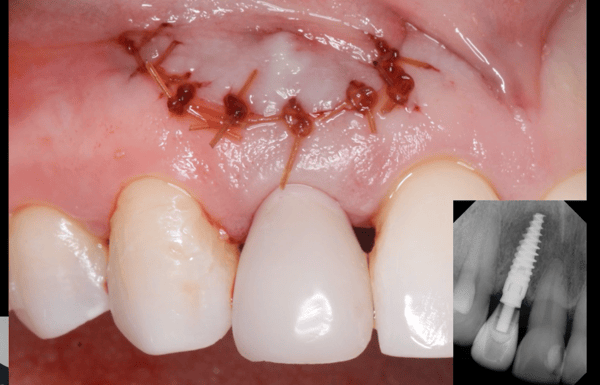
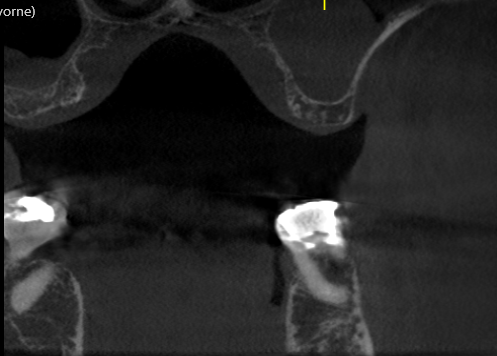
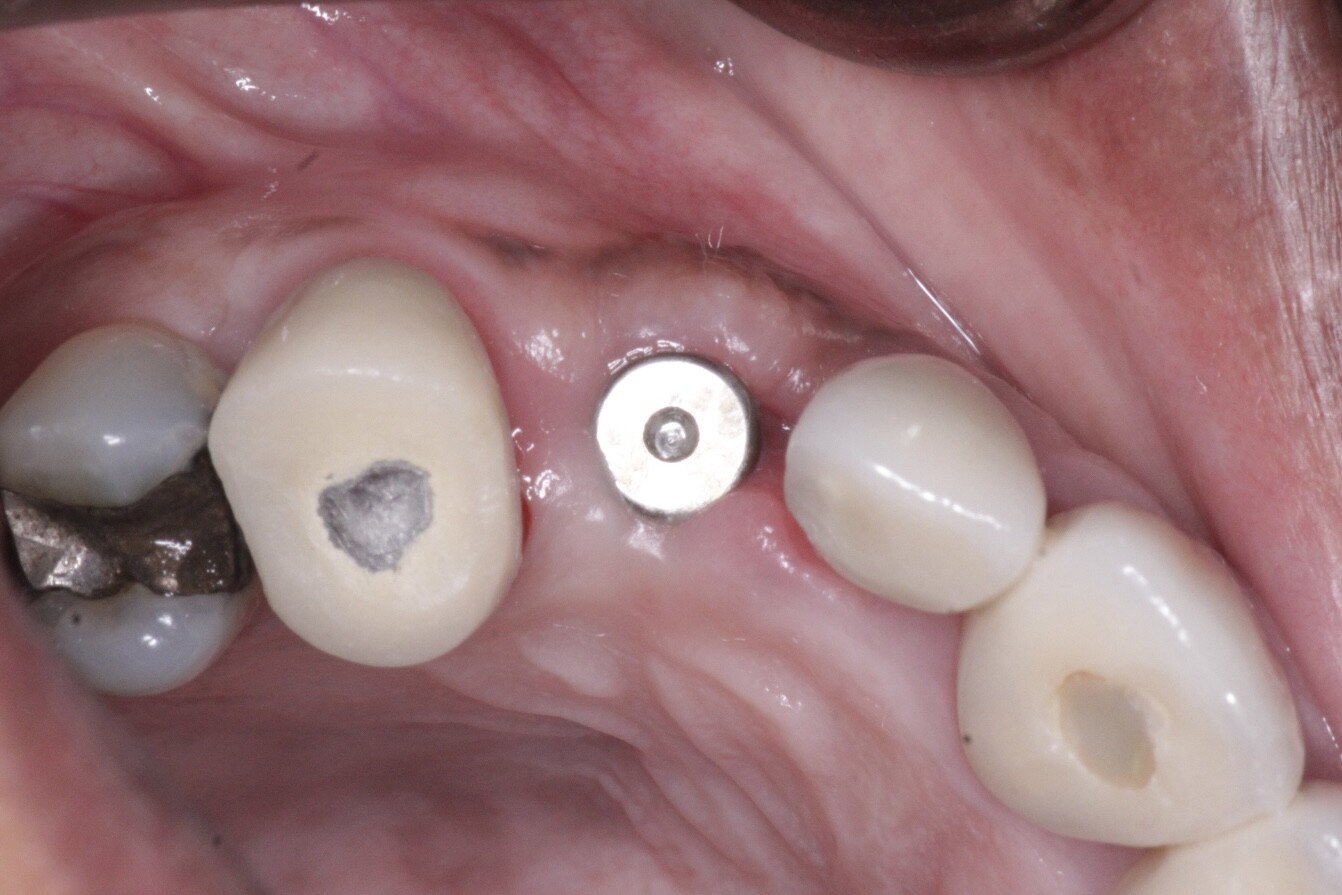
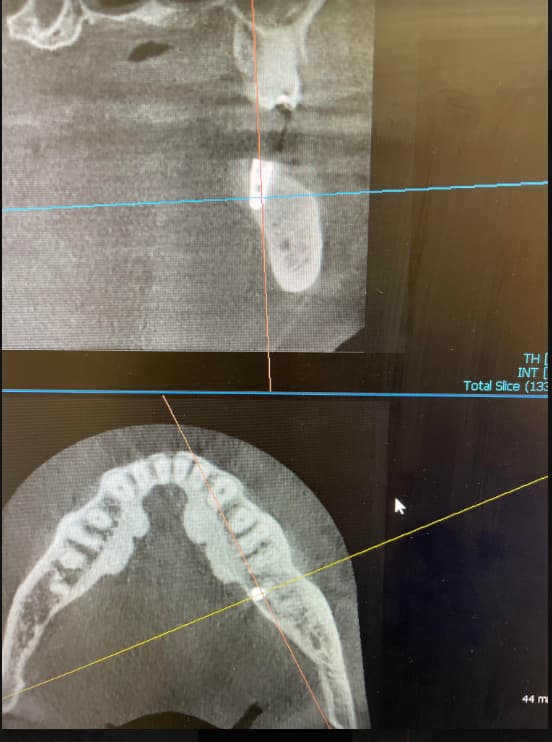
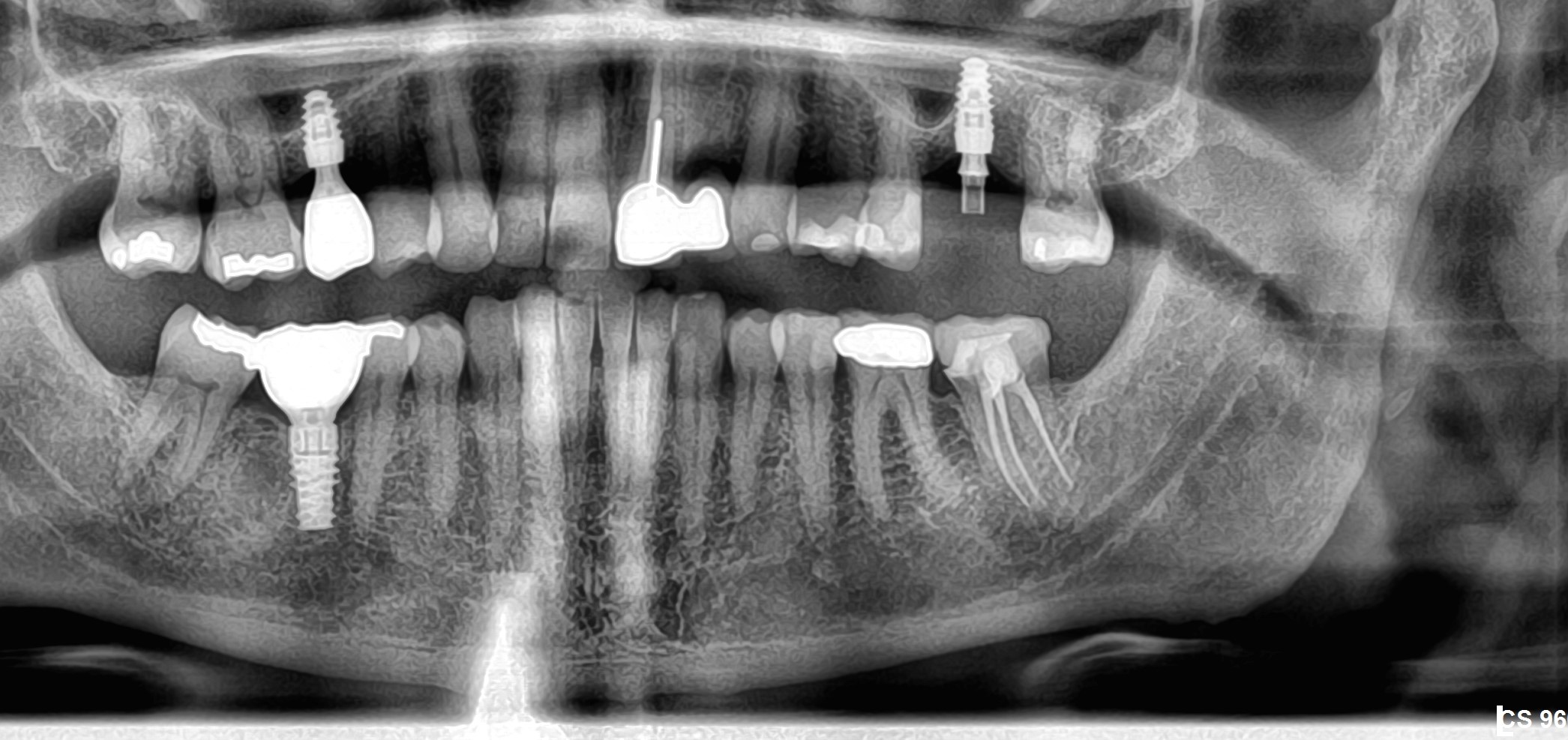
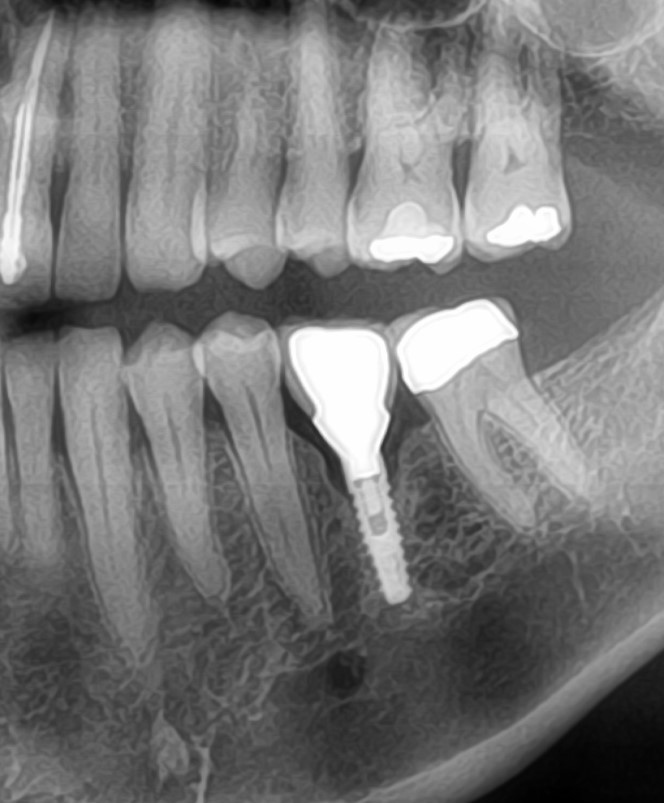
Loose Abutment Screw
Dr. L. asks:
I am a recent grad and have been placing dental implants for 3 years. Recently, I completed a case where I forgot to torque down the abutment screw completely. Now it is loose! The crown is still cemented tightly to the abutment.
I always had an implant rep help me in the beginning. How do I retrieve this screw and tighten it? Can I approach it like an endo access? I placed Memosil in the top of the abutment just in case I needed access. Will I need a special bur to cut through through the crown? How do I avoid damaging the abutment and even worse, the abutment screw head?
30 Comments on Loose Abutment Screw
New comments are currently closed for this post.
Richard Guaccio
3/26/2007
Dear mL: Yes you can do it as an endo access opening. I have had to do this on occvasion and it does work. Rich
satish joshi
3/26/2007
use sharp carbide to cut thru metal part of crown and stop as soon as u see your sealer.you won't damage screw.
Only thing you should worry is damaging threads of abutment screw,because of the movement of abutment during drilling. Make sure to hold crown tightly with hemostat to minimise movement.
If that dose not work, just sacrifice crown and remake new crown after tightening the screw.
Sam Strong, DDS
3/27/2007
Here's a suggestion whether you can retrieve the crown or have to made a new one. After torquing in the screw for the abutment, cement the crown "provisionally". I usually lubricate the crown casting interior and the abutment with a light coating, then cement with ImProv cement for a road test of about two weeks. Then I retrieve the crown with the Richwil Crown and Bridge Remover if there is no interproximal debris accumulation and no occlusal problems, then cement "definitively" with RelyX or similar. The road test helps trouble shoot problems while the crown is still retrievable. You also get another chance to torque the screw at the final cementation appointment.
Paul[Australia]
3/27/2007
As a laboratory technician who has witnessed this several times,I often indicate the point of access with a small spot of coloured porcelain, or a slight depression in the case of gold.
This is also helpfull if there is a need for removal to repair damaged ceramic.
The crown can then be seperated from the abutment by placing in the furnace at standby temp. for a few minutes to break down the cement
Dr. Berk
3/28/2007
All the posts have provided you with the two options you have, to cut the endo access and with a little luck access the screw and either torque the abutment-crown or remove the same, separate the abutment from the crown and replace each ideally. The other option of course is to sacrafice the crown while saving the abutment.
However, what wasn't mention in prior posts is that if you used an external hex implant that the loose abutment can be damaging the hex which is a more difficult problem to deal with. So, take action ASAP.
Don Callan
3/28/2007
That is a problem. We have all been there. There is a learning curve. I suggest to use an implant that does not require a torque procedure. Also, be careful on the road test idea, crowns will come off which can be another problem. A good lab person can help. Do as Dr Burk says take action ASAP.
L Frost DDS
3/28/2007
Dr L: Cut your losses. Take a VPS triple tray of the new crown (hopefully this does not involve a bridge. Cut the crown off doing the least amount of danmage to the abutment. Torque down the screw and recover. Re-impress and temporize. The new crown should be back in two weeks and you patient will be fine with the temp. Patient now has a perefctly intact crown without a hole in the porcelain....it is no fun finding the screw access hole through a permanently cemented porcelain crown...its takes a while and its stressful. and after this patient has paid you alot of $, they now have damaged goods...your cost should be $130.00 + time. good luck.
MB, DDS
3/28/2007
Be careful using the temporary cement. This would not be done in conventional dentistry. We don't use temporary cement in regular crown & bridge dentistry. This causes yet another problem if the temporary cement dissolves underneath the crown. Now you have two micro-gaps! This is exactly what we don't want! I believe we have seen enough research on micro-gaps at the implant-abutment junction to know that creating additional micro-gaps can only be detrimental to the patient. Please be careful with the temporary cement!
Don Callan
3/28/2007
MB,DDS
VERY GOOD POINT!!!
Larry S.
3/28/2007
What do you (the readers) think of retightening a loose screw on an implant in function. My past ( fortunatly limited) experience is that once a screw loosens, retightening it does not last long. I have made it a point to replace any loose screw in my implants and this has stoppped the loosening issue. I seem to remember that loaded screw threads "stretch abit and can never be tightened sufficently to hold under lateral forece again. Just interested in your thoughts .
Dale
3/28/2007
I agree with Dr. Frost. When we (docs) drop the ball, it is our duty to make it right. Cut the crown off and start over. The patient desrves no less. It is a lab fee for the new crown and your time to make it right. Good luck.
Dr. Perry
3/29/2007
I wholeheartdely agree with Larry S. Once a screw has loosened (whether or not it was torqued to start with) I replace the screw. There is no sense to risk that this screw could loosen again (stretching is a real phenomenon)and fracture. I have had to access multiple loosened implant crowns (I had one patient with 8 implant crowns placed in Mexico and every one loosened). Not a situation to redo the crowns. Really study a Bite wing and determine the mesial-distal position of the implant under the crown. As an aside, if I have an off angled screw hole I take an intra-oral photo of the abutment on the implant and attach it to the digital record.
While redoing the crown is the ideal, if you plan to save the crown, cut through the porcelain with a diamond bur. Then cut through the metal with a GW 2 from great white. These cut through metal in seconds. You will shortly fall into the memosil you placed then immediately go laterally to open the access and you should perceive the internal of the abutment as increased resistance through the handpiece. Do not go too deep and muck up the head of the screw, life will then be very difficult. It is much better to notch up the internal of the abutment than hit the screw. the second you fall into the internal of the abutment, stop and just go horizontally. We all learn by experience...you'll never forget to torque again. good luck.
Peter Fairbairn
4/3/2007
Use of Technolock can further reduce the rare incidence of loosening..
Albert Hall
5/15/2007
Call your rep!
Rick Meyer
12/11/2007
I have tried to find the answer, but no luck, so here goes. Why does an implant become loose? I have had to have my crown removed by my dentist and will see the Oral Surgeon that performed the original implant to retighten the abutment. At the time it is tightened, the tooth in front of that implant will be extracted, infection and tooth can not be saved, but again, why did the abutment become loose?
Any help would be appriciated.
Dr S.SenGupta
3/14/2008
Screw loosening is primarily attributed to improper occlusion set up (and not torquing in the first place!)
Absolutely replace crown and screw
I certainly would not accept a hole my crown
Re microgap and temp cement I have to DISagree with previous posts of not using temp cement Microgap issues are at the junction of the implant and connection to abutment
Crown margins are not at bone level ..or should not be so
I do use temp cement and fairly often it keeps options open and allows the patient to get accustomed to the prosthesis
In larger cases even with passive fit (as is essential)metal to metal is very retentive .
What if your 8 unit anterior implant bridge case comes back and says she wants more OJ or OB or shade alteration?
Done too many of these to risk resin cement right away (there are also non soluble temp cements)
Martin Cowan
4/16/2008
I'm a patient. Screws in two adjacent implants had to be tightened 8 years after insertion. Have had no problems with half a dozen or so other implants, older and newer. Question is why? Loosening due to vibration or heat/cold expansion and contraction seems unlikely. However, could it be the result of repeated x-rays at frequencies that cause harmonic resonance in the metal (which are crystaline in formation)? I may also be a grinder. Could that do it?
Ken Clifford, DDS
4/17/2008
Martin - Ever ride a Harley? Screws come loose from vibration almost daily! Eight years without retorqueing seems pretty good to me. If you are a grinder, just count your blessings! I can't imagine any way an x-ray could cause a harmonic resonance. x-rays are just photons with a different frequency than visible light.
peter
5/26/2008
The screw has loosened on my implant after 10 years. After reading this thread I still don't believe there is consensus. My dentist is suggesting that she drill through the back of my crown to find the screw and tighten. It sounds a little like guess work to me. What is the best and most honest appraoch to fixing this problem. I'm afraid that tightening the screw will only be temporary.
Martin Cowan
7/22/2008
As a follow-up, my dentist tried to drill through the crown and tighten the screw. About a week later, the crown disintegrated, and I needed a new one. I also had to visit the dental surgeon to tighten the screw.
I don't know whether x-rays can cause the problem, but saying that they are merely light rays with a different frequency does not mean very much. Lasers are also light rays, but can blind, even kill. X-rays can also kill (think of radiation from nuclear reactions). Worse, X-rays are capable of ionizing body cells, which can cause sterilization and either cure or cause cancer. Even ordinary AM radio waves can cause vibrations in tooth fillings (there used to be reports of patients listening to radio broadcasts though their filings, because the radio frequencies caused their fillings to vibrate just like the old-fashioned cyrstal radio sets, in the days before radio tubes and transistors made them obsolete.) So, no, I am not persuaded that X-rays are incapable of producing vibrations.
Benjamin Pirih
8/22/2008
Thank you everyone for the excellent information posted here. I have a loose abutment with a crown cemented in on my lateral incisor. I am very glad that it is just this and not a total failure of y implant. Worst fears..
I believe that removal of existing screw/crown and replacement is the proper path. I have also been advised to seek a gum/bone graph around the area after the existing crown abutment once removed as the current condition has caused bone/ gum lose at the abutment junction.
Can anyone give any further advice about my situation? I have only had my existing implant for 3 years and noticed the problem initially although I thought it was a side effect of the healing process. Is it possible to not cement the crown in place? I.e. if the abutment does loosen again in time.. (although I believe this was an initial torque issue) that the abutment can be adjusted without remove of entire crown??
Other then my current issue, I have been very pleased with my implant and consider losing this crown / screw a step closer to having a "lasting" solution. I consider the gum/bone graft fixing the defect that was left by my extraction and in retrospective something I should have done during the initial implant placement.
Thanks for your expert opinions.
Rob
9/15/2008
As for removal of the loose screw, I found that on my implant with loose abutment screw, I could loop some dental floss around the shaft of the screw and simply unwind it. I also used the inverse of this method to snug it a little (obviously couldn't torque it completely) while waiting for my dentist to return from vacation.
Benjamin Pirih
10/3/2008
Just a follow up to my story..,
My Dentist was able to remove my crown exposing the dental abutment screw. I have come to find out that my problem was not a loose abutment screw. A great amount of torque was required to release the abutment and unscrew it from the implant. At one point I was fearful that we would not be able to remove the screw. After several attempts the abutment screw did eventually release allowing for the removal and placement of a healing cap. I imagine a failed implant would have slid out under such load. Could a failing implant handle such torque?
With the healing cap in place, a synthetic bone graft and membrane was placed. I am very happy about the results so far the original extraction defect has now been completely removed. I have also noticed a firming of the adjacent maxillary central incisor after this graft.
I have read the following article http://www.thejcdp.com/issue019/green/green.pdf which also had a preliminary diagnosis as a loose abutment screw. What I do find interesting about this is that it points to the problem of a miss-fitting crown.
When my crown was placed I had the same issue with the crown being too high. The Dentist was required to remove more internal area from the crown with a drill to achieve proper placement. Could this action have undermined the structure and casing the rocking motion? I would think that that dental cement would have sealed such gaps? Wouldn’t a lose crown just fall off and not rock. I say rock as my restoration would shift toward the central incisor and back.
Does it seem possible that a rocking crown could cause bone loss at the abutment junction? Would a loose implant rock in such a fashion?
Thank you everyone for your input.
Annie
10/13/2008
I have just had my second go on one implant. I graft was performed both times. 2 weeks after the second go around and finally getting the crown back in place, I inadvertantly bit on an olive seed. It was painful and now the implant is loose again. The last thing I want to do is go through the entire process all over again. Any suggestions?
Benjamin Pirih
10/21/2008
How long was your heal time between the procedures. Did you loose you implant. i.e. was it removed? Did you do the full 6 months after the 2nd procedure? Sorry to hear about this.. I feel your pain!!
Orhan Kaunis
10/27/2008
Retighten a loosened screw? How sad it should even be questioned. If the torque applied initially were significant, and it loosened, then the screw must be changed because of possible "stretching". You may try to reuse the same screw...but even professional car mechanics DO NOT use the same bolts to torque heads down. Have the specifics regarding these screws been exhausted? It does not sound so.
Thor MAY
1/28/2009
Help needed for a tricky problem. I work in China, but it used to be South Korea. Eighteen months ago a Korean dentist fitted me with a titanium post and gold crown (right mandibular second molar. There's no third). Three weeks ago the crown unscrewed itself and fell out. Two Chinese dental hospitals in Zhengzhou (pop. 4 million, 4 fast train hours south of Beijing) have refused to touch it. They don't know the Korean system and have no tools (they use ICI from staumann.com). Nobody here speaks English, so it is hard to argue. The Korean dentist has ignored all contact attempts, and so has the Korean Dental Association. I'm in a bind. Here's what I need to know: a) who made the thing (photo of crown and abutment with screw at http://www.flickr.com/photos/32846109@N03/3233731362/ ); b) can I separate the abutment without destoying the crown? On a Chinese teaching salary, money matters; c) can anyone in China fix this problem? Suggestions welcome.
Benjamin Pirih
1/30/2009
Hello Thor,
Sorry to hear about your issue. I'm not a professional in this industry so my advice is only from what I have read. In most cases the crown is cemented to the abutment and you cannot remove the crown without damage to it.
You best bet is to start over with a new abutment screw and crown. I know the cost will be painful.
to quote the previous post..
Retighten a loosened screw? How sad it should even be questioned. If the torque applied initially were significant, and it loosened, then the screw must be changed because of possible “stretchingâ€. You may try to reuse the same screw…but even professional car mechanics DO NOT use the same bolts to torque heads down.
I think this is excellent advice.. Sorry about the money issues and the fact that you are having a hard time finding quality service.
civic
5/26/2009
Dear Thor,
I hope ı am not too late to help.
Just place the abutment-crown assembly in a regular dry heat oven. Heat it up to maximum (I guess regular home type electrical ovens can go up to 300 degrees)and immediately throw it in a cup of water (use a teaspoon to hold and carry :D). The titanium abutment and the screw will not be effected by the mentioned heat, neither will the crown but the cement in between will fracture and you will easyly separate them . Rest is up to you but IMHO you must at least replace the screw.
GOOD LUCK
Tan Ta Dental Lab
6/15/2009
Hello Thor.
A dental laboratory in your area might be able to help you separate the gold crown from the abutment. A ceramist can place the whole thing in a porcelain oven at standby temperature (normally 400 C degree or less) and close it Without running a baking program for five to ten minutes. Open the oven, hold the Crown with a large hemostat (screw facing down), hit the hemostat with an object like another hemostat and the abutment might falls off. Be cautious because they are hot!
Another option is to ask a technician to wrap the existing crown and the abutment with an impression material to create a mold (make a few markings to help with alignment later). He/she then makes a long slit from occlusion to margin using a surgical blade to remove the mold. Technician then cut vertically into the crown carefully without hitting the abutment. He/she then removes the crown and the screw and get everything clean up. Cut a 1 mm hole on the lingual side and a smaller size hole on the buccal side. Cover the screw access hole in the abutment and apply a coat of separator to the abutment. Put the mold back on the abutment with the markings lined up. Use a warm glass pipet (medicine dropper) to inject hot wax into the mold from lingual side hole until excess wax spills out the buccal hole. Wait for the wax to cool down and the technician has a wax pattern to cast and polish you a new crown (there are many different types of golds for a gold crown). Take everything to your doctor. Make sure you save the screw because they might not have a extra screw needed to fit you implant, in your region.
Please let us know the result.
Good Luck.
Tan Ta, CDT