Membrane Exposed: Suggestions?
Posted in advice Bone Grafting
« Is This Implant an Internal or External Hex Implant? | Periapical Radiolucent Lesion: When is it Safe to Place Implant? »
Dr. C asks:
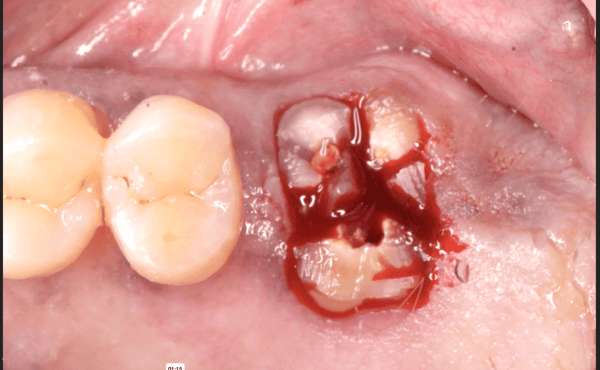
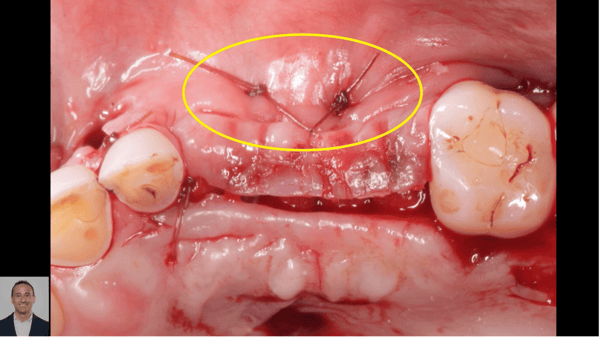
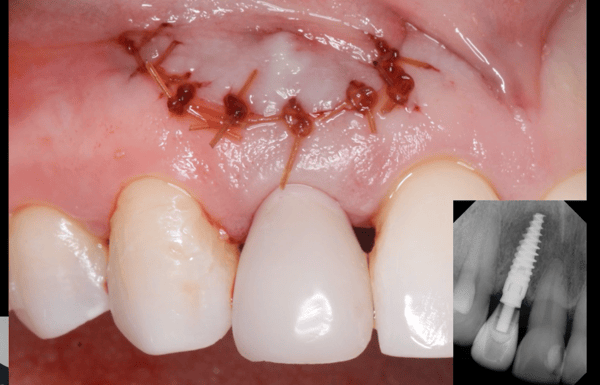
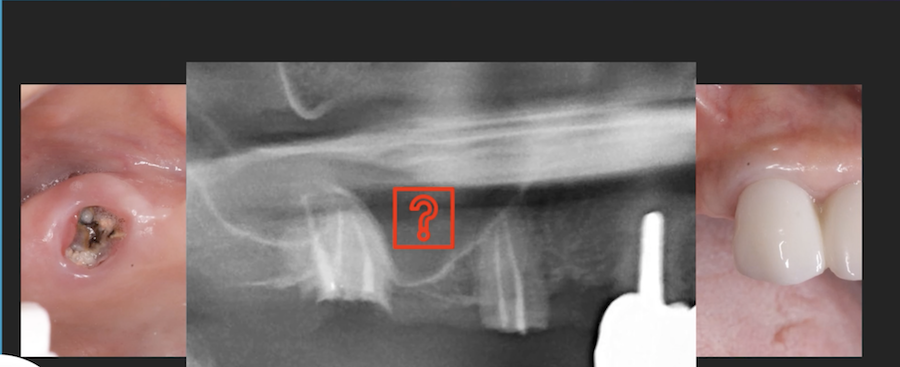
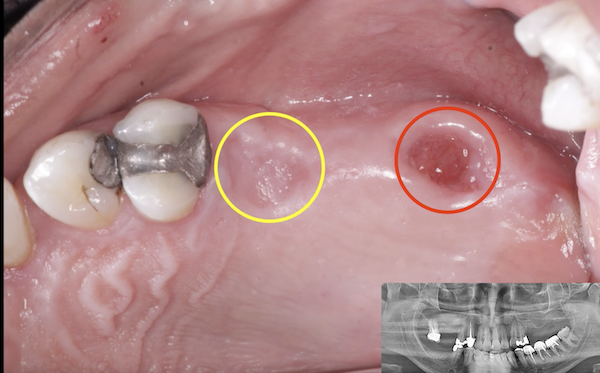
I extracted #3 [maxillary right first molar; 16] and did a bone graft for socket preservation. #3 had previously had root canal treatment and apical surgery. I tried to remove it without damaging the surrounding bone but the extraction process was difficult and I chipped some of the buccal and lingual cortical plate. I placed a bone graft with Cerasorb [Riemser], a synthetic bone product, and covered it with Epiguide [Riemser], a bioresorbable membrane which does not have to be completely covered by the tissue. Much of the membrane was exposed because of the large dimensions of the extraction site. Shortly after the graft procedure, the sutures broke and I was concerned that the membrane would be displaced. Radiographically, the graft looked fine. I covered the graft site with a periodontal dressing to stabilize the membrane. The extraction site is about 10mm wide and is actually bigger now then at the time of extraction. I have prescribed an antibiotic and a chlorhexidine rinse. I would appreciate suggestions on how to proceed at this point.
Subscribe to this Post
Hi my opinions – Socket preservation is a misnomer -why does one want to preserve a socket? I want it to fill up with bone!! not synthetic granules or forein matter – just bone. I think there is enough evidence to support this happening. In my opinion on posterior teeth that have stuff packed in, the resorption is the same as for a socket left to heal on its own after an 8 week period.
It would be impossible to get soft tissue coverage unless you have wide releasing flaps {and this causes bone loss!}I personally dont like exposed membranes for reasons of infection. If one has to graft ater a socket has healed for about 8 weeks or so there is more soft tissue , hopefully keratinized, to work with.
Anti biotics are of limited use now as they cant get into the graft if there is no vasculer bed yet.
You may get epithelialization but if the membrane gets dislodged further I think you may lose the granules of cerasorb. I would irrigate the loose particles out and let it heal and then asses the bone volumes etc.
I feel in these cases you would probably need a graft anyway so whats the rush? I like lots of sorf tissue to work with if I graft.Time is our best ally with implants {I WISH PATIENTS and some practitioners, WOULD REALIZE THIS!}
If the graft survives you will probably need to wait a few months before an implant can be placed.
Just my thoughts. Good luck
Tom Carson: I agree that time is an ally to a point. You can actually lose bone about unloaded (asleep) implants. I do like to graft to facilitate ridge maintenance. I have found that “Osteogen” does give osteogenesis a kick and is an encellent resorbable graft material.
I would just continue wound management, eval the patient every week and keep them on the chlorhexidine rinse. You are sure to get some integration of the graft as long as you removed all the granulation tissue from the socket. Make sure before you graft you can feel clean bone with a curette in the entire socket. On large extraction sites I like to use a PTFE membrane and remove it after 4 weeks.
I am very familiar with the clinical applications of Cerasorb and Epiguide. Epiguide membrane exposure in the oral cavity is not the main issue here, rather, your wound closure technique. Properly used, the combination of Cerasorb and Epiguide is very predictable and will give you D2 type native bone.
Before I can answer your questions, what were the pre-operative conditions, can you show post-operative radiographs? What type of suture material did you use? What size Cerasorb particles did you use and how did you hydrate the Cerasorb? How did you
place the Epiguide ? Once we trouble shoot, I can assure you, you will avoid this from ever happening again.
Does anyone know the name of the non-resorbable membrane that is keyhole shaped for socket grafting?
Thanks,
JB
Dear Dr John Barksdale. Try the Osteogenics Cytoplast Non-resorbable Membranes TXT-200 (Dense PTFE membranes) or the Cytoplast Ti-250 (Titanium-reinforced Dence PTFE) which you can curve to cover the defect.
I have very good results with this membranes
Elie DDS
Still being a novice in the implant side of dentistry, having places 30 odd simple ones, I’am still unsure of how long and of what diam to place for optimum success. I realise it is dependant on bone type, but are there any rules or formulas.
Dr. John Barksdale
FRIOS BoneShield is a titanium foil membrane that is perforated usig Laser. it has several shapes, on of them is that with key hole to be fixed with the implant.
Zimmer has the memmbrane that looks like a keyhole. I think it is called socket repair.