Misaligned #4 Implant: Options?
Anon. asks:
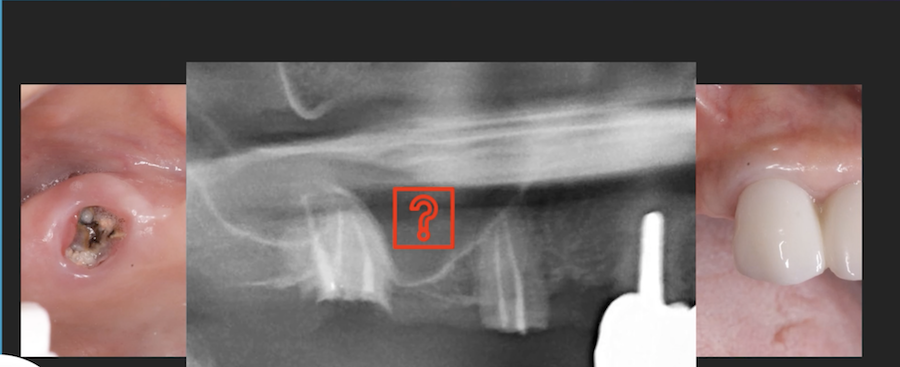
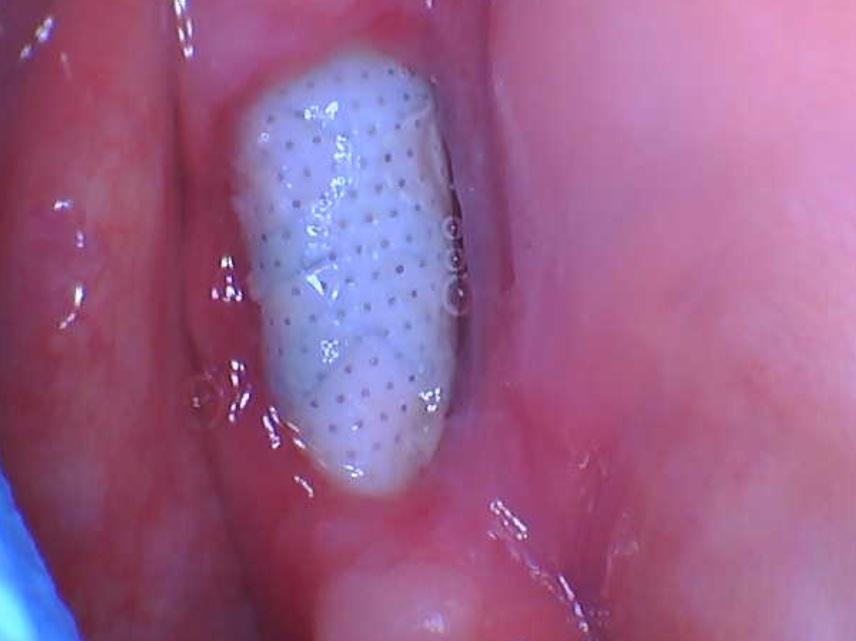
I am doing a maxillary overdenture on 4 conventional implants placed in the second premolar and lateral incisor positions [#4, 7, 10, 13]. They support a full arch bar. My lab has told me that they do many overdentures of this kind and they are quite successful. My problem is that the implant in #4 site is misaligned and flares out to the buccal. The bar is slightly distorted at that point. When I go to insert the overdenture it hangs up on #4 area and then snaps down. The overdenture does not rock. The patient has some difficulty in seating the overdenture because of the distortion in the bar at that point. Should I replace #4 and remake the bar and overdenture? Anyway this can be saved?
11 Comments on Misaligned #4 Implant: Options?
New comments are currently closed for this post.
Alejandro Berg
9/16/2008
Its actually pretty easy to solve, get yourself 4 new ucla abutments (non hex), and make a new bar. The implant in nº4, flares up to buccal, that is not a problem, the bar will have to be waxed to the palatal side of the implant and the screw will go through the buccal of the abutment, probably a short head screw would be best for this implant. Then a new overdenture, and you are done.
This works if the implant is up to maybe 35º of flaring, depending on the depth of it.
Your lab should know this, maybe a better lab is a good advise too.
best of luck
Robert Gougaloff, DMD
9/16/2008
Hi
Another option is to get rid of the hader bar altogether and ride on telescoping attachments. These need to be custom-cast and precision milled by the laboratory technician and will therefore automatically be properly angulated. I would probably still recommend a metal superstructure within the denture for stability. The metal superstructure also leaves the option to add extra brea-type attachments, if more retention is needed.
Good Luck!
Bruce G Knecht
9/16/2008
This has happend to me and it is an expensive error, but can be done. Since all of the other implants except #4 are in good axial position to screw in a bar, and you still want to use a bar, a custom abutment can be made to the #4 to align it with the other implants. The abutment on #4 will be placed and then the bar will be slid over the abutmnet. The other implants will have the implant screws coming through the top of the bar and #4 will have a small lingual set screw to retain the bar to the implant. These set screws are tappered and are used on crowns(especially in Germany). The impression can be a bear since a bar is best impressed with a through the tray technique. #4 may need a closed tray with the rest as a open tray. Hope this helps. Anyway, who is this Anon guy?
Mark Huels, CDT, MICOI
9/16/2008
In what way is the bar distorted? If it fits passively on all four implants then the angle of #4 implant is not a problem. Is just the denture or the overcasting--if it has one--hanging up? Since it should have an intimate fit then pressure indicating paste may not be the answer but a sharp pencil or possibly a marker can thinly coat the inside of the denture where it goes over the bar at that point. See if it rubs off on the bar. If so you can simply adjust either the bar or the inside of the denture in that area. If this is not the case you may e-mail me ([email protected]) with further details and if I can be of assistance I'll be glad to help.
Nicholas Toscano DDS MS
9/17/2008
Without seeing some pictures and radiographs its truly hard to comment, but what you are describing occured in the Case report below. Dr. Raghoebar did a segmental osteotomy of the mal-positioned implant and the case worked out well. Pull the paper it is very good. I might suggest that maybe you consult your local periodontist or OMFS to see if a segemental osteotomy repositioning of the implant is possible in this case. This option of course is far less conservative then the ones presented above. Hope that is helpful.
Correction of a malpositioned endosseous implant by a segmental osteotomy: a case report.Raghoebar GM, Visser A, Vissink A.
Department of Oral and Maxillofacial Surgery, University Hospital Groningen, The Netherlands.
A mandibular overdenture supported by 2 or 4 endosseous implants has been proven to be a reliable treatment modality for patients suffering from conventional denture problems. However, fabrication of an implant-retained mesostructure to support an overdenture is not possible in all cases. Malpositioning of implants is a common cause of failure in such cases. A case is presented in which a ball attachment caused pain and severe swelling of the floor of the mouth because of the lingual inclination of an endosseous implant. The lingual inclination of the implant was corrected by a segmental osteotomy. Six weeks later, prosthodontic treatment began, and the resultant overdenture supported by a Dolder bar was quite acceptable for the patient. Int J Oral Maxillofac Implants. 2005 Jul-Aug;20(4):627-31.
Dr. Dan Smith
9/18/2008
I don't see how a patient can be charged so much $$$ for a treatment that's going to fail within 3 years. This kind of treatment, with only 4 implants, may work for mandible where higher quiality of bone is able to tolerate this poor biomechanical desing, but for maxilla you need at least 3-4 more implants to restore the type of prosthesis you're describing - maxilla has much softer bone and that needs to be taken into consideration during the planning session.
Dr S SenGupta
9/19/2008
I am inclined to agree with Dr Dan above
This is an overdenture with a bar on 4 implants
That means it is Implant supported and not tissue borne
Thus you have made a fixed bridge 12 units on 4 implants in softer bone one with off axis loading...not a great idea
Biomechanically you are likley to have bigger problems than a misaligned implant might cause
Unless you are opposing a much compromised mandible
You effectivly have an implant supported structure
You either add more implants as suggested above or convert this into an over denture that is retained with o ball or zest anchors
You will be back to your misaligned problem however
Without doing this you will see failure soon
satish joshi
9/20/2008
I totally agree with Dr. Sengupta.Case is crying to be failure.Do something as advised, before it is too late.
It is a disservice to patient to depend only on lab for your eduaction.
Dr. Rahul Sharma
10/4/2008
I agree with above comments. This case is going to fail in near future.
The alternate options are go 3 more implants or go for a Over Denture with a ball head of 2.5 mm.
Nicholas Varras, CDT
10/8/2008
Remaking a bar and overdenture can be quite expensive. A more effective and economical solution is going to free-standing (resilient) attachments. You can retrofit the existing overdenture to accept the new attachments and buying four abutments is much less expensive and complicated than making a new bar. You will also gain a few advantages by going with free-standing abutments. First, you will go with a restoration that is much gentler to the implants. The previous comment about supporting a 12 unit bridge on four implants is very true. By using free-standing abutments you will create a tissue-supported overdenture with much better force distribution. The UCLA study by Drs. Federic and Caputo showed us that free-standing abutments are more favorable than bar restorations. Another advantage, is correcting the misaligned implant. With ERA attachments (Sterngold) you can use the angle correction abutments and correct the path of draw on #4. Correcting this misalignment will do two things, first it will help the patient insert and remove the denture easier and you will preserve the vertical resiliency of the attachments. Think of a door and hinges. If the hinges in the door are not parallel, then it is ulikely that the door will swing open and shut. A study by Dr. Vicki Petropoulos at the University of Pittsburgh in PA showed that the ERA is much gentler than any other resilient attachments, because of this ability to correct misaligned implants and preserve the vertical movement. I hope this helps.
Michael Johnson
11/25/2008
Free standing abutments in softer bone also is asking for failure. If you are using ERA, Locator or ball abutments with four implants the palate must be covered for stability. Otherwise you risk rocking the implants out of the bone under function since there will be a lack of soft tissue coverage. It seems the primary reason patients want an implant retained maxillary prosthesis is to open up the palate. If so, don't compromise with 2 or 4 implants or free standing implants. Always use at least 6 implants connected with a bar. Then the prosthesis is implant supported and retained and the palatal coverage can be removed. To answer the initial question, if there is an undercut at the #4 implant, use an indicator medium to find the friction, or undercut, and remove it from the bar or the internal of the prosthesis. This will at least get your prosthesis to be functional. I am a prosthodontist and have had 16 years of experience screwing up maxillary implant prostheses by underengineering them. If you're asking patients to spend significant amounts of money, use a design that is as bullet proof as possible! i.e. at least six implants splinted by a bar.