Patient with Paresthesia: What’s the Proper Treatment Plan?
« Eliminating Bilateral Sinus Lifts? | Endopore Implants in the Posterior Maxilla? »
Dr. R. asks:
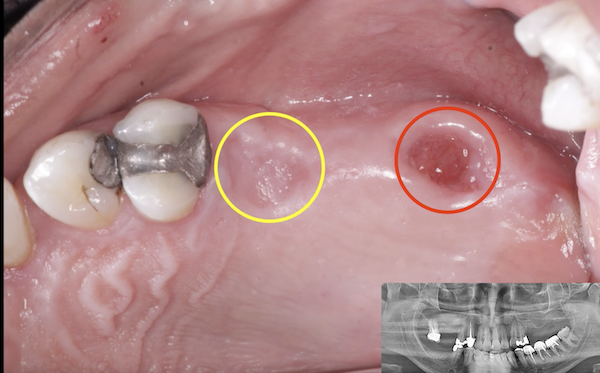
Three months ago, I extracted #18 and immediately placed and replaced it with an ITI TE wide body with Bio-Oss graft and collagen membrane. I achieved primary closure. I prescribed Amoxicillin after the procedure. Paresthesia was present for two days post- operatively.
Panoramic radiograph revealed no obvious insult to the IAN. Pateint recovered spontaneously and has had no alterations in sensation for 2.5 months. Three months post-op, patient’s paresthesia returned. Panoramic radiograph is unremarkable. Dental Impant clinically is healthy and well integrated with no apparent signs of disease or peri-implantitis. I resumed the Amoxicillin and palliative treatment. I am unsure what to do next. I am not convinced that removing the dental implant at this time will reverse the paresthesia. Any advice from anyone here? What would you do? Thanks.
Free Daily Email Alert Click Here>>
Get OsseoNews.com Comments delivered daily! Click Here to subscribe.FREE Weekly Email
Keep current on the latest dental implant discussions! It's Free!
>>Click Here to Subscribe to OsseoNews.com Now!
-
Editor Picks
-
Popular Posts
-
Hot Topics
- Implant Systems: Commercially Pure Titanium vs. Alloy?
- Type of Anesthesia for Dental Implant Surgery?
- Implants Too Close: Can I Use Orthodontics To Create Space?
- Large Defect in the Labial Cortical Plate
- Abutment Screw Gets Stuck: How to Prevent This?
- Crown 1mm Short of the Margin: Recommendations?
- Suture Lost Exposing the Implant: What to Do?
- Mini Implants in Anterior Mandible: Expectations of Longevity?
- Space Between Implant Fixture and Natural Teeth: How Much Is Enough?
- Bucco-Lingual Resorption Exposing the Threads on Implants: How to Manage?
- Options for Provisional Restoration?
- Loose Bio-Oss Particles: Can Implants Be Placed?
- Maxillary Overdentures: What Implant Support is Required?
- Mixing Metronidazole Solution in Grafting Material?
- Sinus Lift Complication after using Summer’s Osteotome Technique?
- Cone Beam vs. Conventional CT Scans: Radiation Levels?
- Sinus Tear: How Long to Wait for Regraft?
- Mini Implants for Long-Term Use?
- How to Avoid Hitting the Mental Foramen Nerve?
- Best Technique for Removing Osseointegrated Implants?
Implant Courses
>>More Implant Courses

14 Responses to “ Patient with Paresthesia: What’s the Proper Treatment Plan? ”
The delayed onset of dysfunction in the area of anesthesia gives rise to several etiologic questions: the flap design and extent of dissection, the loop of the mandibular nerve as it approaches the mental foramen, the compressibility of cancellous mandibular bone and its ability to transfer force or pressure to a nearby nerve from an implant (remote nerve compression), surgical trauma of treatment, postoperative inflammation, Herpes zoster and other viral or bacterial infections, mental nerve block, neoplastic compression, compartment syndrome, and hematoma.
Postoperative nerve dysfunction is a condition that is almost totally dependent on the patient’s perception and reporting of the deficit. We must rely on this perception to assess an occurrence, improvement, recovery, or non-recovery of a sensory nerve dysfunction. During surgery, nerves can be stretched, compressed, or partially or totally transected. The factors that affect nerve response to injury include the size, number, and pattern of nerve bundles in the nerve trunk; the amount of epineural tissue surrounding the nerve; the position of the nerve fibers in the nerve trunk (the most distal fibers are at the center of the trunk); the type of injury (compressed nerves regenerate faster than severed nerves); and physiologic susceptibility. Peripheral nerves show a greater capacity for regeneration than central nervous system nerves.
A nerve can be compressed by various materials that can cause an altered sensation. Compression of the pudendal nerve while bicycle riding has been shown to cause neuropathy. Cancellous bone that is compressed by a dental implant might press against the nerve, causing a dysfunction. Implants are slightly larger that the receiving osteotomy, usually about 0.5 mm. When the implant is placed, a compression of bone may occur. Human trabecular bone has variable Young’s modulus related to its density and a compressive strength range between 18,000 and 24,000 pounds per square inch. A trabeculation of cancellous bone would have enough induration to transfer compression force and subsequent stretching of the nerve.
If an implant is seated and the apex presses on a segment of trabecular bone that happens to be positioned in the same axis as the implant, it is conceivable that the piece of trabecular bone could be displaced 0.5 mm toward the mental nerve, distal to the bifurcation, inducing a neural inflammatory degenerative process .The bifurcation of the mandibular nerve into the mental and incisive nerves occurs in the molar area well before reaching the mental foramen.
The possibility also exists of an interposition of the mental artery that may act to compress the nerve, as has been found in some cases of blood-vessel compression trigeminal neuralgia; decompression of the nerve in this situation can produce rapid relief, probably from release of demyelinated axonal distortion from the compression and remyelination. An arterial compression of the nerve may induce a delayed neural inflammatory process. The implant in this case does not radiographically show to touch the nerve. The term “remote nerve compression” might be used in these situations to better characterize the condition, if it indeed exists.
Some clinicians recommend reversing fully seated implants a quarter of a turn to alleviate bone compression.
Consider a late infection from either the apical end of the implant or another tooth in that quadrant. Seems like a pressure phenomenon and at this point you certainly can’t back out the implant.
Also, the basic principles of antibiotic prophylaxis would dictate it been given prior to surgery. Prescribing an antibiotic postoperatively has no protective benefit to infection and only increases issues of side effects, resistant strains, etc.
Get a neuro consult. Patient may have other neurological problems, such s MS etc.
I have had a referral of a patient with with a similar presentation of reccurent parestheisia. There was endodontic involvement of the adjacent molar where the apies were immediately adjacent to the IAN
Thank you for the important and insightful comments on antibiotic use, Dr. Leiblich. There has never been any good evidence to support the post-operative administration of antibiotics as a means of reducing the incidence of infection from dentoalveolar surgery in immunocompetant individuals. Sound surgical principles dictate that a loading dose of antibiotics in the blood stream at the time of incision is the best way to reduce iatrogenic infections, along with sterile technique. The problem with antibiotic resistant bacteria is not going away, and we only have ourselves to blame for the overuse of antibiotics for so many years. Think seriously about the consequences before you prescribe!
Sorry. There was a misprint. The patient began Amoxicillin 500 tid, 48 hrs pre extraction/immediate implant and continued for 8 days post op.
In addition, the socket was thoroughly curretted and debrided with sterile saline and betadine prior to implant preparation and grafting.
I perform these procedures following Branemamrk OR sterility standards, etc.
Thanks for the input. As an OMS, I respect the IAN and at no time during the surgery, did I visualize or get any feedback indicating its proximity.
I appreciate the opportunity to discuss this event with colleagues.
Richard
Assuming the reflection incision did not go thur raphae and the lingual nerve damaged, parathesia is very limited, if not completely, from mandibular inflitration anesthesia. Block anesthesia is not necessary and is contraindicated with mandibular implants distal to mental nerve. After placing over 18,000 implants since 1969, three patients had parathesia lasting longer than two months. Approximately ten have had some nerve alteration lasting one month or less.
Alfred L. Heller, DDS MS
Director Midwest Implant Institute
midwestimplantinstitute
Try, with, B complex, 2 weeks and see waht happend,
Well again I would comment about antibiotic usage 48 hours before surgery. Again, prophylaxis against infection would dictate administration of antibiotics in the perioperative period (just before the incision is made). In the case where intravenous antibiotics are not being given, then one hour before surgery is the time to start, not 48 hours before.
Initial paresthesia was more likely from needle trauma to bundle which resolved as most do. the new paresthesia is possible a neuroma from the intial insult or a new etiology. would suggest a neuro consult and a Cat Scan and/or MRI of brain and a full work up for other nerve problems. Return of this late would lead me to other areas
Dr.R
May I suggest getting an i-cat scan on your patient to see if there was compressive calcification on the IAN.Once you use cone beam tech you’ll never go back.
Bill Pace
In my experience you can try to unscrew only for 180 ° the implant. is the best choice with eventually the subministratio of 4 mg betametasone intramuscular for three days.
I am looking into using low level laser therapy to treat similar situation to this case. There is an article discussing the use of LLLT on patient with injured IAN. Report on only four patients, though all were reversed after a year with paresthesia before treatment. I will do the study on my own and let all of you know what happen.
Hello,
I have been reading this website because I have mental paresthesia since 1/2/07 from nerve decompression surgery. I would love to talk with anyone who thinks they know how to solve this problem and am willing to fly anywhere. My email is: dawnomalley@comcast.net
Sincerely,
Dawn O’Malley
Leave a Comment
Note: Please refrain from ad hominem attacks, and promotional comments. Outside links are not permitted in comments. Though we require an email to route questionable comments to our editors, we will NEVER publish your email or use it for any other purpose. Thank you for your understanding.
Note: At times your comment may not appear on the website immediately, because it has been sent to our editors for approval. Once approved, we will publish the comment. There is NO need to resubmit your comment, if it does not appear on the website immediately.