posted in Techniques and Procedures, One Piece Implants
« Implant Supported Fixed Bridges: A Large Opportunity ? | Abutment Holders: Worth the Extra Expense? »
Print This PostDr. Y. asks:
I have been hearing a lot about platform switching. Can someone explain, in simple terms, what platform switching is, and why it may lead to less bone loss? Is this truly a new concept or merely an old concept that is being being re-marketed? Finally, in what types of cases do you recommend platform switching and what particular problems have you encountered with this technique?
51 Responses to “ Platform Switching: Thoughts? ”
Platform switching is simply using an abutment thatis smaller than the implant. not all systems will allow you to do this. The reason that it is supposed to work is beacause it reduces the microgap, thus reducing bacterial indeuced bone loss. Does it work? The jury is still out.
Comment: Platform switching ..is supposed to work is beacause it reduces the microgap, thus reducing bacterial indeuced bone loss.
Question: I would love to hear the explanation of how the microgap is reduced by moving it medially. The abutment still has to seat on the implant. Now we have something that is “supposed to work” based on a non-plausible theory.
It is not a matter of reducing the microgap.
The narrow abutment to implant connection allows the tissue to attach to the connection and therfore sealing off the marginal bone and as a result helps prevent or significantly reduce any bone loss.
Check with the various manufacturers for scientific data, (Astra, 3i)and whichever other company has this platfrom swith type connection.
The microgap is not in any way reduced. Platform switching merely attempts to move it from immediately around the top of the implant inwards so that less bone is lost from around the top of the implant and in theory bone won’t be lost down to the first thread of the implant as often happens.
‘Platform switching’ has been around for years and it certainly isn’t a 3i invention as they would have you believe!
Platform switching on its own doesn’t solve the bone loss problem, but combining an internal precision fit abutment (morse or locking taper) connection with platform switching (as Ankylos and Bicon do) seems a step in the right direction and in many cases reduces bone loss around the top of the implant.
In the same sort of vein as this discussion, has anyone seen the new Heraeus-Kulzer implant (iq-nect.de)
which claims to have a screw-free connection between the implant and abutment? They seem to suggest that the 2 parts click together. The only info is in German at the moment-which I can’t translate!
Platform switching definately do not reduce the microgap. Simply, the microgap is mooved medially and the effect of the bacterial infiltration accociated with the microgap is less detrimental for the marginal bone around the implant cervix. You can avoid the bacterial infiltration effects by placing the implant cervix overcrestally. However, when the implants should be obligatory placed subcrestally i.e. in anterion aesthetic zone,platform switching may reduce the marginal bone loss as it has been shown in unbulished yet data from animal research in our department.
Definately, platform switching is not a new concept since it was used as an inherent characteristic of morse or taper locking abutment connection systems. 3i and some authors simply repositioned this issue and reconsider it’s biological value and application for the hexed implant systems. I believe that the research is still in progress and it is too early to reach into conclusions about platform switching concept
Definitely the comments of the Drs MS and Veis Alexander are near the true. The topic is very interesting because let us to know the way some companies manage the publicity. As dentists. we have to maintain a very professional position. I am worried about some dentists that using smaller prosthetic elements or mixing different commercial components are saying that they are practicing “the platform switching concept”
Gentelmen….
gap is gap supracrestal or infracrestal….and soft tissue attached with perpendicular fibers…
Frialit 2 showd more bone stability due to the connection…..but the system is not marketing like others…
Mixing components only lead to failures, mor difficult to solve and more difficult to explain to patients…
Without sighting the literature & going into great detail, I would simply state that “platform switching” moves the bacterially (is this a word?)contaminated microgap away from the bone about 2mm. creating a “biologic width”, whatever that is,in order to avoid the bone “saucerization” that we commonly see when placing the implant platform at the bony crest. It is well documented that healed implants have approximatly 2mm. of epithelial & 2mm. of connective tissue attachment, much like teeth (although the fiber orientation & insertions differ). Whether we move the implant-abutment gap vertically or horozontally doesn’t seem to make a difference. The whole idea is to prevent gingival recession, black triangles, poor esthetic results,etc.,etc.;a whole other subject. All these new rough collars up to the platform tops have the same objective. Whether we end up with more periimplantitis problems with rough surfaces in the sulcus remains to be seen.
It seems that the company that promotes the term “Platform Switching”is not clear enough and we are helping this company to make money with our comments….It seems like this company mixed components and the term appear to be good biologicaly, could that be?
Most of the comments so far regarding platform switching are factually incorrect. As the first purchaser of the Frialit system in the US in 1995, we made some early mistakes using the impression posts. All of the hexes were interchangeable and, on occasion, we would use an impression post smaller than the implant diameter. When we completed the case and realized our mistake, we simply followed the bone levels over time. We found that the implants with the smaller abutments actually had less crestal remodeling than the correct abutments. We started to DELIBERATELY use this paradigm, hence the name platform switching. The implants that claim today to be platform switched are designed as negative emergence profile, NOT platform switched. If you look at Astra, Ankylos, or Bicon, you cannot use an abutment smaller than the one designed for it, hence you cannot “switch” the platforms. I would prefer using the term “negative emergence profile” in it’s place to be intellectually honest. With regard to the “horizontal component” and “microleakage”, these are two completely different concepts. Yes, microleakage can result in inflammation, production of matrix metalloproteanases (i.e. collagenase) and result in crestal bone remodeling. But the abutment connections today are far more stable and dramatically reduce microleakage so this factor is not as important as it was. The horizontal movement of the CT attachment really speaks to the circumferential gingival fibers as there is no connection of fibers into titanium. It creates a stable platform, the same as the upper threads of earlier implant designs used to provide.
At least one colleague, at least one….Thank you Dr. Miller………
How we educate doctors without thinking too much in Implant Companies?
I really apreciate Dr. Miller comment for deferentiating between the 2 concepts of creating the biological width via 2 techniques: 1- Platform switching and 2- Negative emergence profile (a term which should be added to our implant dictionary ).For each term will accuratly describe the real technical feature of each implant design in the way they create the biological width
Please explain “negative”. Emergence profile I understand.Do you mean a smaller diameter abutment as compared to the diameter of the fixture? Is it possible to use a simpler self explainatory term instead of ambigous terms like “platform switching” and “negative” ? Thank you.
Most older designs have a flaring emergence profile where the abutment starts at the fixture diameter and enlarges as it moves coronally. We refer to these abutment designs as positive emergence profile. Some designs are parallel to the fixture diameter and only flare after they emerge. We call these designs straight emergence profile. Those abutments that begin smaller than the implant diameter are negative emergence profile. The NEP implant designs have a clinical history of reduced crestal bone remodeling that we are now just beginning to understand. But most of the explanations from the implant companies are not completely accurate in their explanations of the phenomenon. Their lack of understanding of the concept is represented by their misuse of the term “platform switching”. In addition, simply reiterating the clinical manifestations of “horizontal biological width” also belies this misunderstanding. The implant companies should stop pontificating about the virtues of NEP until they completely understand the phenomenon.
[…] Platform Switching ? (Comments: 15) […]
Robert J. Miller said:
>If you look at Astra, Ankylos, or Bicon, you cannot use an abutment smaller than the one designed for it, hence you cannot “switch” the platforms.
Forgive me if I’m misunderstanding you, but I believe that you can use a smaller diameter abutment with any Bicon implant. Thomas Driskell even had this in 1981 with the precursor to his Bicon design.
The size of the abutment that I am referring to is the diameter as it leaves the implant. The abutment flare or size of the supragingival component has little effect on the attachment apparatus.
Got it. I thought I might be having a “senior” moment.
But doesn’t Bicon’s implant shoulder and the way it tapers in towards the abutment post do the same thing?
bicon.com/b_why.html
Also, the hemispherical base of Bicon’s abutment is subgingival.
I believe Tom Driskell had this with the Titanodont as well, back in ‘81.
Robert J. Miller said:
“With regard to the “horizontal component” and “microleakage”, these are two completely different concepts. Yes, microleakage can result in inflammation, production of matrix metalloproteanases (i.e. collagenase) and result in crestal bone remodeling. But the abutment connections today are far more stable and dramatically reduce microleakage so this factor is not as important as it was.”
QUESTION: are you therefore saying that MOST implant systems on the market today do NOT have the bacterial issue around the microgap juncture?
i have read what seems to be just the opposite on this site under the microgap baterial issue. this issue is in a different thread on this site.
the majority of the posters in that thread suggest that it is a real issue today, but systems like the Bicon and Astra and maybe the PerioSeal do a pretty descent job of eliminating the bacterial buildup around the microgap on the abutment.
I made the statement that “it is not as big an issue as it once was”. The issue does exist to some degree in all implant systems. But you cannot scientifically compare abutment to abutment unless you can eliminate the other factors that contribute to crestal bone remodeling as well. Type of implant surface, emergence profile, prosthetic material, level of interface off the bone, micromovement of abutment/crown, single vs two stage procedure, and degree of inflammatory response post-surgery will all contribute to bone remodeling. The proof of this can be found in single unit implants with no implant/abutment interface that STILL demonstrate significant crestal bone loss. So let’s not attribute this phenomena to a single cause without analysis of all of the potential contributory factors. RJM
I am still a little confused about the bacterial issue around the implant abutment microgap junction(the “IAJ”).
It would seem to me that if the IAJ is placed BELOW the gumline, then this will NOT solve the microgap bacterial issue around the IAJ because all this does is move the IAJ a little further down into the bone where bacteria can still find their way.
But if the IAJ is kept near the top of the implant AND if the IAJ is completely covered by the crown of the implant in the final restoration [ie., the crown of the implant is cemented over the IAJ and completely covers the IAJ], then it would seem to me that there would be no way for the bacteria to work their way into the IAJ. In other words, the cement of the implant crown would effectively seal off the IAJ; thus, no bacteria could find their way into the IAJ since the IAJ would be completely covered with cement.
Do others agree with my above assessment of the IAJ? Or am I missing something?
Yes, you are missing an important piece of the puzzle. The amount of bacteria you get at the IAJ is more about what type of connection the implant has. For example, the nobel replace select system has a larger microgap and more micromovement than the connection of the Astra system. This is due to the connection. The connection of Astra is a deep, conus connection, whereas the connection for the nobel is a flat to flat design, the flat portion of the abutment sits atop the flat portion of the implant. This is a weaker connection than a deep conus connection. Whenever there is a force placed on the implant(chewing) the abutment will move to a certain degree. Bacteria can collect here. Hope that helps.
So Ste Mc, are you saying that the Astra system does have a microgap but this microgap is very very small compared to other systems, and therefore the Astra is far less likely to have bacteria populate around its IAJ?
Also, is anyone aware of ANY implant system currently on the market that has solved the IAJ microgap bacterial issue FULLY?
Or are systems like the Astra, the Bicon, and the Ankylos, the BEST that current technology has come up with to solve the IAJ microgap bacterial issue?
what about Hermetics ring from Friadent?
Yes, these implant systems on the market have almost no microgap. I believe they are the best technology to solve the microgap problem. Astra’s microgap is 2 microns. Nearly nothing. I believe Ankylos and Bicon are similar but Ankylos is not indexed and is a pain to place. I do not know much about bicon except that it is a press fit implant, you basically have to tap it in with a osteotome or surgical mallet. Not fun for the patient.
But I have to agree with Miller that there is no one aspect of an implant that is THE ANSWER. oNE FEATURE OF AN IMPLANT is not the magic bullet for the best response. It is a combination of factors that will give you the best hard and soft tissue response over a long period of time.
SteMC,
there is another implant out there where the microgap gets covered by the cement that holds the crown on the implant.
in other words, you cement the crown on the implant and the microgap gets covered with the crown’s cement since the microgap is very near the top of the implant.
would this be a better solution at eliminating the microgap than the Astra system? or do you think this is a flawed setup?
any thoughts by anyone else on this is also greatly appreciated.
what is the name of the implant system?
I think he might be talking of the Perioseal.com
Yes, I looked at their website. The Clinical studies pages is well, there are no real clinical studies there to support what they are claiming. One of the radiographs looks like cylinders, I do not think they have been used for a very long time. They have no clinical studies 1 year, 2 years 5 years out to evaluate results, I would be very careful of this system.
Mr. Ste Mc: do you think the concept of cementing the microgap within the crown in order to eliminate the microgap bacterial issue even makes sense? if not, why?
i guess the theory for this is that if cement is covering up the entire microgap, then no bacteria at all can ever get in the microgap.
also, does cementing the microgap within the crown make more sense logically than just moving the microgap lower down in the bone like the ankylos and bicon systems do?
i’m not sure i truly understand how moving the microgap lower down into the bone helps eliminate the microgap bacterial concern. can anyone explain how that concept is suppose to work. it would seem to me that this just gives the bacteria a chance to populate the microgap lower down in the bone. is that what denetists here have seen with the bicon and ankylos systems [ie bone loss further down in the bone where the microgap junture is]?
Some connections such as Ankylos and Astra have a deep conus connection, or a cup sitting deep within a cup, try to visualize. So the abutment at the connection or apical part is conus and fits into a conus internal connection. The connection is a friction fit. A screw is used to prevent the abutment from coming out. But the connection is the strongest on the market with nearly zero microgap due to the connection… other systems like nobel, zimmer, 3i, thommen, looks like periseal, too have a connection that is more of a butt joint, that is the flat part of the abutment sits on top of the flat part of the implant. The connection is internal and is held together by a screw. When a force is placed on the butt joint connection the abutment will move at the microgap, which is called micromovement. Bacteria will collect here, it is what makes the tissue look red, inflammed, or bloody. When you have a deep conus connection like ankylos, Astra, there is hardly any microgap, when a force is placed on the abutment, micromovement is minimal compared to the butt joint connection. Thus, you get less bacteria irritating the area, the tissue is much healthier.
I do not like the idea of using cement to seal a microgap because cement overhangs tend to irritate the tissue surrounding the area. It can also can contribute to bone resorption. Hope I have helped you
The Zimmer system also has a frictional fit abutment that prevents micro movement and minimizes the micro gap. They also have a one piece implant with a pre-contoured abutment.
I recently spoke to a straumann rep. and she explained to me that the top of their implant forms the margin for the crown. The micro gap would be covered by the crown itself. If this was explained to me correctly, wouldn’t this eliminate the microgap conern altogether?
With that said, I can also see some concerns with crown design if the implant is not in ideal alignment.
About the only thing that you can say positive about platform switching is that it seems to work. However, getting a poorly designed connection away from the outside of the fixture and possibly internalizing tipping forces is a poor excuse from designing the connection correctly in the first place. I think the
biologic width argument makes even less sense. While biologic width is variable to think it’s 2.0 mm one moment and 0.2 mm the next is rather far fetched. Isn’t the 3.0 mm rule just the distance required to keep two cupping bone loss patterns from bumping into one another? There are those who point out that the reverse bevel at the top of an Astra implant is platform switching but it is there to provide strength for the eleven degree conical connection and any reference by Astra to platform switching
would only be an attempt to capitalize on the present platform switching hysteria. However, the reverse bevel at the top of Astra implants may act as a ledge of support for the CT fibers at the bottom of the tissue tunnel. That is pure speculation on my part but Astra tissue tunnels are very healthy in appearance and they don’t collapse when the healing abutments are removed.
someone mentioned iq-nect.it seems to be a new system designed in Aachen by Spiekermann,who to my knowledge is a prosthodontist.As such he came up with an idea to cement abutment like you would cement a castpost.anything “new” is well forgoten
“old”.
J green wrote: I recently spoke to a straumann rep. and she explained to me that the top of their implant forms the margin for the crown. The micro gap would be covered by the crown itself. If this was explained to me correctly, wouldn’t this eliminate the microgap conern altogether?
How can the crown cover the microgap on the Straumann system? how did she explain that happens?
Straumann systems design is clever in that the submergence that is typically developed with the crown begins with the implant itself. The flaring of the implant creates a platform to which your lab person will utilize as the “margin” for the restoration, the IAJ is therefore located well above the crest level. The system has its flaws as well, particularly if you like crestal placement.
Addendum,
even though you don’t have a “microgap” you now have a crown-implant junction to deal with.
However the Strauman crown to implant “gap” cannot be qualified as a “microgap” as it is not between 2 component of the implant(ie. not between fixture and abutment).
I place my Strauman implant at the crestal level and my interphase between crown and implant is SUPRA-crestal but slightly below gum line. I do this even for front teeth
I find that there is almost no bone loss even after years of loading. I agree with Dr Kang , that the Strauman, possibly by accident, have flared the cervical part of the implant so that the level of the so call “micro-gap” is never as deep as other implant system.
I also call upon the scientific freternity to look again at this concept of “biological Width”
FH
Anything that is near the crestal bone /implant interface will inevitably bring about an inflammatory induced resorption. One of the best features of the negative emergence profile is that the cement margin of the crown is away from the bone. This will allow for better removal of excess cement and prevent contamination of he biological width.
As mentioned above one piece implants with no micro-gap or possible movement of the abutment still exhibit bone loss, as do one piece abutment crowns that can be used with the bicon system where no cement is required. Unfortunately no system is absolutely perfect in the hostile mouth with different host bacteria and pt. hygiene regimes.
One caution with use of these NEP systems is that if recession does occur (which may be nothing to do with the skilled professionals whom placed them)you will be left with a ‘crown on a stalk’ appearance and very few options to remedy this.
Wow, many myths to “platform switching”, since most comments are not entirely correct nor entirely false.
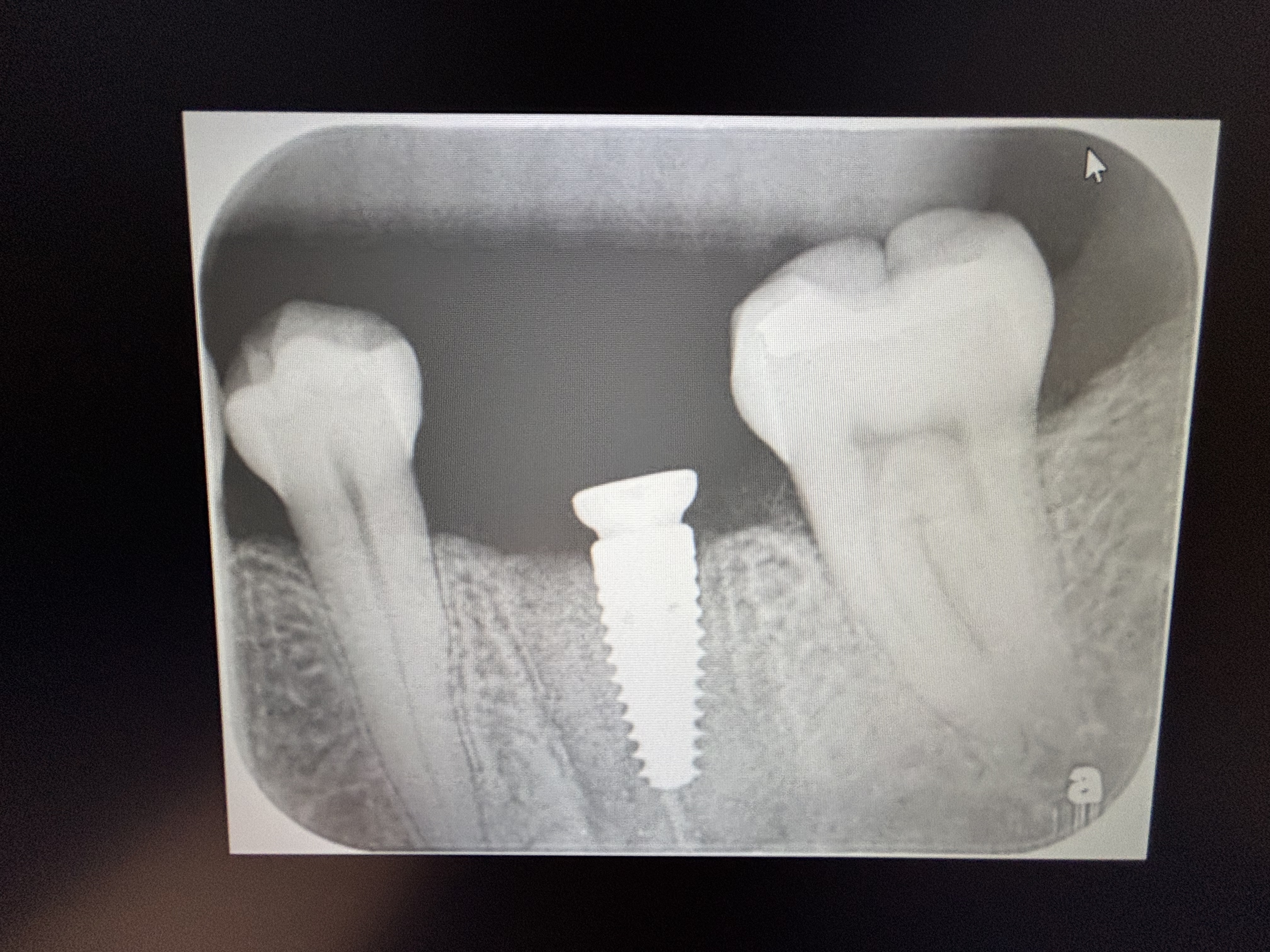
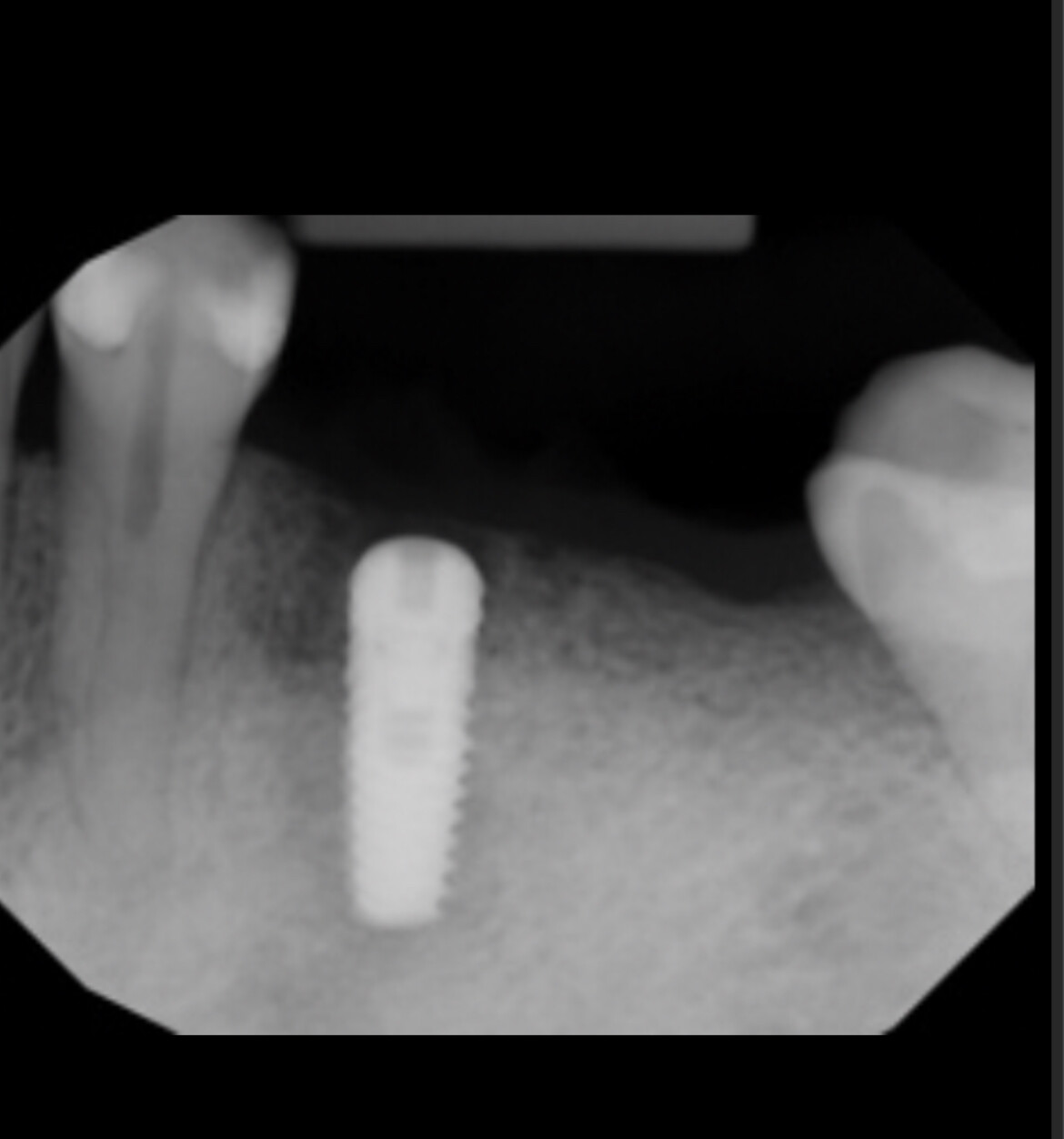
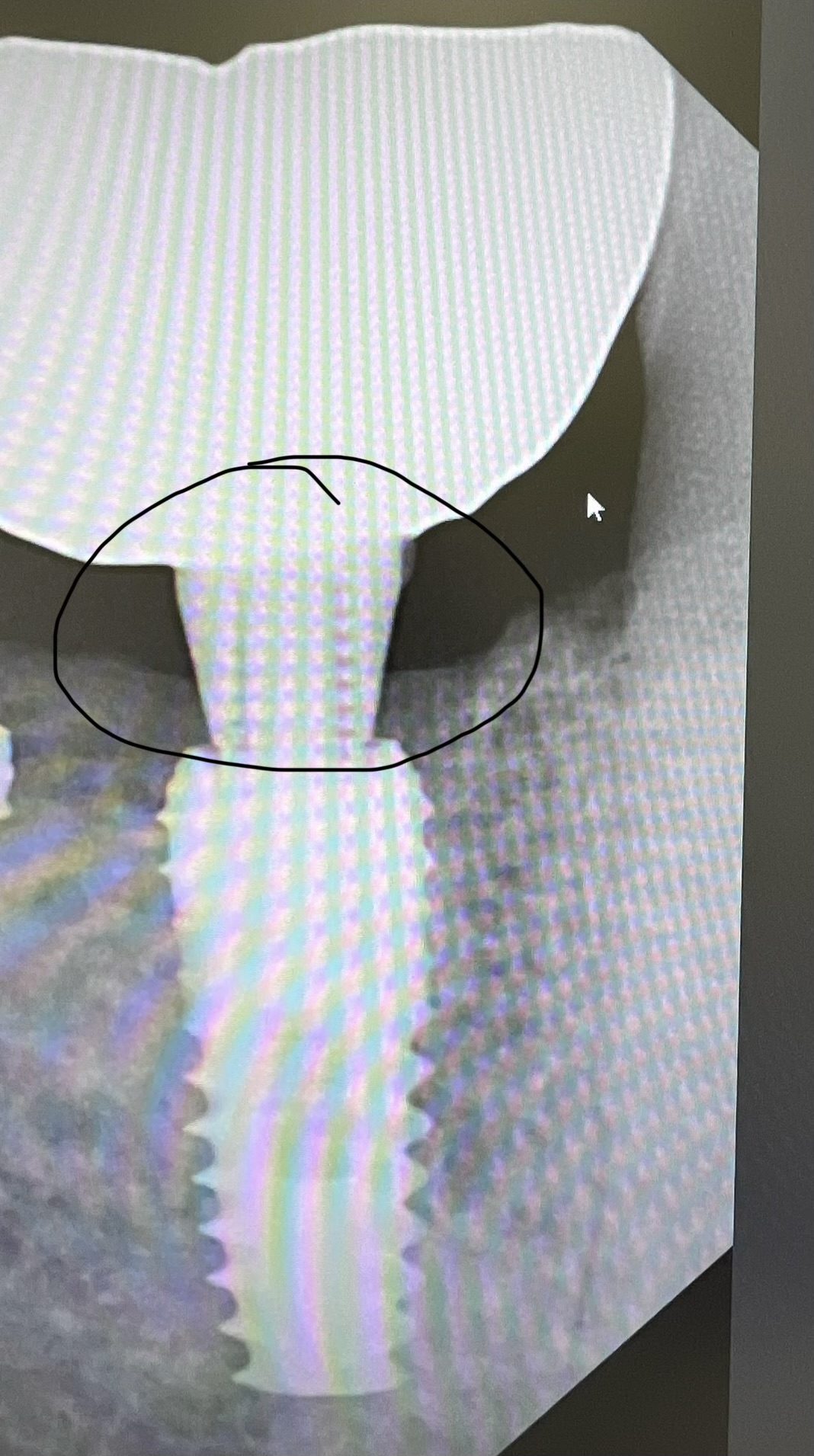
A “platform” describes the size (sometimes in millimeters) of the interface of the fixture or implant body. They traditionally come in various sizes, but most are categorized into narrow (3-3.5), regular (4-4.7) and wide (5-6.8) depending on which implant system you use. Bicon, ankylos are not traditional systems, so these numbers do not apply. Now conventionally the profession has practiced so that the implant platform had to match the abutment platform, meaning it had to be the same size. I do agree with the post that “platform switching” was found my chance, when a narrow platform abutment was placed on a regular platform implant. This causes the microgap (interface between the abutment and implant) to be placed more medially or centrally, or towards the center of the platform. We all know about biological width from a crown margin, and the theory states the alveolar crest bone and fibers will reorganize to 1.8mm from the crown margin. That’s the principle behind crown lengthening for deep caries. Instead of a having a vertical path of reorganization, the platform switching allowed the bone loss to be displaced horizontally along the shoulder of the implant. This concept is better shown with pictures, which unfortunately cannot be duplicated here. I’m sure you should be able to find the concept online somewhere. Theoretically it preserves the height of bone around the implant better than a traditional setup of platform matching due to the horizontal setup not a vertical.
Bone remodeling around an implant can be related to several factors:
1) implant/abutment junction(IAJ)and its size and proximity to the crest of bone. The larger the microgap the more is the issue of bacterial contamination.
2) crown/implant junction is similar to the IAJ in this regard; same as it would be on a natural tooth.
3) surface shape and texture of the implant. A wider polished collar is more likely to permit bone loss than a micro roughened or textured collar region.
4) stability of the interface between the implant and abutment. More micromovement facilitates increased bacterial percolation and inhibits soft tissue attachment(biologic width).
A soft tissue attachment or close adaptation onto the implant surface is essential to the body. It seals the underlying bone from outside influences. This “biologic width” is found on both teeth and implants alike. In the case of an implant, the tissue attachment may bridge over a very narrow gap(IAJ) as long as there is no micromovement or macromovement such as repeated removal and replacement of an abutment or healing abutment. If there is constant micromovement, macromovement, or bacterial leakage, the tissue attachment will be forced to move apically on the implant surface and this is accomplished at the expense of bone attachment level. This is a major cause of the bony remodeling seen around most implants after exposure and abutment insertion.
5) Other factors must also influence bony remodeling. As has already been mentioned, we still see significant remodeling around one piece implants such Nobel Direct where there is no microgap and (if properly placed to depth) a textured surface is present for bone attachment.
Regarding platform switching, the concept appears to be about increasing the width of the epithelial collar around the abutment, hence resulting in a thicker and tighter seal around the abutment, minimizing “pocketing around the abutment. This is a difficult concept to grasp as we all know that when we cement a crown subgingivally around a tooth we have an increased likelihood of periodontal problems due to the potential pocketing around the crown. With a titanium abutment it appears to react differently-we get a better hemidesmosomal attachement around the abutment resulting in a tighter seal-or so the theory goes.Of course if you make the crown itself finish significantly subgingivally and cover the titanium abutment, then the reaction will be like the subgingival crown on a tooth and you can expect to have increased gingival problems.
As to the problem of microgap, there is no question that an unsealed subgingival implant abutment connection is a reservoir for organisms. Anyone who has removed an unsealed abutment, no matter what type of connection,must surely have smelt the problem. For many years now I have been advocating sealing the implant abutment interface of external hex implants with glass ionomer cement prior to torquing and there is no question that this virtually eliminates the microgap problem. Unfortunately with internal morse taper connections, sealing with cement defeats the purpose of the morse taper so that can’t be done. There are implant designs with internal connections which address the problem to some extent by having the final crown margin sealing the abutment margin and thereby stopping the microgap problem. The internal connection Innova implant is one such implant. The proble with this style of connection is that the crown margin has to finish in this area, meaning there is less flexibility in implant placement possibly resulting in a crown which is cemented too far subgingivally, ending up with the same problem of the subgingivally placed crown on a natural tooth, possibly resulting in an increased likelihood of peri implant gingival problems.
I think people need to review the PerioSeal literature a little more. If you read the literature a little more carefully then you will see that the abutment doesn’t have a “butt joint” as someone called it. The implant itself has a 2 mm neck which 1 mm is the prosthetic and 1 mm is the soft tissue neck. PerioSeal does have a large amount of studies and has been around since 1997. The PerioSeal implant didn’t come to market until 2002, because they wanted to run the trials on the implant to make sure it was going to work the way it was designed….to seal the microgap within the prosthetic crown with cement….as someone mentioned Straumann has this type of design on their implant, however as the science behind the degree angle of the prosthetic neck needs to be typically between 5 and 10 degrees like normal crown dentistry….Straumanns prosthetic margin (neck) is greater than 45 degrees which science would prove that the occlussal forces would disapate the crown from the implant thus opening the microgap, because the forces will be distributed across the implant rather than through the entire implant as it is needed to eliminate micromovement….also the Straumann implant I am referring to also has a polished neck which will NOT osseointegrate with the bone thus creating horizontal and vertical bone loss….I have seen a ton of radiographs to prove what the Straumann implant does under loading and non-loading…Now the PerioSeal’s neck is “Machined (which will osseointegrate)” and the body of the implant is sand blasted to increase surface area for osseointegration…the patented “Ferrule” attachment is the key to the implant design as it allows the prosthetic to rest on the already technically designed prosthetic margin with an angle of 6% (simple bridge and crown dentistry - going back to the science behind it) thus allowing the occlusal force to be distributed throughout the entire implant rather in a parallel fashion to allow for one side to get overloaded which would increase the size of the microgap on the opposite side….this still happens in the moarse taper design too as the abutment is still being placed ontop of the abutment and not creating a “Ferrule” attachment like the PerioSeal….PerioSeal doesn’t have clinical studies on their implants to prove this because there is no need and no physical way to probe to the implant in a patients mouth who doesn’t show any inflammation or bone loss….and remember bone loss is of the past….INFLAMMATION is the real problem….this is the link to periodontal pathogens found throughout the entire body assisting in damaging our cirulatory system….Thread design is not the problem as some big companies would state….ALL IMPLANTS OSSEOINTEGRATE!!! Inflammation is the REAL PROBLEM….REMEMBER: Chronic diseases rarely are symptomatic….and this is why most of the big companies say the Microgap is not the problem…
Now to end my novel….PerioSeal is not perfect and not the answer to all problems, however if you read the true science behind its design and the concept of the implant system you will find it is the best implant you can find at the present time…..this company is a whale swimming in a pool the size of the universe, however it won’t be long till people take the time to really research all manufacturers and the TRUE science and TECHNICAL makeup to see the difference…I urge all of you to take the time to make the best decision for you and MOST IMPORTANTLY your patients
From reading the comments above, dentistry does not have the answer. If it did work, then it may be that the crowns placed on natural teeth should all be changed. Try it and let us know how it worked.
To Ted:
Cement itself as a rough surface can be contaminated by bacteria. In time cement will dissolve, as we know from the conventional crowns on teeth, and the microgap is open again! Submerging the gap will introduce more boneloss in the future: at least down to the level of the gap. For these reasons I “believe” more in platform-switching than in the perioseal concept.
RB:
Can you explain (in more detail) how the “Ferrule” attachment works, and why it is better than other implant system designs on the market today?
I’m not sure I truely understand the concept behind the ferrule.
To Muradin:
If the prosthetic crown is developed correctly then with the PerioSeal implant design it shouldn’t leak cement. Also as I said before, PerioSeal isn’t a perfect solution….however there is no perfect solution out there today. I am more confident in a solution that is combating systemic diseases and has had success in such a short period of time….I’d rather be safe than sorry….Also it is very easy on the pocket book which is a plus and shouldn’t be a decision factor as there are alot of companies out there that are less expensive, however are those companies (and even the large companies) trying to reshape a concept that will better the industry or are the companies too worried about their share holders and making a quick decision on how to get a quick share of the market? Private companies definitely have a greater edge in this area….
Now To TP:
Go to PerioSeal’s website and read the explanation….what they are trying to show in the diagram is the implant already has a prosthetic margin built on the implant (Looks the same as a prepped tooth for a crown…at least the DR’s who prefer a margin rather than a feather ridge). Now when the prosthetic is placed over the abutment the prosthetic is actually resting on the prosthetic margin of the implant…thus creating a “Ferrule” attachment…now the support for occlusal force is the entire implant….rather than relying on the support of the abutment and the design of the abutment locking mechanism with the implant.
In current models, other than PerioSeal, the prosthetic is sitting on the abutment and is not the greatest support for occlusal forces as the forces are not always parallel in nature due to everyone’s imperfect occlusion….with the “Ferrule” attachment the forces dissipated through the entire implant since the design makes two components act as ONE…..
Did I answer your question in better detail?
To RB:
Yes you explained it better; thanks.
You mentioned in one of your posts that the PerioSeal isn’t perfect [nor is any other implant system perfect].
What makes you say that the PerioSeal isn’t perfect? In other words, what *issues* have you seen with this particular implant system, and do you know if the PerioSeal company is working on a newer design of the implant to address these items?